

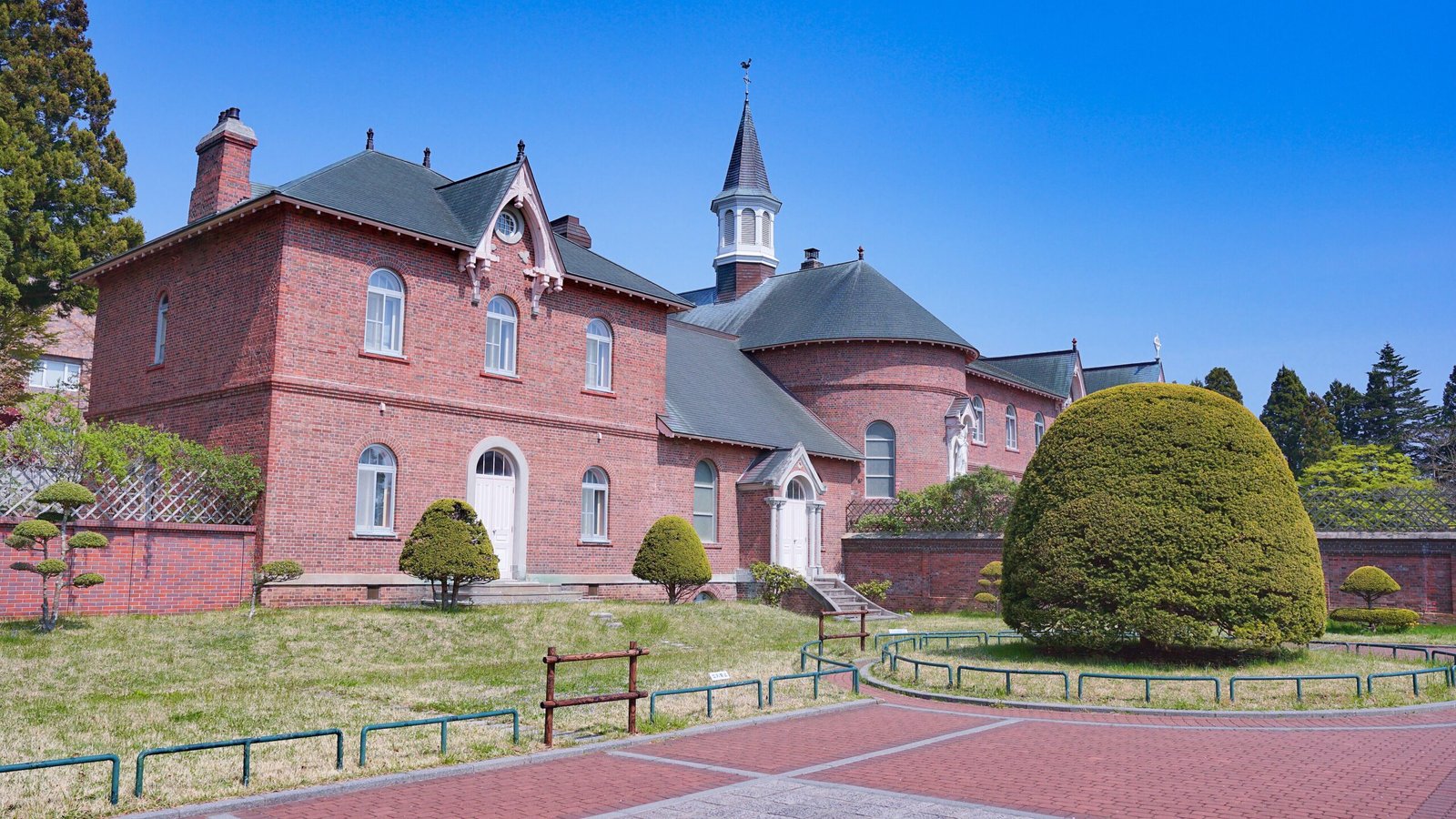
Japan’s first women’s contemplative monastery, founded by French Trappist nuns in the late 19th century and twice rebuilt after devastating fires.
At a glance
Our Lady of the Angels Trappistine Abbey, colloquially known as Tenshien, is a women’s Trappist community on the outskirts of Hakodate in Hokkaido. It represents a significant chapter in Japan’s modern religious history as the nation’s first women’s contemplative order.
History
Eight French nuns established the abbey in 1898, bringing the Trappist tradition of strict contemplative life to Japan. The community endured considerable hardship: fires destroyed the buildings in 1925 and again in 1941, requiring two complete reconstructions. Despite these setbacks, the monastery persisted and became an integral part of Hokkaido’s spiritual landscape.
What you see
The current structures date from the post-1941 reconstruction, reflecting the practical rebuilding of monastic spaces rather than architectural elaboration. The abbey’s layout follows traditional Trappist design principles, organized around contemplative and functional spaces for a cloistered community.
Cultural significance
The abbey gained cultural resonance beyond religious circles when poet Rofū Miki visited and composed a lyric titled “Nobara” (Wild Rose). Composer Kōsaku Yamada later set these words to music, and the song became widely known in Japan—transforming the monastery’s spiritual sanctuary into an unexpected source of popular cultural expression.
Key facts
- Country: Japan
- Location: Hakodate, Hokkaido
- Founded: 1898
- Coordinates: 41.78785, 140.822514
- Founder: Eight French Trappist nuns
- Status: Japan’s first women’s contemplative order
Practical information & getting there
The abbey remains an active monastic community. Specific visiting hours and access policies should be confirmed locally, as contemplative communities often have restricted visiting schedules.
Sources & resources
Find it on the map
See this place and what’s around it →📷 Become a Cultural Heritage Online photographer
Share your photos of places: they stay published under your name as the author. The more they're seen, the more you get noticed — and soon a contest will reward the most appreciated photos.
Log in or sign up free to add a photoIs this page about you?
This page is read by travellers and heritage enthusiasts who find it on Google. Tell us how you are connected to this place and we will take it from there.