
The cathedral stands on the highest point of the white city, built entirely in pietra ostunese, the compact white limestone of the surrounding countryside. It was begun in 1435 and finished between 1470 and 1495, in a flowering Gothic-Romanesque already touched by the Renaissance. Its rose window is the most elaborate in Puglia, and it was the exterior — the only part of the church left untouched by four centuries of alteration — that had the building declared a national monument in 1902.
At a glance
- Type
- Co-cathedral of the Archdiocese of Brindisi-Ostuni
- Dedication
- Santa Maria Assunta (the Assumption of the Virgin)
- Built
- begun 1435; completed between 1470 and 1495
- Style
- Flowering Gothic-Romanesque, on the threshold of the Renaissance
- Material
- Pietra ostunese, a compact white limestone
- Where
- Largo Trinchera / Largo Beato Papa Giovanni Paolo II, 72017 Ostuni (BR)
- Coordinates
- 40.7341° N, 17.5790° E
- Protected
- National monument since 1902; co-cathedral since 1986
Overview
Ostuni climbs a hill of the Murge plateau, some eight kilometres from the Adriatic, and the cathedral crowns it. The old town packs so tightly around the church that the front cannot be taken in until one comes out from under the low arch beside Palazzo Incalzi and finds it at close quarters, standing on the bare rock that the street reveals at its foot.
The stone is local: a limestone so white and so compact that it yields to the chisel and then hardens under a brown patina which protects it from the weather. It is the same stone, whitewashed, that gives Ostuni the name of città bianca.
History
Building began in 1435 and was completed between 1470 and 1495, replacing an earlier church on the same summit. A long local tradition credits the rebuilding to bishop Nicola Arpone, and the evidence is carved on the church itself: in the lunette of the main portal a bishop kneels at the foot of the Virgin’s throne, with a scroll reading Mater Dei Miserere mei Nicolai Arpoide de Tarento Episcopi Hostunensis III. The Ministry catalogue is careful with the attribution — the kneeling figure is “probably a bishop, plausibly Arpone” — and the sculpture is linked to the wide output of the workshop of Stefano da Putignano.
On 28 October 1668 bishop Carlo Personè reconsecrated the church; the inscription recording it survives inside, above the side portal of San Biagio, and the interior probably received its first Baroque dress on that occasion. A thorough remaking came with the restorations of monsignor Francesco Antonio Scoppa, bishop from 1747 to 1782, which also swept away the old form of the little square in front of the cathedral and gave it, and the houses along the flank, their eighteenth-century look. The painted coffering of the side aisles is later still: it was frescoed in 1895 by Vito Lo Zuppone of Lecce.
The result is a building of two halves. The outer walls, the rose windows and the friezes came through it all untouched, while the interior was reworked over four centuries until the original plan can no longer be read from it. It was for the exterior, precisely, that the church was declared a national monument in 1902. Since 1986, with the union of the two sees, it has been the co-cathedral of the Archdiocese of Brindisi-Ostuni.
What you see
The front is divided into three by pilasters. The central section ends in a gable formed of two inflected arches, the wings in two half-lunettes, and a frieze of interlaced ogival archlets on carved corbels runs along the crown, down the flanks of the church and up the bell tower, an unbroken band of stone lacework. Four heads of apocalyptic lions project from the top of the four pilasters.
Three pointed portals open beneath, each with a carved lunette: at the centre the Virgin enthroned with the Child among music-making angels and the kneeling bishop; on the left San Biagio, patron of the city, in episcopal vestments, holding a model of Ostuni in the form of a castle with three towers; on the right St John the Baptist with the lamb and the scroll Ecce Agnus Dei.
Above them the rose windows — the great one at the centre, two smaller ones over the side doors, a third on the end of the left transept and a fourth, badly damaged, behind the high altar. The central rose is set in three concentric circles: an outer frame of foliage sprouting around the draped busts of prophets and apostles, and twenty-four small columns framing the sculpted figure of Christ blessing at its centre. Local historians call it the most spectacular in Puglia, and tradition holds that the stonecutters who carved it portrayed themselves in the corbels beneath the trilobed archlets.
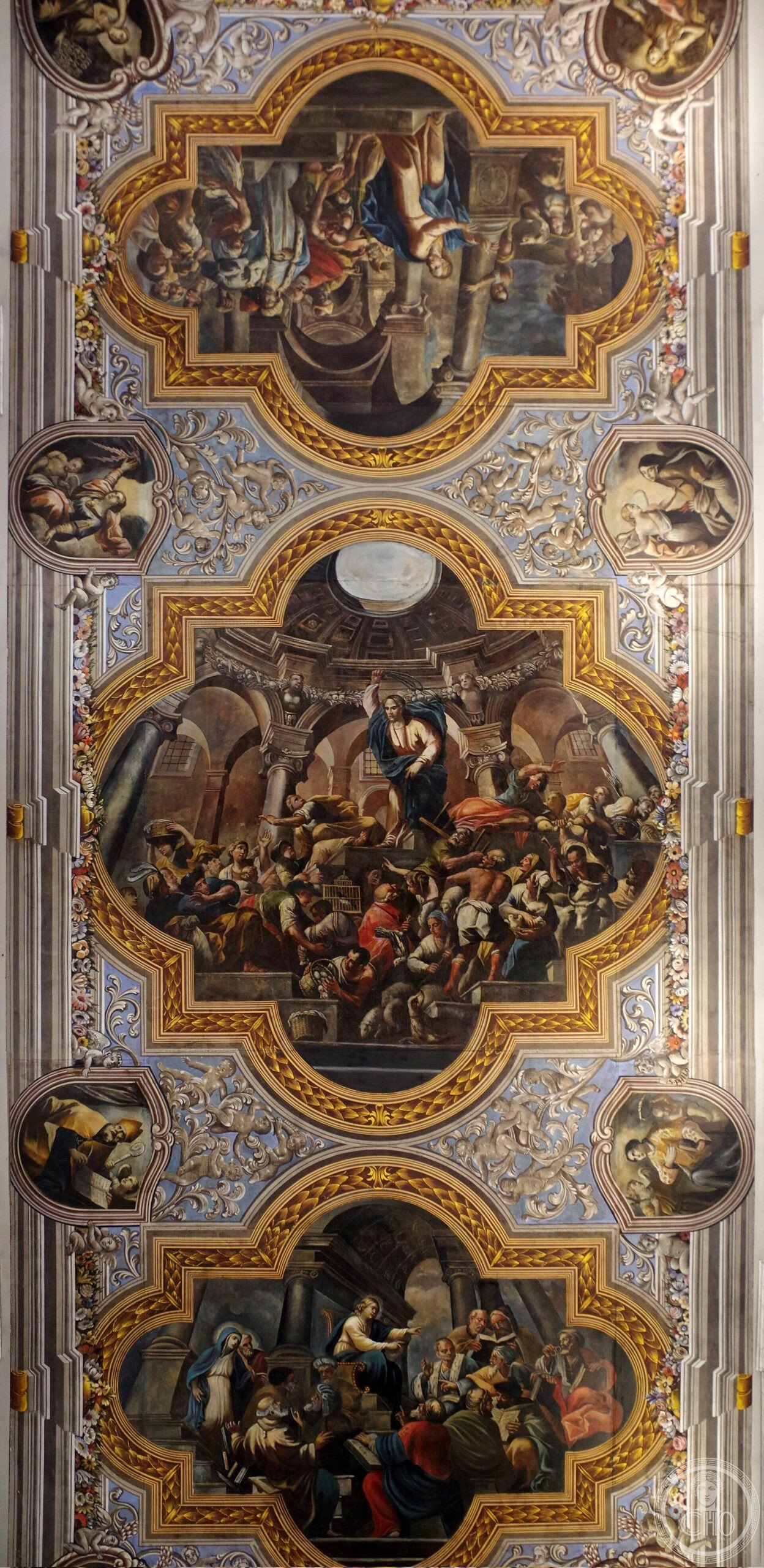
Inside, the church is divided into three aisles by heavy stone colonnades with Ionic capitals carrying round arches; the eye is led to a wide triumphal arch framing the hall transept and a deep rectangular chancel flanked by two chapels. The ceilings of the nave and transept are hung with large painted canvases of the second half of the eighteenth century — scenes from the life of Christ, the martyrdom of San Biagio, the preaching of Sant’Oronzo — close to the manner of the Neapolitan Francesco De Mura and of the Lecce painter Oronzo Tiso. Along the left aisle stand an octagonal baptismal font in polychrome marble by eighteenth-century Neapolitan workshops and the altar of San Gaetano, built in 1776 by Carlo and Bartolomeo Petrarolo, whose canvas of the Virgin with Saints Gaetano and Filippo Neri is by Domenico Antonio Vaccaro.
Cultural significance
Ostuni’s cathedral is the one late Gothic church of this ambition in southern Puglia, built at a moment when the region was already turning to Renaissance and then Baroque forms. Cosimo De Giorgi, who surveyed the monuments of the Salento in the nineteenth century, called it one of the most exquisite works of fifteenth-century architecture in the area, and its front — visible for kilometres across the Itria valley — remains the fixed point of the skyline of the white city.
Practical information
- Address: Largo Trinchera / Largo Beato Papa Giovanni Paolo II, 72017 Ostuni (BR), Puglia.
- Entry is free; the church is normally open daily for visits, but hours and Mass times change with the season — check with the parish or the local tourist office before travelling.
- It is a working church: visits are not possible during services.
Getting there
Ostuni has its own station on the Bari–Lecce line, about three kilometres below the old town, with bus and taxi connections up the hill. By car, leave the SS16 Adriatica at Ostuni or take the Fasano/Ostuni exit from the A14. The historic centre is pedestrian only and steep; paid parking is available at the gates.
Sources
- Ministero della Cultura, Catalogo generale dei Beni Culturali (ICCD) — Chiesa Cattedrale di Ostuni, ed. D. Segoni and V. Santoni, 29 May 2022: catalogo.beniculturali.it
- Conferenza Episcopale Italiana, Le chiese delle diocesi italiane — Concattedrale di Santa Maria Assunta, Ostuni (Archdiocese of Brindisi-Ostuni).
- Brundarte — La Cattedrale di Ostuni, an anthology of the local historical literature (C. De Giorgi and later studies), listed among the resources of the Ministry catalogue: brundarte.it
- Cultural Heritage Online historical archive — original Italian entry on beniculturalionline.it, verified and rewritten in August 2026.
Find it on the map
See this place and what’s around it →📷 Become a Cultural Heritage Online photographer
Share your photos of places: they stay published under your name as the author. The more they're seen, the more you get noticed — and soon a contest will reward the most appreciated photos.
Log in or sign up free to add a photoIs this page about you?
This page is read by travellers and heritage enthusiasts who find it on Google. Tell us how you are connected to this place and we will take it from there.