
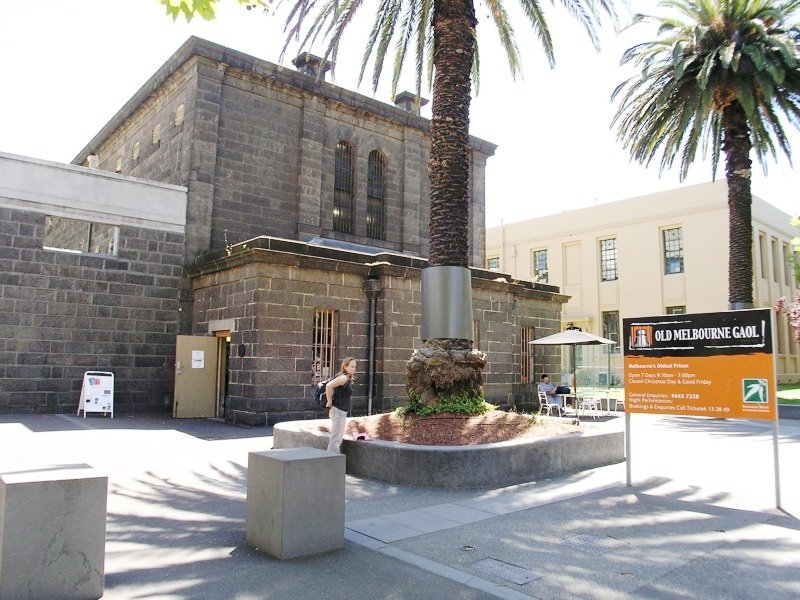
A bluestone prison that held Australia’s most infamous criminals, from bushranger Ned Kelly to serial killer Frederick Bailey Deeming, before becoming a museum of crime and punishment.
At a glance
The Old Melbourne Gaol stands on Russell Street as a three-storey bluestone structure and courtyard. Once one of Australia’s most significant correctional institutions, it now operates as a museum documenting its turbulent past and the notorious figures imprisoned within its walls.
History
Construction began in 1839 on the Russell Street site. The prison formally opened in 1845 and operated continuously until 1924, when it ceased functioning as a correctional facility. A brief wartime occupation during World War II followed before its permanent closure.
During its seventy-nine-year operation, the gaol executed 133 people by hanging, earning it a place in Australian criminal history as the site of executions of the nation’s most notorious offenders, including bushranger Ned Kelly and serial killer Frederick Bailey Deeming.
What you see
The building comprises three storeys of bluestone construction arranged around a central courtyard. The gaol stands adjacent to the old City Police Watch House and City Courts buildings, with Russell Street Police Headquarters opposite. Parts of the complex were later integrated into RMIT University.
Cultural significance
The Old Melbourne Gaol documents a crucial period in Australian penal history and the lives of those condemned within its cells. Its role in the execution of high-profile criminals—particularly Ned Kelly—has made it central to Australian cultural memory and criminal folklore.
Key facts
- Location: Russell Street, Melbourne, Victoria, Australia
- Coordinates: −37.808°S, 144.965°E
- Construction began: 1839
- Operational period: 1845–1924
- Total executions by hanging: 133
- Current status: Museum
Practical information & getting there
The Old Melbourne Gaol operates as a public museum on Russell Street in Melbourne’s city centre. You can reach it by Melbourne’s public transport network. The museum displays original artifacts, including death masks of executed prisoners, personal belongings, and historical records documenting the lives and crimes of its inmates.
Sources & resources
Find it on the map
See this place and what’s around it →📷 Become a Cultural Heritage Online photographer
Share your photos of places: they stay published under your name as the author. The more they're seen, the more you get noticed — and soon a contest will reward the most appreciated photos.
Log in or sign up free to add a photoIs this page about you?
This page is read by travellers and heritage enthusiasts who find it on Google. Tell us how you are connected to this place and we will take it from there.