

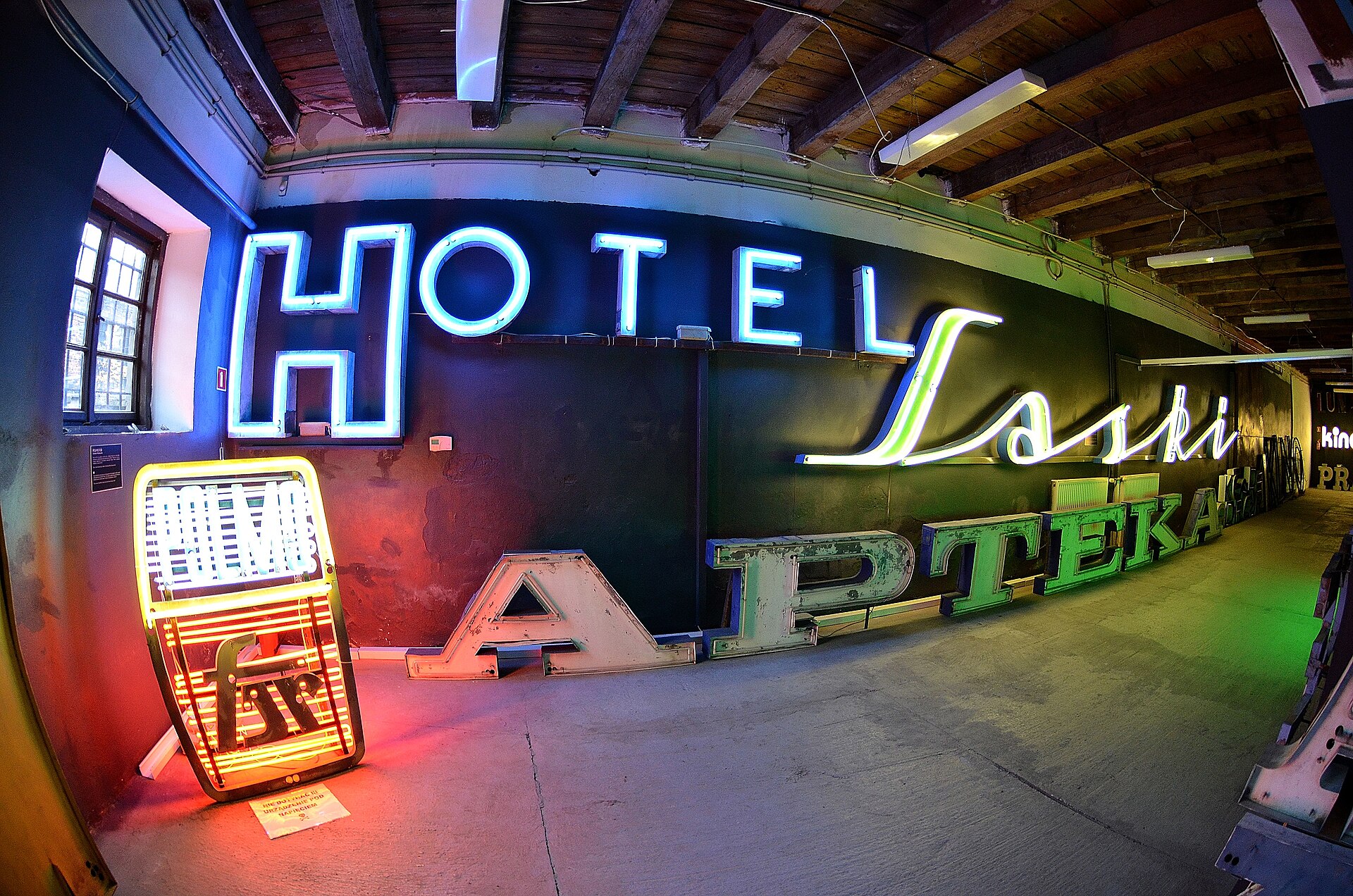
The Neon Museum in Warsaw is a dedicated collection of Cold War-era neon signs rescued from the streets of communist Poland. Housed on the fourth floor of the Palace of Culture and Science, it preserves the distinctive visual culture of the Polish People’s Republic — a period when state-commissioned neon became one of the few colourful, design-conscious features of an otherwise austere urban landscape.
At a glance
- Type
- Specialist design and industrial heritage museum
- Period
- Collection focuses on Polish neon signs c. 1950s–1990s; museum established 2012
- Style
- Fourth floor of the Palace of Culture and Science
- Location
- Plac Defilad 1, 00-901 Warsaw, Poland (Palace of Culture and Science, fourth floor)
- Coordinates
- 52.2501° N, 21.0602° E
Overview
The Neon Museum (Muzeum Neonów) was founded by David Hill and Ilona Karwińska, who began collecting endangered neon signs from demolished or refurbished buildings across Poland in the early 2000s. The collection now numbers in the hundreds of original signs, representing restaurants, hotels, cinemas, shops, and public amenities from the communist era. It occupies rooms on the fourth floor of the Palace of Culture and Science, the socialist-realist skyscraper on Plac Defilad in the centre of Warsaw.
History
Neon had a paradoxical flourishing in communist Poland from the 1950s onward. The state invested in large-scale neon installations to project modernity and brighten cities, making Polish neon one of the most distinctive design traditions behind the Iron Curtain — sophisticated in lettering, colour, and figurative imagery at a time when such commercial aesthetics were suppressed elsewhere. After 1989, rapid privatisation and urban renewal led to the wholesale scrapping of these signs. Hill and Karwińska began rescue operations, eventually formalising the collection as a public museum in 2012.
What you see
Visitors walk among glowing and unlit signs suspended, stacked, and displayed at floor level in a vast shed-like space where the industrial bones of the building remain exposed. Signs range from delicate cursive lettering in pink and gold to bold figurative icons — a leaping fish for a restaurant, a stylised dancer for a cabaret, angular typography for a cinema. At night, the illuminated signs create a cinematic atmosphere that communicates the original street presence of these objects far more effectively than a conventional museum display would.
Cultural significance
The Neon Museum preserves a chapter of Polish design history that came close to complete erasure. Cold War Polish neon represents a creative response to ideological constraints — designers working within a state system produced work of genuine aesthetic originality that is now studied internationally. The museum has been instrumental in the global reappraisal of communist-era graphic and industrial design as a legitimate design heritage.
Practical information
- Address
- Plac Defilad 1, 00-901 Warsaw, Poland (Palace of Culture and Science, fourth floor)
- Admission
- Entry fee applies; check website for current prices
Getting there
The museum is in the centre of Warsaw: take the Metro M1 or M2 to Centrum or Świętokrzyska, and the Palace of Culture and Science stands immediately beside the station. From Warsaw Central station, the journey takes approximately 20 minutes by public transport.
Warsaw’s first neon appeared in 1926, and the permanent collection now consists of about a hundred old signs and advertising installations.
Sources & resources
- Neon Museum official website — neonmuzeum.org
- More European cultural heritage — Cultural Heritage Online
Find it on the map
See this place and what’s around it →📷 Become a Cultural Heritage Online photographer
Share your photos of places: they stay published under your name as the author. The more they're seen, the more you get noticed — and soon a contest will reward the most appreciated photos.
Log in or sign up free to add a photo