
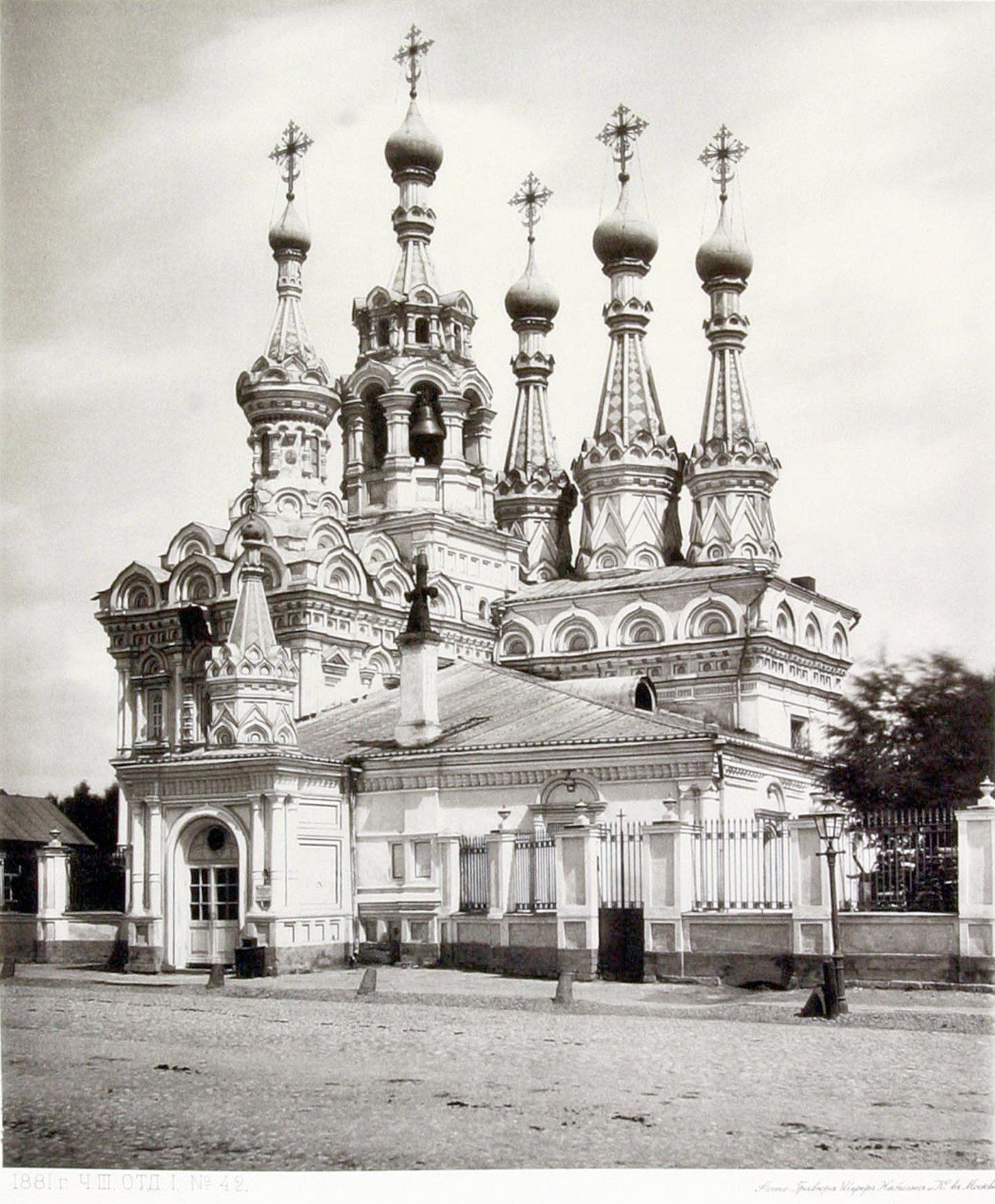
A snow-white cluster of tented roofs rising above a former highway to the Trinity Monastery, this is the last great tent-church built before the design was banned.
At a glance
Built in the Uzorochye style favored under Tsar Alexis Mikhailovich, the church is prized for its unrepeatable roofline. Six tented and pyramidal roofs crowd a compact footprint. It stands listed as a protected heritage monument today.
History
Alexis Mikhailovich commissioned the church in 1649. It was meant to mark a road leaving Moscow for the Trinity Monastery. Builders finished the work within three years, a rapid pace for such an intricate plan. According to tradition, Patriarch Nikon rode past it on pilgrimage and was appalled. He judged the tented form un-Orthodox and moved to forbid such roofs on future churches, effectively closing a chapter of Russian architecture with this one building. The church’s later history was harder. After Soviet authorities shut the Vysokopetrovsky Monastery in 1929, Archimandrite Bartholomew Remov quietly moved its monks and nuns into the Nativity Church, where he served as rector. Monastic life continued there in secret. It ended in 1935, when the NKVD arrested everyone involved. The state closed the church outright in 1938, yet strangely funded its repair in 1957. Only after the Soviet Union dissolved did the building reopen, this time as a patriarchal metochion.
What you see
Six roofs compete for the eye. Three tall, candle-like tents stand in a row atop the main church body. Behind them, the refectory carries its own tent above tiers of corbel arches, a stacked, almost lace-like profile. A fifth tent tops the belltower, wedged between church and refectory. Even the porch refuses a flat roof, ending instead in its own small pyramid. The overall palette is white stone against azure and gold domes, an effect often likened to carved ivory. Little here is symmetrical in the classical sense; the composition instead layers forms until the roofline reads as a single dense silhouette.
Cultural significance
This church marks an ending. Its unorthodox massing so troubled Patriarch Nikon that tent-roofed churches were subsequently discouraged across Russia. Few buildings can claim to have closed off an entire architectural fashion by existing. The church also carries a quieter, more dangerous history: for six years it sheltered an underground monastic community during a period of state suppression, until arrests in 1935 ended that chapter. Its survival through demolition threats, closure, and eventual state-funded repair reflects the uneven fortunes of Moscow’s church architecture across the twentieth century.
Key facts
- Location: Moscow, Russia
- Style: Uzorochye
- Commissioned: 1649, by Tsar Alexis Mikhailovich
- Construction completed: within three years
- Closed by Soviet authorities: 1938; repairs funded: 1957
- Reopened as patriarch’s metochion after the Soviet collapse
- Heritage status: listed monument
Practical information & getting there
The church stands within central Moscow, near the historic route once leading toward the Trinity Monastery. You can reach it easily on foot from the city center’s metro network. As an active patriarchal metochion, it functions as a working church rather than a museum, so visits are best planned around service times.
Sources & resources
Find it on the map
See this place and what’s around it →📷 Become a Cultural Heritage Online photographer
Share your photos of places: they stay published under your name as the author. The more they're seen, the more you get noticed — and soon a contest will reward the most appreciated photos.
Log in or sign up free to add a photoIs this page about you?
This page is read by travellers and heritage enthusiasts who find it on Google. Tell us how you are connected to this place and we will take it from there.