
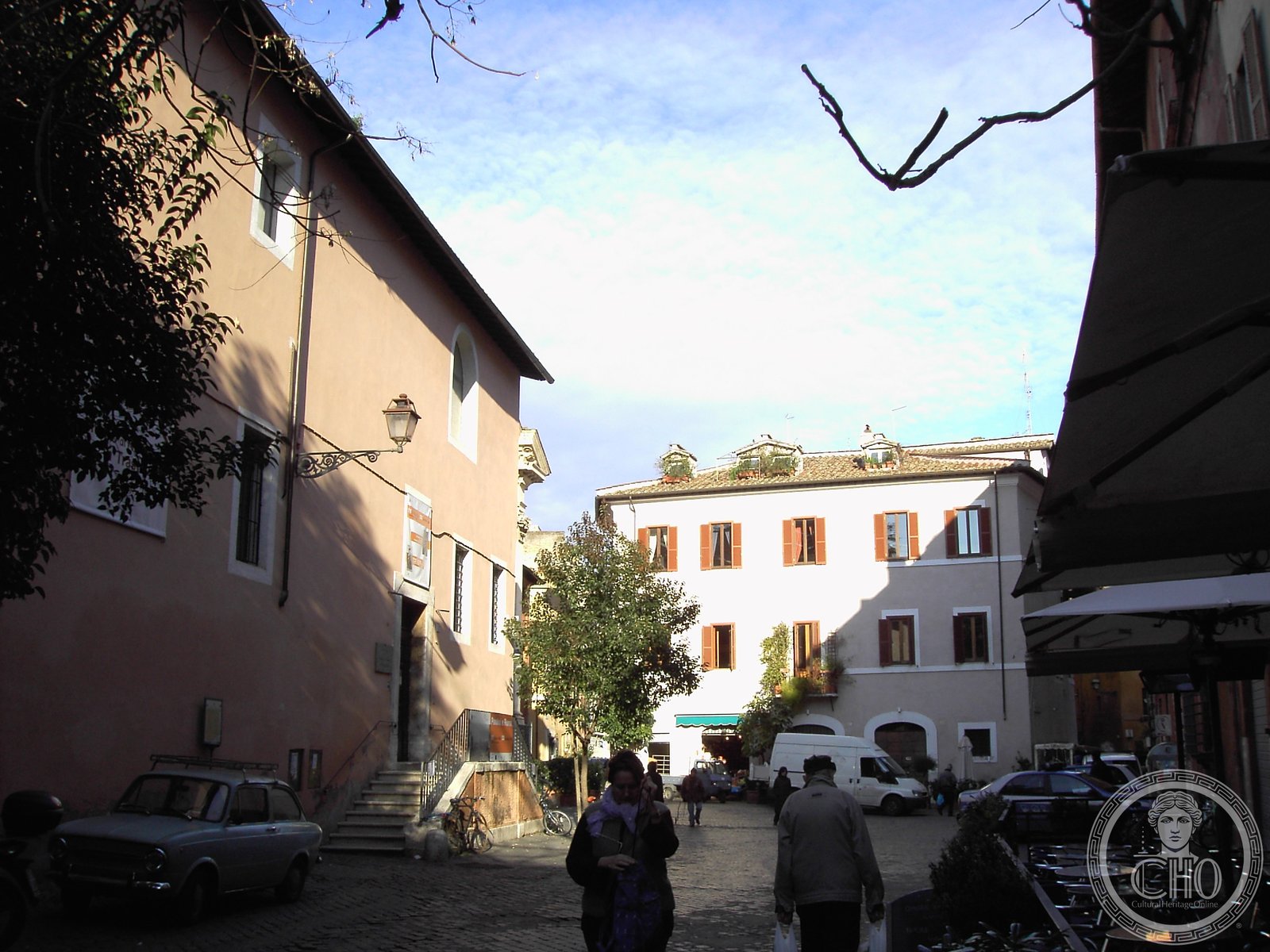
Housed in a restored seventeenth-century Carmelite convent, this museum preserves the material memory of Roman life from the late eighteenth century through the twentieth century, documenting daily customs, crafts, and streetscapes of a vanished city.
At a glance
The Museum of Rome in Trastevere occupies a former Carmelite convent in the heart of Rome’s historic Trastevere district. Its collections focus on the social and cultural life of ordinary Romans—streetscapes, domestic scenes, trades, and traditions—through paintings, reconstructed interiors, sculptures, and watercolors spanning nearly two centuries.
History
After the Unification of Italy, the convent passed to municipal ownership and was repurposed as the Ettore Marchiafava pediatric sanatorium from 1918 onward. A comprehensive restoration between 1969 and 1973 returned the building to public use. The museum opened in 1977 under the name “Museum of Folklore and Romanesque Poets,” drawing on materials previously held at the Pastificio Pantanella (1930–1939) and later displayed at Palazzo Braschi. A second major renovation, completed in 2000, added facilities for temporary exhibitions and events on the ground floor.
What you see
The collection is deliberately eclectic, united by a single purpose: to document Roman life before rapid modernization erased it. Paintings from the late eighteenth and nineteenth centuries capture street scenes and craft workshops. Life-size mannequins recreate nineteenth-century Roman trades and professions in three-dimensional detail. An eighteenth-century Roman nativity scene, inspired by the design of Angelo Urbani del Fabbretto, relates to the famous crib displayed annually on the Spanish Steps. Watercolors by Ettore Roesler Franz titled “Roma sparita” (Lost Rome) preserve cityscapes transformed or demolished. The so-called “Trilussa room” displays objects assembled from the studio of the poet Trilussa, offering insight into intellectual and artistic life.
Cultural significance
The museum functions as a counterweight to grand institutional histories. Its heterogeneous collections testify to what the city lost between unification and the twentieth century—the rhythms, crafts, humor, and textures of popular Roman culture. By combining paintings, sculpture, watercolors, and reconstructed interiors, it makes history tactile and immediate, inviting visitors to inhabit the worlds of ordinary Romans whose stories might otherwise remain unrecorded.
Key facts
- Address: Piazza di S. Egidio, 1b, 00153 Roma
- Coordinates: 41.8897445, 12.4687891
- Telephone: 06 0608
- Website: http://www.museodiromaintrastevere.it/
- Building: Former seventeenth-century Carmelite convent
- Reopened: 1977 (major renovation completed 2000)
Practical information
The museum is administered by the Municipality of Rome. Current opening hours, admission fees, and exhibition schedules are available on the official website. Guided tours and educational programs may be arranged by contacting the museum directly.
Getting there
The museum is located on Piazza di S. Egidio in Trastevere, one of Rome’s most accessible neighborhoods. Multiple tram and bus routes serve the area. If driving, street parking is available in the surrounding quarter, though Trastevere’s narrow streets can be congested during peak hours.
See the place
Sources & resources
Find it on the map
See this place and what’s around it →Historical events at this place (6)
- 2020 Frammenti. Fotografie di Stefano Cigada
- 2020 Ara Guler. Istanbul vista attraverso le foto in bianco e nero del maestro turco
- 2020 Inge Morath: la mostra fotografica
- 2020 Roma di Notte: Trastevere e Isola Tiberina
- 2021 Vista della collezione Trilussa al Museo di Roma in Trastevere
- 2024 Visita guidata LGBTQIA friendly nella mostre fotografiche del Museo di Roma in Trastevere
📷 Become a Cultural Heritage Online photographer
Share your photos of places: they stay published under your name as the author. The more they're seen, the more you get noticed — and soon a contest will reward the most appreciated photos.
Log in or sign up free to add a photoIs this page about you?
This page is read by travellers and heritage enthusiasts who find it on Google. Tell us how you are connected to this place and we will take it from there.