
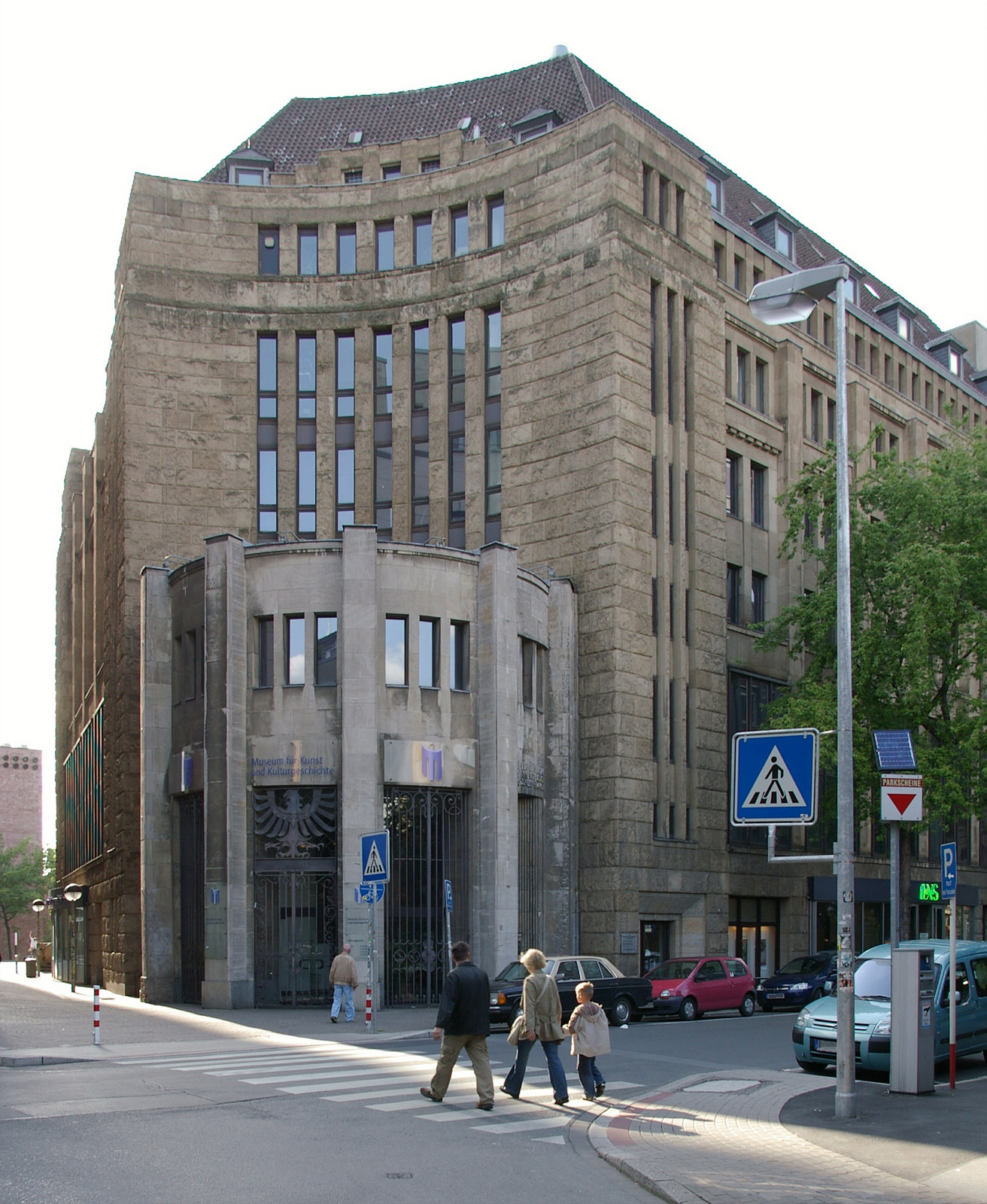

The collection has changed address more than once since 1883. Since November 1983 it has lived in a savings bank of 1924 — an Art Déco building, now itself a protected monument.
At a glance
The MKK is Dortmund’s municipal museum of art and cultural history, housed since November 1983 in the former Municipal Savings Bank, an Art Déco building of 1924 by Hugo Steinbach that is listed in its own right. Its collections of paintings, sculpture, furniture and applied arts run from prehistory to the twentieth century, and it is the city’s main venue for large loan exhibitions. The Vermessungstechnisches Museum association keeps a permanent display on the history of surveying here, with rare geodetic instruments.
Key facts
- What it is: Dortmund’s municipal museum of art and cultural history
- Founded: by a council decision of 25 June 1883, on the proposal of the historian and schoolmaster Eduard Roese
- The building: the Municipal Savings Bank of 1924 by Hugo Steinbach, Art Déco, a listed monument; the museum opened here in November 1983
- Where: Hansastraße 3, Platz von Amiens, 44137 Dortmund
- Open: Wednesday and Thursday 11:00–20:00; Friday to Sunday 11:00–18:00; closed Monday and Tuesday
- Admission: free, to the permanent and the special exhibitions alike
History
The museum began as a proposal. On 25 June 1883 the Dortmund council, prompted by the historian and grammar-school teacher Eduard Roese, resolved to set up a collecting point for historical and artistic objects. The drawing master Albert Baum became its first head, and built a substantial collection.
Then it moved, repeatedly. Between 1899 and 1905 it occupied the newly restored Old Town Hall. In 1911 it took over the vacated Oberbergamt, the regional mining office, a building of 1872–1875 by the Berlin architect Gustav Knoblauch, adapted for museum use to plans by the city building officer Friedrich Kullrich. There the Municipal Museum of Art and Applied Arts filled seventy rooms with archaeological finds, applied arts and local history.
The savings bank on lower Hansastraße, designed by Hugo Steinbach and built in 1924, became its home in November 1983.
What you see
The building turns the street corner in a curve. Its stone front is cut into narrow vertical bays, the upper floors stepping back under a tiled roof, and the ornament is concentrated where a bank puts it: at the door, behind a wrought-iron grille carrying an eagle. It is Art Déco of the sober German kind, built for weight rather than display.
The building is being refurbished. The permanent display is currently not accessible, the entrance has moved to the Platz von Amiens side, and the programme runs on special exhibitions and the STADT_RAUM space.
Practical information
- Closed Monday and Tuesday; late opening Wednesday and Thursday until 20:00.
- Entry is free, including the special exhibitions; workshops and guided tours are charged separately.
- During the works, enter from the Platz von Amiens.
Getting there
U-Bahn lines U41, U43, U44, U45, U47 and U49 stop at Kampstraße; U42 and U46 at Reinoldikirche. Both are a short walk from Hansastraße, in the centre of the city.
Nearby
- The Reinoldikirche, on the U-Bahn stop of the same name, five minutes away.
- The site of the Old Synagogue, destroyed in 1938.
- The Dortmunder U, the former brewery tower now a centre for art and creativity.
Sources
- Stadt Dortmund, MKK — your visit — opening hours, free admission, address, U-Bahn lines and the current refurbishment.
- German Wikipedia, Museum für Kunst und Kulturgeschichte Dortmund — the 1924 savings bank by Hugo Steinbach, its Art Déco style and listed status, the opening of the museum there in November 1983, the council decision of 25 June 1883, Eduard Roese and Albert Baum, the moves of 1899–1905 and 1911, and the surveying collection.
- Wikidata (Q164887) — coordinates.
Find it on the map
See this place and what’s around it →Events here — now on & upcoming
- The Language of Things (Museum für Kunst und Kulturgeschichte, Dortmund)11 Sep 2026 — 28 Feb 2027See the event →
📷 Become a Cultural Heritage Online photographer
Share your photos of places: they stay published under your name as the author. The more they're seen, the more you get noticed — and soon a contest will reward the most appreciated photos.
Log in or sign up free to add a photoIs this page about you?
This page is read by travellers and heritage enthusiasts who find it on Google. Tell us how you are connected to this place and we will take it from there.