

A hospice for the poor, then a tenement where a comedian was born, then a hotel, now a museum. The building at the corner of Reforma and Hidalgo has been useful to the city for two hundred and thirty years.
At a glance
The Museo Kaluz stands in the historic centre of Mexico City, where the Paseo de la Reforma meets Avenida Hidalgo, in what was the Antiguo Hospicio de Santo Tomás de Villanueva. The building dates from 1790 and belonged to the Augustinian Recollects. It opened as a museum on 22 October 2020 and holds the Kaluz Collection, assembled by the businessman Antonio del Valle Ruiz and administered by the Fundación Kaluz.
Key facts
- What it is: a museum of Mexican art in an eighteenth-century hospice
- The building: Antiguo Hospicio de Santo Tomás de Villanueva, 1790, of the Augustinian Recollects
- Later lives: a tenement after the disentailment of church property — the comedian Germán Valdés, «Tin Tan», was born in it — and in the twentieth century the Hotel de Cortés
- Museum since: 22 October 2020
- Collection: Mexican art, strong in landscape, genre painting and still life — Dr Atl, José María Velasco, Joaquín Clausell, Siqueiros, Orozco, Rodríguez Lozano, Ángel Zárraga, and a substantial holding of women artists from the nineteenth century to the present
- Where: Avenida Hidalgo 85, Centro Histórico, Mexico City
History
The hospice was built in 1790 for the Augustinian Recollects, on what is now one of the busiest corners in the city. The nineteenth-century disentailment of church property put it to other uses, and for a long stretch it was a vecindad, a tenement of single rooms around the courtyard; Germán Valdés, the comic actor known as Tin Tan, was born there.
In the twentieth century the Hotel de Cortés took the building, and ran in it until the museum project began. After restoration, the Museo Kaluz was inaugurated on 22 October 2020 by Claudia Sheinbaum, then head of government of Mexico City.
The collection behind it was begun by Antonio del Valle Ruiz and covers Mexican art with an emphasis on landscape — Velasco and Dr Atl above all — on genre painting and on still life, with a deliberate effort on women artists, Mexican and foreign, from Josefa Sanromán and Eulalia Lucio to Alice Rahon, Olga Costa and María Izquierdo.
What you see
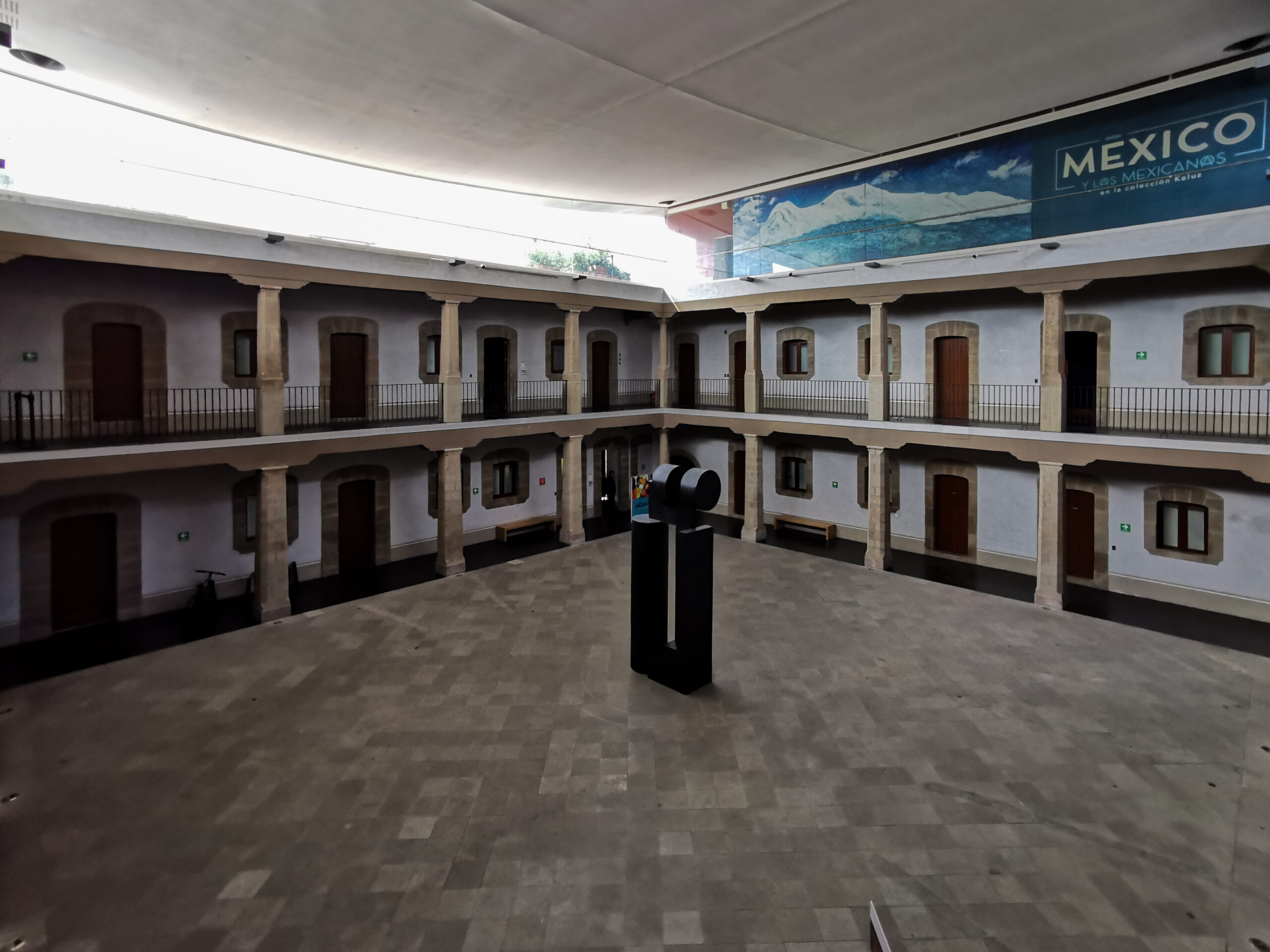
The heart of the building is the courtyard: two storeys of arcaded galleries on square piers, doors opening off each level, a stone floor. It has been roofed over, so the patio now works as a hall — the change that turns a colonial hospice into a museum without moving a wall.
From outside, the terraces look north over the Alameda Central and the head of the Paseo de la Reforma.
Getting there
Metro to Hidalgo or Bellas Artes; the museum is on Avenida Hidalgo at the corner of the Paseo de la Reforma, on the north side of the Alameda.
Nearby
- The Alameda Central, immediately opposite.
- The Palacio de Bellas Artes and the Art Déco of Mexico City.
- The Museo Mural Diego Rivera, at the western end of the Alameda.
Sources
- Spanish Wikipedia, Museo Kaluz — the 1790 hospice of the Augustinian Recollects, its use as a tenement and the birth there of Germán Valdés, the Hotel de Cortés, the inauguration of 22 October 2020 by Claudia Sheinbaum, and the scope of the Kaluz Collection.
- Wikidata (Q115943193) — coordinates and address.
Find it on the map
See this place and what’s around it →Events here — now on & upcoming
- Timeless Mucha: The Magic of Line at the Museo Kaluz — Mexico City08 Oct 2026 — 08 Feb 2027See the event →
📷 Become a Cultural Heritage Online photographer
Share your photos of places: they stay published under your name as the author. The more they're seen, the more you get noticed — and soon a contest will reward the most appreciated photos.
Log in or sign up free to add a photoIs this page about you?
This page is read by travellers and heritage enthusiasts who find it on Google. Tell us how you are connected to this place and we will take it from there.