

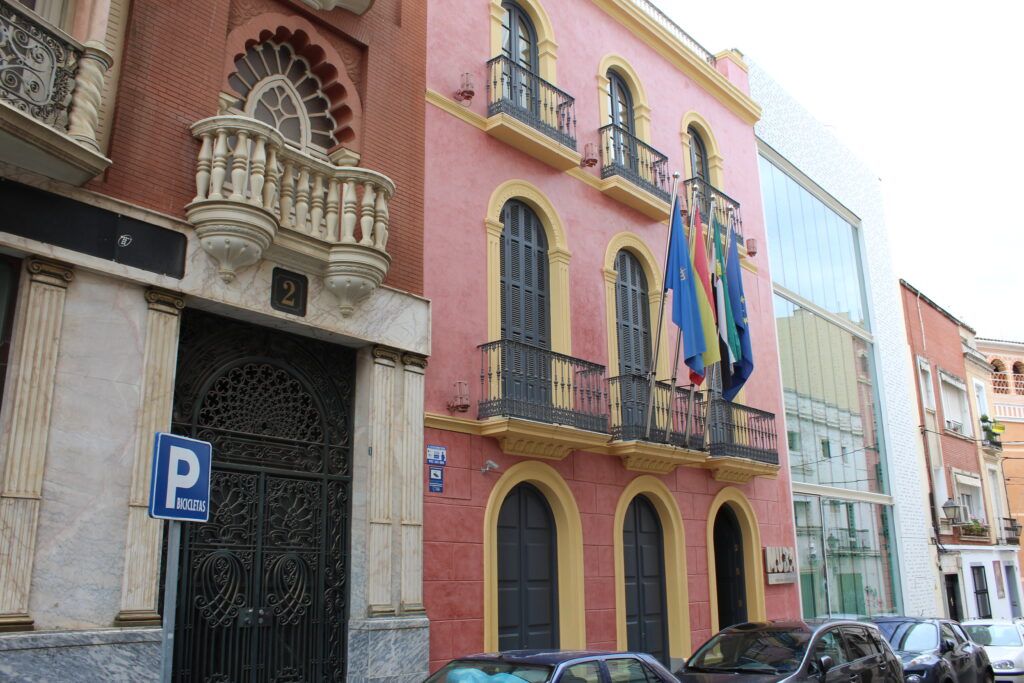
More than 2,000 works, from the sixteenth century to the twenty-first, including the earliest painting known by Zurbarán, in a nineteenth-century palace house in the centre of Badajoz.
At a glance
The Museo de Bellas Artes de Badajoz, known as MUBA, occupies a group of buildings at Calle Duque de San Germán 3, the oldest of them a late nineteenth-century palace house. It is a provincial institution, run by the Diputación de Badajoz, and it holds more than 2,000 pieces. The collection runs from the sixteenth century to the twenty-first and is built around artists of Extremadura, with Francisco de Zurbarán and Luis de Morales at the older end. Admission is free.
Key facts
- Created in 1919; the first three rooms opened on 4 January 1920
- First director: the painter Adelardo Covarsí Yustas, in post until 1951
- More than 2,000 works, from the sixteenth century to the twenty-first
- Holdings declared a Monumento Histórico-Artístico in 1962
- Address: Calle Duque de San Germán 3, 06001 Badajoz
- Admission free
- A provincial museum, under the Diputación de Badajoz
History
The museum began with a decree, not a collection. A Real Decreto of 24 July 1913 ordered a provincial museum of fine arts in every provincial capital that did not yet have one, and Badajoz acted on it in 1919. The painter Adelardo Covarsí Yustas, a teacher at the city's school of arts and crafts, drove the project, and became the museum's first director, a post he held until 1951.
The first three rooms opened to the public on 4 January 1920, on the ground floor of what is now the Palacio Provincial. In 1962 the museum's holdings were declared a Monumento Histórico-Artístico.
In 1978 the provincial council bought a late nineteenth-century building on Calle Meléndez Valdés, the former head office of the Banca Crespo and until then the property of the Pinna-Crespo family, to give the collection a home of its own. It opened there in full in 1981, arranged chronologically from the sixteenth century to the twentieth. A second building, at Calle Duque de San Germán, was inaugurated in November 1998.
The last campaign began in 2011 and finished in 2014; the new galleries opened on 30 March 2015. The complex now holds more than 2,000 pieces. Its strength is the painting of Extremadura.
What you see
The visit runs backwards. It starts with the twentieth and twenty-first centuries and ends with the oldest works, those of the sixteenth century. Francisco de Zurbarán and Luis de Morales are the names to look for at that end. The Zurbarán is a Virgin of the Clouds, commissioned in 1619 by the council of Llerena for a gate in the town wall and paid at 77 reales; it is now considered the painter's earliest known picture. Around them hang Adelardo Covarsí, Eugenio Hermoso, Godofredo Ortega Muñoz, Juan Barjola, Timoteo Pérez Rubio, Isaías Díaz, Antonio Juez, Pérez Jiménez, Torre-Isunza, Aurelio Cabrera, Bermudo Mateos, Felipe Checa and Nicolás Megía.
One of the buildings is a late nineteenth-century palace house. It has the scale and the staircase that come with it. The newest galleries were added behind and beside the older rooms, and the whole complex is now much larger than the three rooms of 1920.
Practical information
- Address: Calle Duque de San Germán 3, 06001 Badajoz. Telephone +34 924 212 469 / +34 924 248 034
- Morning opening: Tuesday to Sunday, 10:00–14:00
- Afternoons, October to May: Tuesday to Friday, 17:00–19:00
- Closed on Mondays that are not public holidays
- Admission free
Getting there
The museum is at Calle Duque de San Germán 3, in the historic centre of Badajoz, a few minutes on foot from the Plaza Alta and the Alcazaba.
Nearby
- Plaza Alta
- Alcazaba de Badajoz
- Catedral de San Juan Bautista
- Puerta de Palmas
Sources
- https://muba.badajoz.es/historia.html
- https://muba.badajoz.es/eledificio.html
- https://muba.badajoz.es/coleccionhistoria.html
- https://muba.badajoz.es/pinturazurbaran.html
- https://muba.badajoz.es/horario.html
- https://muba.badajoz.es/
- https://www.spain.info/es/lugares-interes/museo-bellas-artes-badajoz/
- https://turismoextremadura.gobex.es/es/explora/Museo-de-Bellas-Artes/
Find it on the map
See this place and what’s around it →📷 Become a Cultural Heritage Online photographer
Share your photos of places: they stay published under your name as the author. The more they're seen, the more you get noticed — and soon a contest will reward the most appreciated photos.
Log in or sign up free to add a photo