

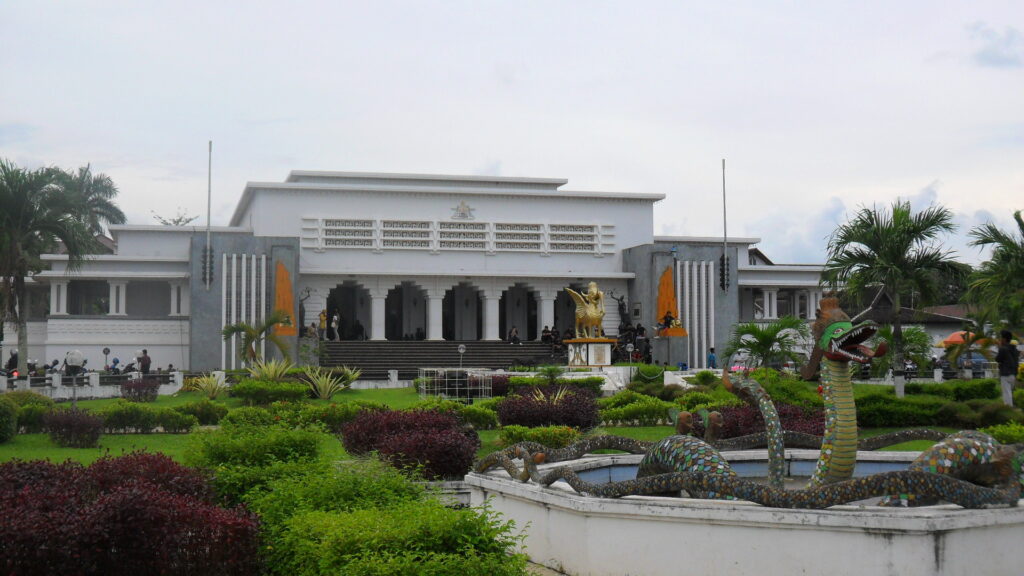
A former sultanate palace transformed into a repository of royal history, housing antiquities from across Asia and Southeast Asia.
At a glance
The Mulawarman Museum occupies a Dutch-constructed palace beside the Mahakam River in Tenggarong, East Kalimantan. The Dutch-built palace remained the sultan’s seat until the monarchy’s status was reduced in 1960; in 1964 a mob attacked and burned much of the complex, the main building was saved, and in 1971 it was converted into a public museum. Today it preserves the material culture of the sultanate alongside art and objects from Ming, Qing, and Yuan dynasties.
History
Built during the 1930s by the Dutch colonial administration, the palace became the power base of the Kutai Sultanate. It remained an active royal residence throughout the twentieth century before being converted into a museum to preserve the sultanate’s heritage and the broader artistic traditions of the region.
What you see
The building retains its colonial-era architectural character while housing interiors that reflect royal life. A richly adorned bedroom features hand-woven doyo fabric traditional to Kalimantan. Period furnishings and spatial arrangements evoke the formal ceremonial functions the palace once served.
Cultural significance
The museum documents the Kutai Sultanate’s long sovereignty and its connections to broader Southeast Asian and East Asian courts. A Balinese puppet theatre, donated by the Sultan of Yogyakarta, underscores the artistic exchanges among Indonesian sultanates. The collections—from historical statues to ceramics spanning three Chinese dynasties—illustrate the sultanate’s regional trade networks and cultural prestige.
Key facts
- Location: Tenggarong, East Kalimantan, Indonesia
- Coordinates: -0.41308, 116.9904
- Constructed: 1930s (Dutch colonial period)
- Housed the Kutai sultans until 1960; museum since 1971
Practical information & getting there
The museum is situated near the Mahakam River in Tenggarong. Contact local tourism authorities in East Kalimantan for current opening hours, admission fees, and guided tour availability.
The museum keeps a replica of the Yupa inscriptions, the stone pillars that carry the earliest known writing of the archipelago; the originals are held at the National Museum in Jakarta.
Sources & resources
Find it on the map
See this place and what’s around it →📷 Become a Cultural Heritage Online photographer
Share your photos of places: they stay published under your name as the author. The more they're seen, the more you get noticed — and soon a contest will reward the most appreciated photos.
Log in or sign up free to add a photoIs this page about you?
This page is read by travellers and heritage enthusiasts who find it on Google. Tell us how you are connected to this place and we will take it from there.
This entry stays online and free either way — and a free account lets you add to it yourself.