
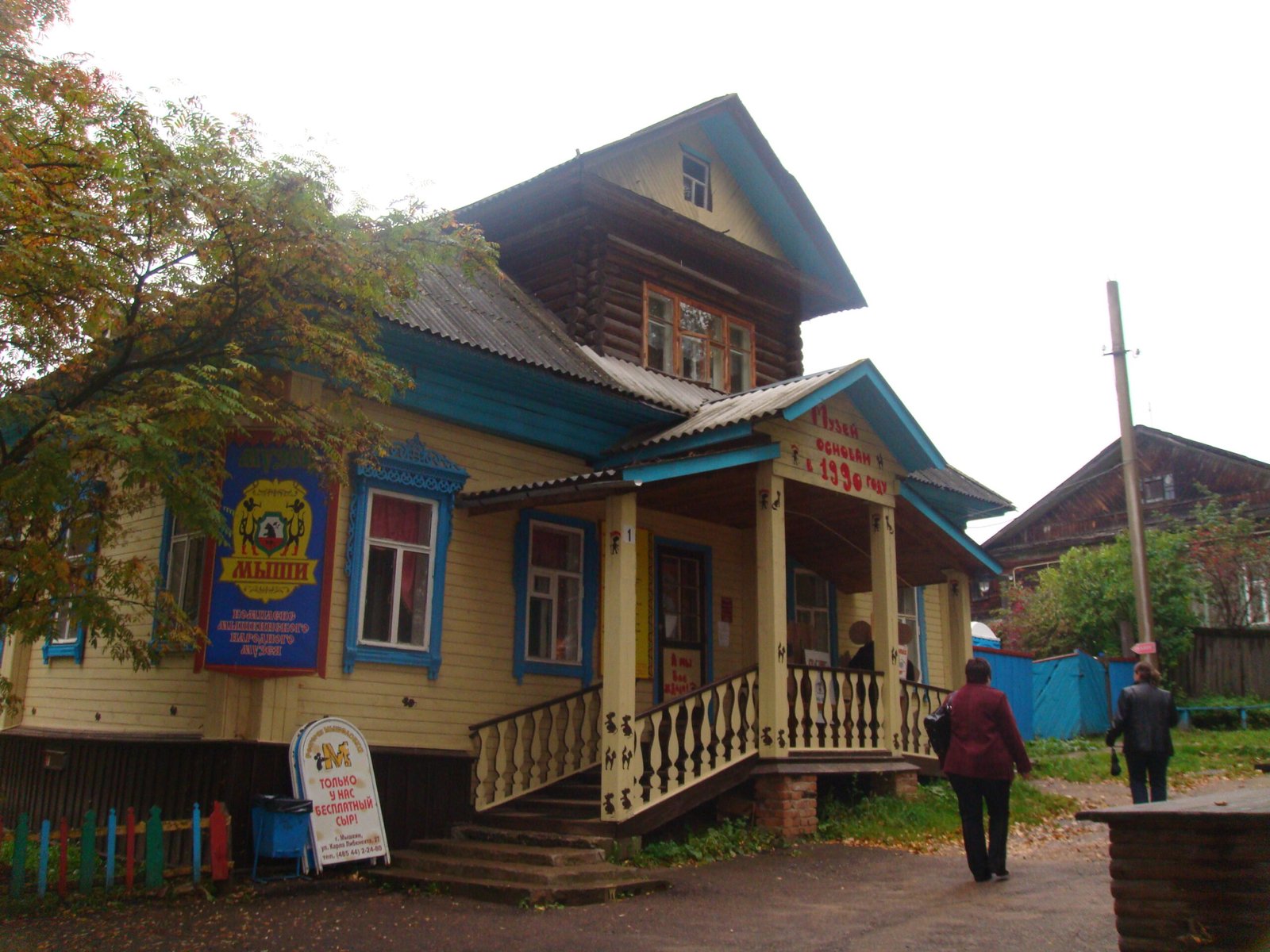
In a small Volga town named for a mouse, a museum dedicated entirely to that animal has become one of the Golden Ring’s more unlikely draws.
At a glance
The Mouse Museum sits in Myshkin, a modest town in Yaroslavl Oblast whose very name translates to “little mouse.” According to the Wikipedia article, it opened in 1990, though Wikidata records an inception year of 1966, a discrepancy the sources do not resolve. Whatever its true starting point, the museum has grown into a repository of roughly 2,000 mouse-themed objects gathered from around the world.
History
The museum’s identity is inseparable from the town’s name. Myshkin leaned into the joke and built a collecting institution around it. In 1996 the town hosted the International Festival “Mouse-96,” drawing attention to its curious specialty. Roughly every twelve years, when the Chinese calendar turns to the Year of the Rat, Myshkin stages a larger civic celebration. The most recent, in 2008, brought President Dmitry Medvedev for a private tour. He received a copy of a bilingual children’s book, “The Town Named Mouse,” written by Robert Aronson and illustrated by Marina Zorina. A fire once damaged a nearby building and sparked rumors of the museum’s demise. Reports of its closure proved false. It remains open.
What you see
Inside, cases hold mice rendered in wood, ceramic, textile, metal, and glass. Techniques vary by country of origin. Some pieces are folk crafts; others are collectible ephemera sent in by admirers of the town’s mascot. The effect is cumulative rather than monumental. No single object dominates; the sense of scale comes from sheer number. The nonprofit that runs the museum also operates four affiliated sites nearby. These include a Museum of Navigation, a Museum of Unique Machines housing an American school bus from Indiana, an open-air Museum of Wooden Architecture, and a museum honoring vodka inventor Pyotr Arsenievich Smirnov. Together they form a small cluster of local-history institutions radiating from the mouse theme.
Cultural significance
The Mouse Museum functions as a piece of civic self-invention. A place name became a tourism strategy, and the strategy worked. The museum and its sister institutions now anchor Myshkin’s standing within the Golden Ring, the network of historic towns northeast of Moscow prized for their heritage architecture and traditions. More than 100,000 visitors reportedly pass through the town and its museums each year. That is a striking figure for a settlement of Myshkin’s size, and it reflects the town’s success in turning a linguistic coincidence into a durable cultural asset.
Key facts
- Location: Myshkin, Yaroslavl Oblast, Russia
- Founded: 1990 per Wikipedia; Wikidata lists an inception year of 1966
- Collection: approximately 2,000 mouse-related objects
- Affiliated sites: Museum of Navigation, Museum of Unique Machines, Museum of Wooden Architecture, Pyotr Smirnov Museum
- Notable event: International Festival “Mouse-96,” held in 1996
Practical information & getting there
Myshkin lies on the Volga River in Yaroslavl Oblast, reachable from Moscow and Yaroslavl by road, and it is a regular stop for river cruises along the Golden Ring route. The official Myshkin site, listed under sources, offers further orientation, though much of its content is in Russian. Check current hours before visiting, since the article gives no fixed schedule. Riverboat arrivals typically dock within walking distance of the town’s museum cluster, making a short stroll enough to reach the mice.
Sources & resources
Find it on the map
See this place and what’s around it →📷 Become a Cultural Heritage Online photographer
Share your photos of places: they stay published under your name as the author. The more they're seen, the more you get noticed — and soon a contest will reward the most appreciated photos.
Log in or sign up free to add a photoIs this page about you?
This page is read by travellers and heritage enthusiasts who find it on Google. Tell us how you are connected to this place and we will take it from there.