

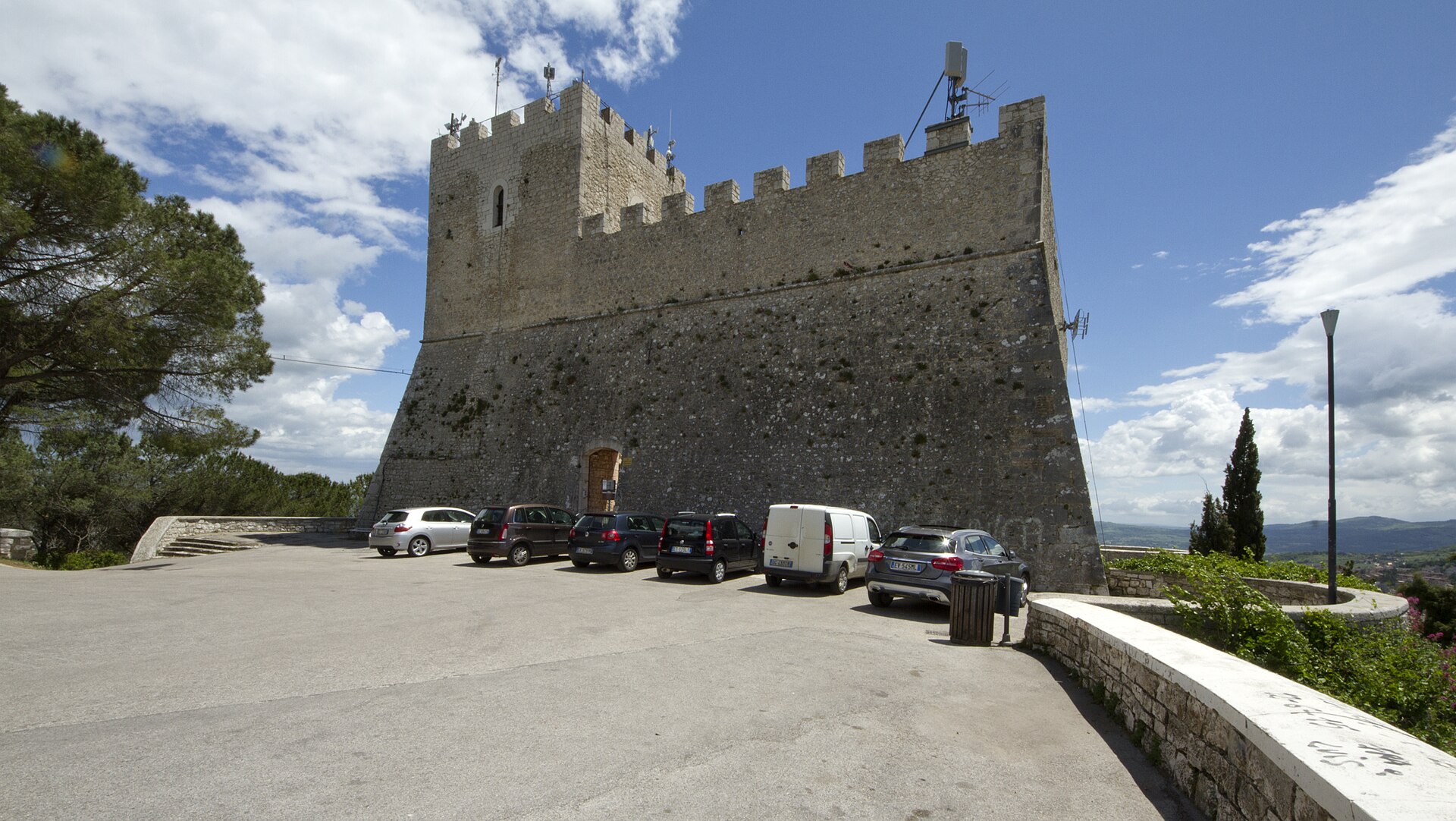
Castello Monforte is the castle of Campobasso, capital of Molise, and the national monument that stands for the city. It crowns the hill above the historic centre at 808 metres and takes its name from Nicola II Monforte, of the Monforte-Gambatesa, who restored it in 1458 after the earthquake of 1456.
At a glance
- Type
- Fortified castle, national monument
- Period
- Built in 1100; present form in the mid-fifteenth century
- Style
- Medieval military architecture, remodelled in the Aragonese period
- Location
- Via delle Rimembranze, 86100 Campobasso (CB), Molise, Italy
- Coordinates
- 41.5634° N, 14.6552° E
Overview
Campobasso climbs a hill in the Molise Apennines, and the castle occupies its summit. The building is a massive quadrilateral whose main entrance, now disused, faced the town below; traces of the drawbridge and of the lateral defensive towers survive in the masonry. The windows are few and small, square openings that read at a distance as loopholes. Above them rises a large rectangular tower, which today houses the meteorological station of the Aeronautica Militare at 808 metres above sea level, one of the highest in Italy.
History
The castle was built in 1100 by Ugo II of Molise over a Samnite settlement, whose walls still emerge on the hill. It was altered after the earthquakes that struck the region in 1348 and 1456, and took its present form in the mid-fifteenth century under Nicola di Monforte. He completed the fortification of the castle and of Campobasso itself in the years before the war between Ferrante of Aragon and Giovanni of Anjou for the Kingdom of Naples, fought between 1459 and 1464. The year 1458, given by the Ministry of Culture for the restoration, is the one usually attached to the present building.
What you see
Along the top of the walls runs a long sequence of Guelph merlons. Above the drawbridge stands the coat of arms of the Monforte, a cross surrounded by four roses. The interior is bare: a staircase climbs to the terrace, from which the view takes in the remains of the Oscan-Samnite walls, the fan-shaped layout of the old town, Campobasso itself and the villages around. On clear days the eye runs from the valleys of the Biferno, Trigno and Fortore to the mountains of Abruzzo with the Majella, across Alto Molise and as far as the yellow hills of Puglia.
Below the courtyard, the castle has underground rooms covering an area equal to the building above. Their original purpose is unknown: they have been read as cisterns, as a prison or as a refuge during sieges. They now hold part of the water reserve of the municipal aqueduct, and a room in the cells, reached through a small turret, was certainly used as a prison.
Cultural significance
The Ministry of Culture describes Castello Monforte as a national monument and the symbol of Campobasso. Its importance is stratigraphic as much as architectural: the Samnite walls, the medieval fortress, the Aragonese rebuilding and the Monforte arms record the succession of powers that controlled the upper Molise. The terrace is the point from which the geography of the region can be read at a glance, from the Apennine ridges to the hills of Puglia.
Practical information
- Address
- Via delle Rimembranze, 86100 Campobasso (CB), Molise
- Access
- The castle is reached on foot from the upper historic centre, by a stepped climb; opening times are managed locally
- Admission
- Check with the municipality of Campobasso before visiting
Getting there
Campobasso is the capital of Molise and is reached by road from Termoli and the A14 Adriatic motorway, and by bus from Rome and Naples. The castle stands at the top of the historic centre: from the main streets of the city the climb is steep but short, and the last stretch is on foot.
Sources & resources
Find it on the map
See this place and what’s around it →
Advertisement. Pictured, from the Cleveland Museum of Art (CC0) and not for sale: Latz commode, Meissen group, Paul Storr tureen. How we handle this
📷 Become a Cultural Heritage Online photographer
Share your photos of places: they stay published under your name as the author. The more they're seen, the more you get noticed — and soon a contest will reward the most appreciated photos.
Log in or sign up free to add a photo