
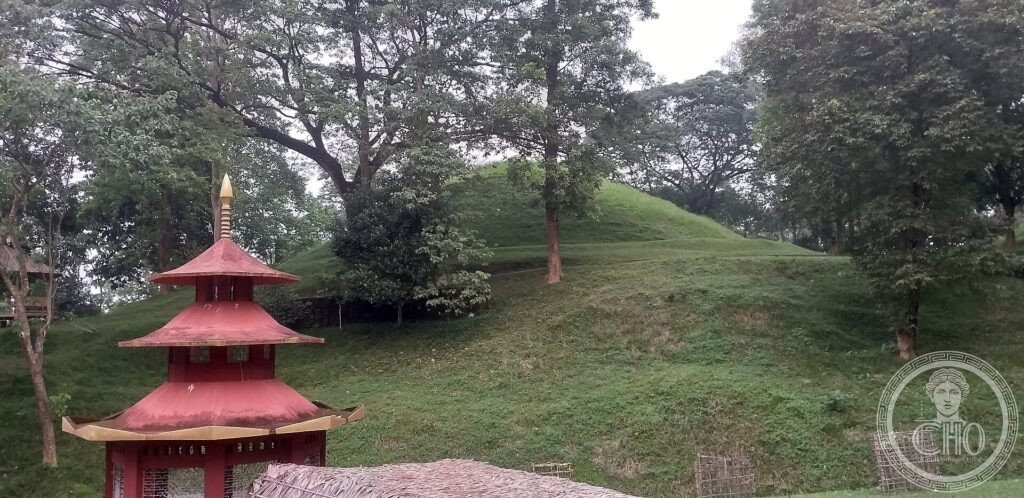
At Charaideo, the first capital of the Ahom kingdom, stand the moidam: large grassy mounds sheltering the kings and nobles of a dynasty of Tai origin that ruled Assam for six centuries. Called the “pyramids of Assam”, they became north-east India’s first UNESCO cultural site in 2024.
At a glance
The Moidams (or Maidams) of Charaideo, in Assam, are the royal burial mounds of the Ahom dynasty, a people of Tai origin who ruled the Brahmaputra valley for nearly six hundred years. At Charaideo, their first capital, kings and nobles were buried beneath great hemispherical earth mounds with vaulted brick chambers, in a tradition sometimes called the “pyramids of Assam”. Inscribed by UNESCO in 2024, they are the first cultural World Heritage site in north-eastern India.
Key facts
- UNESCO: World Heritage since 2024 (Moidams – the Mound-Burial System of the Ahom Dynasty)
- Ahom dynasty: Tai-origin rulers of Assam, c. 1228–1826
- Charaideo: the first capital and royal necropolis
- Royal mounds: earth tumuli over vaulted brick burial chambers
- “Pyramids of Assam”: a unique mound-burial tradition
- First in the region: the first cultural WHS of north-east India
History
In 1228 a prince of Tai origin, Sukaphaa, crossed the mountains into the Brahmaputra valley and founded the Ahom kingdom, with its first capital at Charaideo. The Ahoms went on to rule Assam for nearly six centuries, resisting Mughal invasions and building a distinctive Assamese culture before falling in the early 19th century.
Their kings and great nobles were buried at Charaideo in moidams — mounds of earth raised over brick or stone vaults in which the dead were laid with their possessions, in a custom blending Tai ancestral beliefs with local practice. Dozens of these royal mounds survive in the wooded hills of Charaideo, recognised by UNESCO in 2024.
What you see
Set among trees and grass, the moidams rise as rounded green hillocks of varying size, the largest those of kings, each originally crowned by a pavilion and enclosed by a wall. Excavation has revealed the vaulted brick chambers within. Small shrines and markers stand among the mounds.
The quiet, wooded necropolis, with its mounds rolling across the landscape, evokes the long-vanished Ahom court.
Practical information
- Site: the mound field at Charaideo is open to visitors
- Time needed: 1–2 hours
- Note: in upper Assam, beyond Sivasagar
- Setting: wooded low hills near the Naga foothills
Getting there
Charaideo is in upper Assam, north-eastern India, about 30 km from Sivasagar and reached by road; the nearest airport is Jorhat. GPS: 26.97° N, 94.97° E.
Nearby
- Sivasagar — the later Ahom capital with its temples and tanks
- Rang Ghar — the Ahom royal pavilion near Sivasagar
- Jorhat — the regional town and gateway
Sources
- UNESCO World Heritage Centre — “Moidams – the Mound-Burial System of the Ahom Dynasty” (ref. 1711)
- Archaeological Survey of India / Assam — official body
- Encyclopaedia Britannica — Ahom; Assam
Find it on the map
See this place and what’s around it →📷 Become a Cultural Heritage Online photographer
Share your photos of places: they stay published under your name as the author. The more they're seen, the more you get noticed — and soon a contest will reward the most appreciated photos.
Log in or sign up free to add a photo