

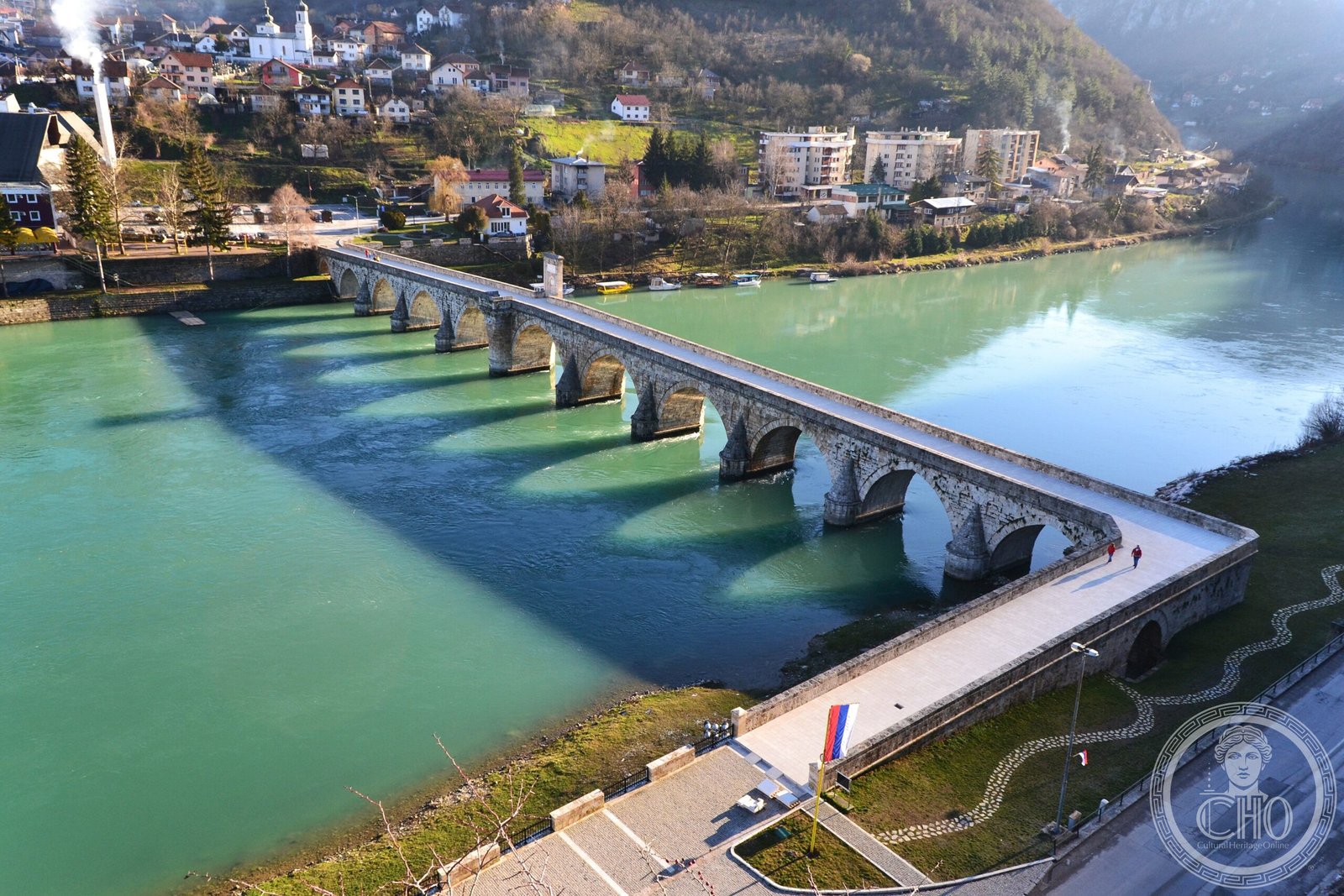
A masterwork of Ottoman engineering, this 16th-century stone bridge spans the Drina River with eleven elegant arches, designed by the renowned architect Mimar Sinan.
At a glance
The Mehmed Paša Sokolović Bridge is a historic Ottoman structure completed in 1577 over the Drina River in Višegrad. Built under the patronage of Grand Vizier Mehmed Paša Sokolović, it represents one of the finest examples of Ottoman bridge architecture in the Balkans.
History
Construction was completed in 1577 following the order of Grand Vizier Mehmed Paša Sokolović, one of the Ottoman Empire’s most influential statesmen. The design and execution were entrusted to Mimar Sinan, the Ottoman court’s chief architect and a figure whose work defined imperial building projects across three centuries.
The bridge remained in continuous use for over four centuries. In 2003, it was designated a National Monument of Bosnia and Herzegovina. UNESCO recognition followed in 2007, when it was inscribed on the World Heritage List.
What you see
The bridge comprises eleven arches spanning the Drina River, constructed of stone with exceptional precision. The arches vary in size, with the central span being the largest. This graduated design allows water to flow naturally during seasonal floods while distributing weight evenly across the riverbed.
The structure reflects the sophisticated engineering principles Mimar Sinan employed throughout his career. Parapet walls line the deck, and the bridge’s proportions create a harmonious visual rhythm that has captivated observers for centuries.
Cultural significance
The bridge embodies the cultural and architectural achievements of the Ottoman Empire at its height. It connected communities across the Drina, facilitating trade and movement for generations. The structure has become an iconic symbol of Višegrad and remains central to the town’s identity and heritage.
Its UNESCO recognition acknowledges its universal value as a testimony to Ottoman architectural mastery and its importance to the broader history of the Balkans.
Key facts
- Location: Višegrad, Bosnia and Herzegovina
- Coordinates: 43.78248°N, 19.28794°E
- Completed: 1577
- Architect: Mimar Sinan
- Patron: Grand Vizier Mehmed Paša Sokolović
- UNESCO World Heritage Site: Yes (inscribed 2007)
- National Monument designation: 2003
Practical information & getting there
The bridge is located in central Višegrad and remains a pedestrian and vehicle crossing over the Drina. The town is accessible by road from Sarajevo and other Balkan cities. The bridge itself is freely accessible year-round. For current visiting conditions and local services, consult official tourism resources for Republika Srpska.
Sources & resources
Find it on the map
See this place and what’s around it →📷 Become a Cultural Heritage Online photographer
Share your photos of places: they stay published under your name as the author. The more they're seen, the more you get noticed — and soon a contest will reward the most appreciated photos.
Log in or sign up free to add a photo