
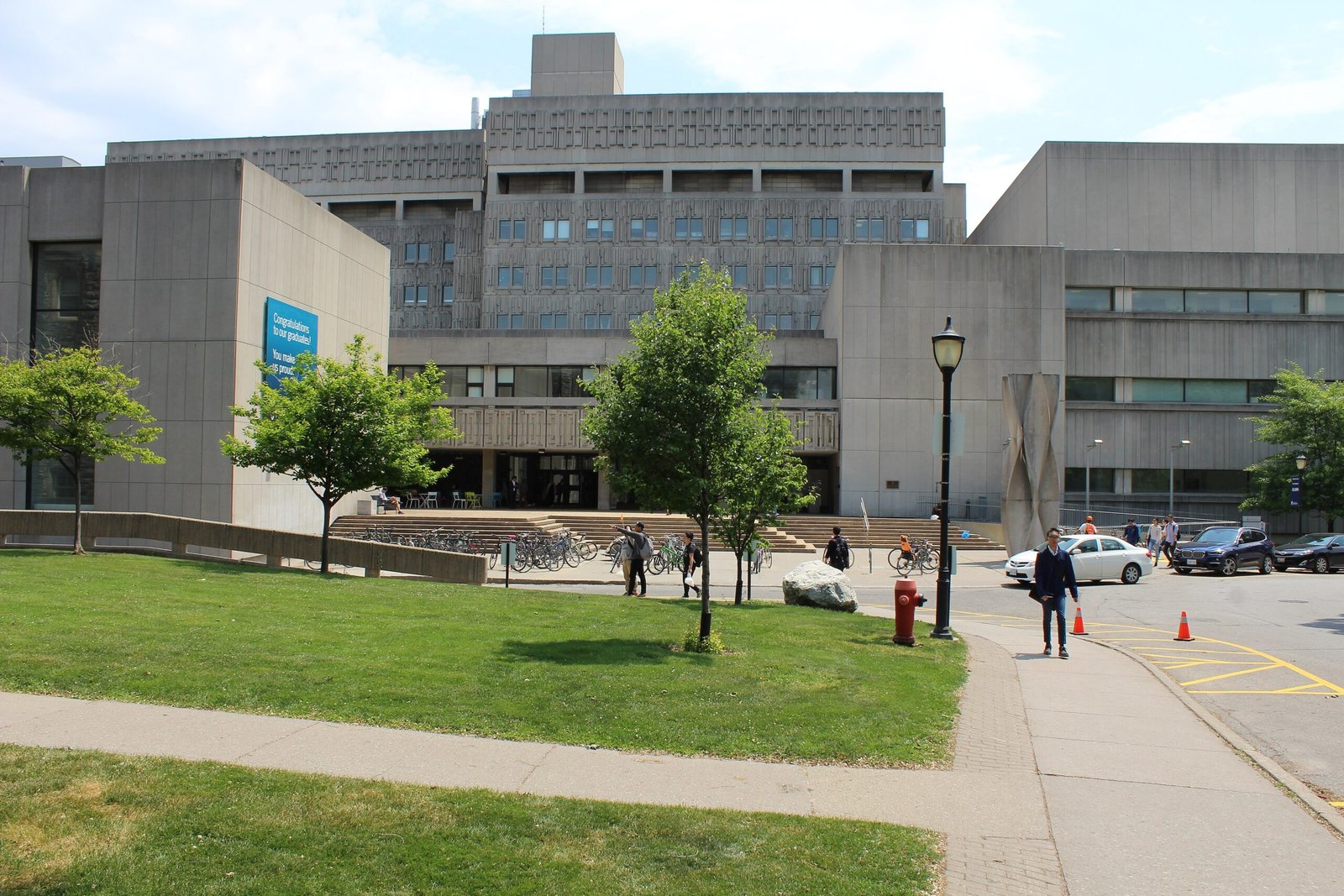
A landmark concrete structure defining medical education at the University of Toronto, the Medical Sciences Building exemplifies Brutalist design of the 1960s within the historic King’s College Circle.
At a glance
The main building of the Temerty Faculty of Medicine rises as a commanding presence on the University of Toronto’s St. George campus. Its massive concrete form dominates the downtown landscape while anchoring the institution’s medical teaching mission since its completion in 1969.
History
Constructed in 1969, the Medical Sciences Building was erected at a pivotal moment in North American architectural practice. Its placement within the historic King’s College Circle represents a deliberate integration of contemporary design into one of Canada’s most significant academic precincts.
What you see
The building’s predominantly concrete construction embodies Brutalism at its most sculptural. Raw surfaces, bold geometric forms, and monumental massing typify the style. The structure connects seamlessly to adjacent facilities, including the Donnelly Centre for Cellular and Biomolecular Research, creating an integrated academic complex along College Street.
Cultural significance
The Medical Sciences Building stands as an important example of 1960s institutional architecture in Canada. Its uncompromising aesthetic reflects the era’s confidence in modernist principles applied to medical education and research. The building anchors Toronto’s Discovery District, home to teaching hospitals including Toronto General Hospital, Mount Sinai Hospital, and The Hospital for Sick Children, making it central to the city’s medical infrastructure.
Key facts
- Country: Canada
- City: Toronto
- Completed: 1969
- Architectural style: Brutalism
- Primary material: Concrete
- Coordinates: 43.66074, -79.3937
Practical information & getting there
The Medical Sciences Building occupies a prominent position on the University of Toronto’s St. George campus in downtown Toronto. The site lies within the Discovery District, well-connected by public transit and pedestrian pathways to the city’s medical and academic institutions.
Sources & resources
Find it on the map
See this place and what’s around it →📷 Become a Cultural Heritage Online photographer
Share your photos of places: they stay published under your name as the author. The more they're seen, the more you get noticed — and soon a contest will reward the most appreciated photos.
Log in or sign up free to add a photoIs this page about you?
This page is read by travellers and heritage enthusiasts who find it on Google. Tell us how you are connected to this place and we will take it from there.