
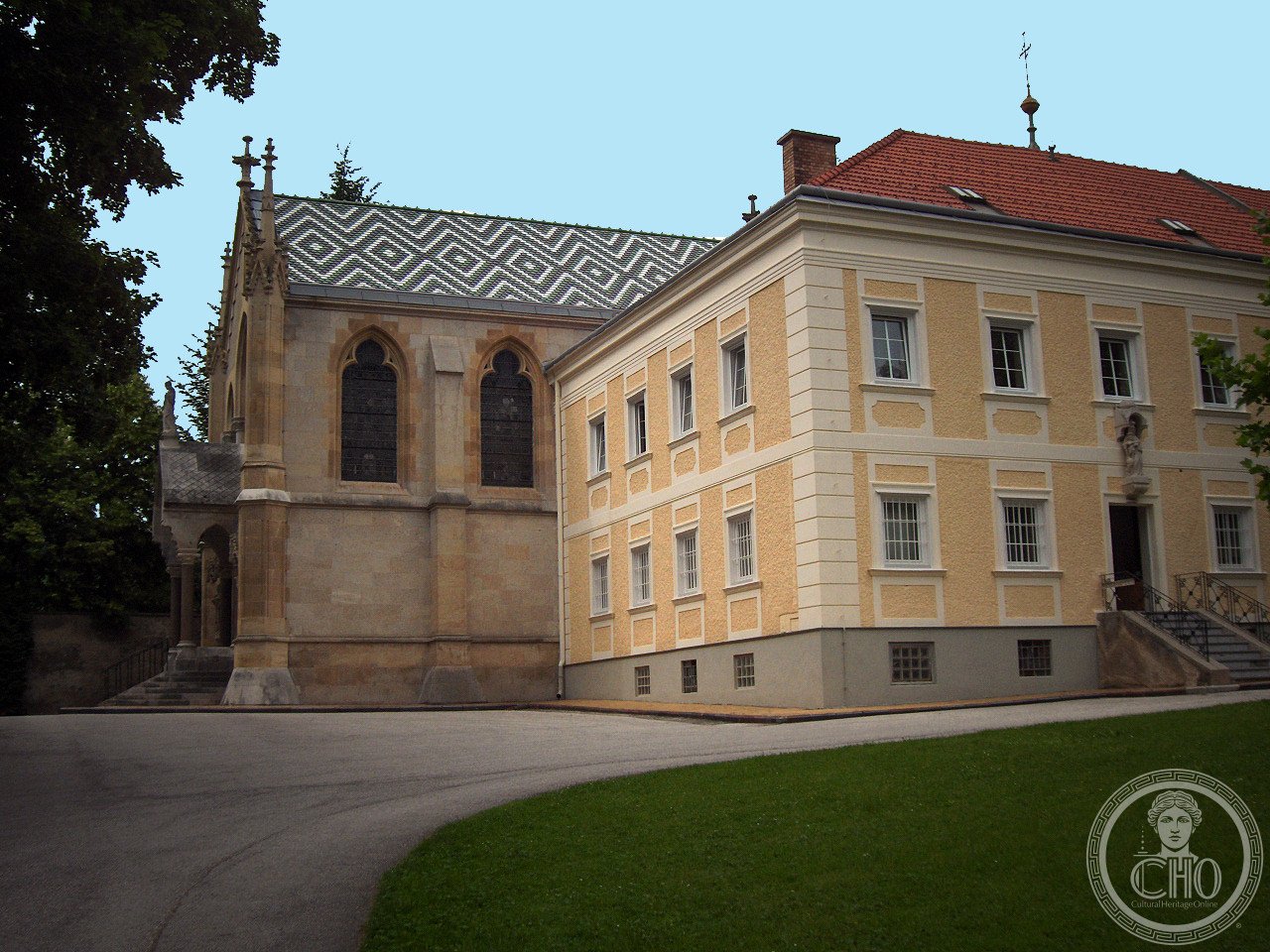
Mayerling is not a castle, and it has not been a hunting lodge since 1889. It is a Carmelite convent, built by Emperor Franz Joseph I around the room in which his son Rudolf, heir to the Austro-Hungarian throne, and the seventeen-year-old Baroness Mary Vetsera were found dead on the morning of 30 January 1889. The church stands on the exact spot. Nuns have lived here ever since.
At a glance
- Type
- Carmelite convent, with a visitor centre and exhibition rooms
- Where
- Mayerling 3, 2534 Alland, district of Baden, Lower Austria
- Coordinates
- 48.0469° N, 16.0986° E
- Before 1889
- An estate of Heiligenkreuz Abbey from 1550; a hunting lodge only from 1886
- The night
- 30 January 1889
- Since
- A community of Discalced Carmelites, in enclosure
Overview
Mayerling is a hamlet in the Wienerwald, the wooded hills south-west of Vienna, in the municipality of Alland. There is no castle here and there never was one worth the name: the German Schloss Mayerling, which the older guidebooks repeat, describes a modest country house, and what stands today is a convent. Visitors come for one night in the history of the Habsburgs, and find a place deliberately built so that the night could not be visited — a church laid over the room, and an enclosed community praying in it.
History
The estate is recorded from 1550 as a possession of the Cistercian abbey of Heiligenkreuz, a few kilometres away. After the dissolution of church holdings at the end of the eighteenth century it passed into private hands and stood largely unused. In 1886 Crown Prince Rudolf bought it from Count Reinhard August zu Leiningen-Westerburg-Altleiningen and had it rebuilt as a hunting lodge: a small single-storey house with green rendering and white shutters, which he opened on 19 October 1887 in the presence of his parents, Emperor Franz Joseph and Empress Elisabeth. He used it perhaps ten times.
On the morning of 30 January 1889 Rudolf and Mary Vetsera were found dead in the ground-floor room whose windows gave onto the garden. The deaths were, and remain, the subject of enquiry and of a great deal of invention; the account generally accepted is that Rudolf shot her and then himself. Rudolf was buried, against his own wish, in the Imperial Crypt in Vienna. Mary Vetsera was buried on 1 February in the cemetery of Heiligenkreuz, after her uncles had persuaded the abbot to allow a Christian burial; her grave was disturbed repeatedly in the twentieth century, and she was reinterred there for the last time in 1993.
The emperor did not demolish the lodge. He had it converted: the architects Heinrich Schemfil and Josef Schmalzhofer added a church dedicated to Saint Joseph on the site of the death chamber, together with a sacristy, cells and enclosure walls, and the house was handed over to the Discalced Carmelites on 15 December 1889. The order the emperor gave with it was to keep watch over the place. A convent was, in its way, the most effective possible answer to a scandal: it made the room permanently unavailable.
What you see
From the drive the two halves of the story stand side by side and do not match. On the left the church: bare stone, pointed windows with tracery, a steep roof laid in a diamond pattern of dark and light tiles, a gabled front with pinnacles. On the right the domestic block, ochre-rendered with white window surrounds and rusticated corners, a red tiled roof and a small statue in a niche above the entrance steps. The church is the addition; the ochre building is what Rudolf knew, absorbed into a monastery.
A visitor centre opened in 2014 presents the exhibition. Among the objects shown are a letter written by Rudolf, the coffin used for Mary Vetsera, and an imperial chalice; in the park stand the Elisabeth chapel and a tea pavilion. The Carmelite community lives in enclosure, and the parts of the house they occupy are not open.
360° photos
Drag inside the frame to look around from this point.
Video
Cultural significance
Mayerling belongs to European culture more as a story than as a building, and the story has been retold continuously for well over a century in novels, in films and on the stage. The best known of the retellings is the ballet Mayerling, choreographed by Kenneth MacMillan to music by Liszt arranged by John Lanchbery, first danced by the Royal Ballet at Covent Garden on 14 February 1978. It is a three-act work and it is still in the repertory.
What survives on the ground is stranger than the legend: an imperial family answered a death by building a church over the place where it happened and installing an enclosed order of nuns to guard it. The site is a piece of Habsburg damage control that has now been quietly praying for well over a hundred and thirty years.
Practical information
- Address: Mayerling 3, 2534 Alland, Lower Austria.
- Opening hours are seasonal and shorter in winter; groups must book. Check the convent’s own site, karmel-mayerling.org, before travelling.
- The convent is a working religious house in enclosure: only the church and the exhibition rooms are open, and quiet is expected.
- Heiligenkreuz Abbey, where Mary Vetsera is buried, is about three kilometres away and can be reached on the marked forest paths.
Getting there
Mayerling lies in the Wienerwald roughly 25 kilometres south-west of Vienna, in the municipality of Alland in the district of Baden. By car it is reached from Baden or from Alland on the B11; regional buses serve Alland, from which Mayerling is a short ride. Marked hiking trails connect the site with Heiligenkreuz and the Alland valley.
Sources
- Karmel Mayerling — the convent’s own history pages
- Museumsmanagement Niederösterreich — museum record for Karmel Mayerling
- Stift Heiligenkreuz — on the burial of Mary Vetsera
- Kenneth MacMillan Estate and the Royal Ballet — for the 1978 ballet
- Cultural Heritage Online historical archive — original Italian entry on beniculturalionline.it, verified and rewritten in August 2026.
Find it on the map
See this place and what’s around it →📷 Become a Cultural Heritage Online photographer
Share your photos of places: they stay published under your name as the author. The more they're seen, the more you get noticed — and soon a contest will reward the most appreciated photos.
Log in or sign up free to add a photo