
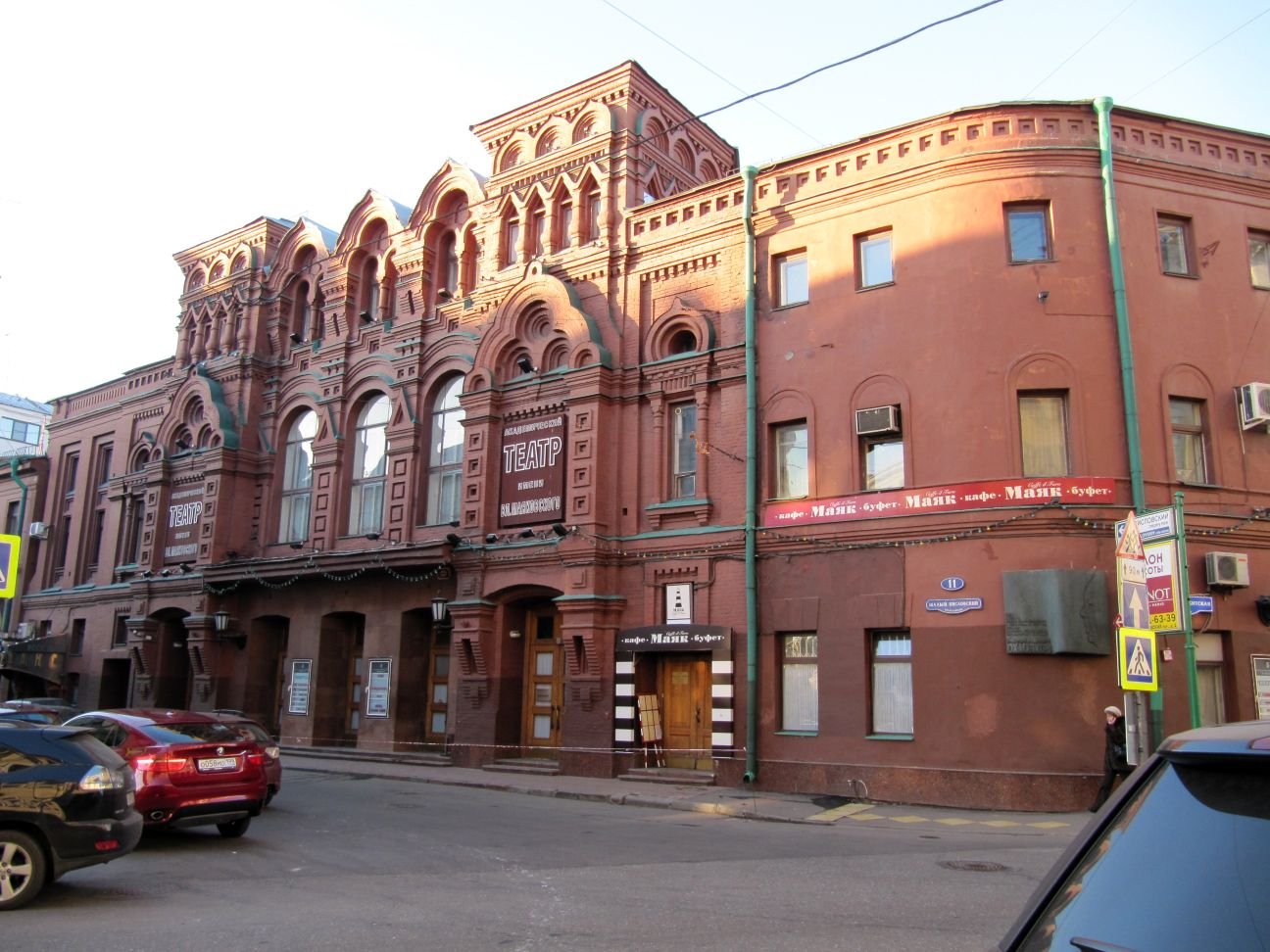
Behind a Russian Revival façade on Bolshaya Nikitskaya Street, a stage built for touring stars became one of Soviet theater’s most restless proving grounds.
At a glance
The building dates to 1886, designed by Konstantin Tersky as a rented hall for visiting foreign celebrities. It has housed a theater company continuously since 1920, though under several names. Since 1954 it has borne the name of poet Vladimir Mayakovsky.
History
Known locally as the theater “At Nikitsky,” the hall opened to host international performers. Sarah Bernhardt appeared there. So did Eleonora Duse and the Coquelin brothers. By the turn of the century it traded under the name Internationale, still a stage for touring rather than resident artists.
That changed in 1920, when the Theater of Revolutionary Satire, or Teverstat, took up residence. Reorganized in 1922 under Vsevolod Meyerhold, it became the Revolution Theater. Alexei Popov ran the company through the 1930s, staging “Romeo and Juliet” and “Death of a Squadron” among other works. His successor Nikolay Okhlopkov, director from 1943 to 1967, reshaped the theater’s identity twice over: first renaming it Drama Theater in 1944, then Mayakovsky Theater in 1954, honoring the futurist poet. Okhlopkov’s productions of “Hamlet” and “The Bug” defined a distinct visual style. Andrey Goncharov then led the company for over thirty years until his death in 2001, followed by Sergei Artsibashev, whose 2005 staging of “Dead Souls” combined both parts of Gogol’s novel for the first time on a Russian stage.
What you see
Tersky’s exterior belongs to the Russian Revival idiom fashionable in late-Imperial Moscow. The auditorium was conceived as a rental venue, not a permanent home. Its plan had to accommodate whichever touring company arrived next. That flexibility outlasted the building’s original purpose by decades.
Cultural significance
Few Moscow stages carry so many names in one shell. Terevsat, Revolution Theater, Drama Theater, Mayakovsky Theater: each label marks a shift in Soviet cultural policy and artistic ambition. Meyerhold’s early involvement ties the building to the most experimental currents in Russian theater. Okhlopkov’s decades cemented its reputation for bold, visually driven staging.
Key facts
- Location: Moscow, Russia
- Architect: Konstantin Tersky
- Building completed: 1886
- Architectural style: Russian Revival
- Theater company founded: 1920
- Renamed Mayakovsky Theater: 1954
Practical information & getting there
The theater sits on Bolshaya Nikitskaya Street in central Moscow, an easy walk from the Kremlin and Tverskaya Street. Check the official website before visiting for current repertoire and ticketing. Performances are in Russian.
Sources & resources
Find it on the map
See this place and what’s around it →📷 Become a Cultural Heritage Online photographer
Share your photos of places: they stay published under your name as the author. The more they're seen, the more you get noticed — and soon a contest will reward the most appreciated photos.
Log in or sign up free to add a photoIs this page about you?
This page is read by travellers and heritage enthusiasts who find it on Google. Tell us how you are connected to this place and we will take it from there.