
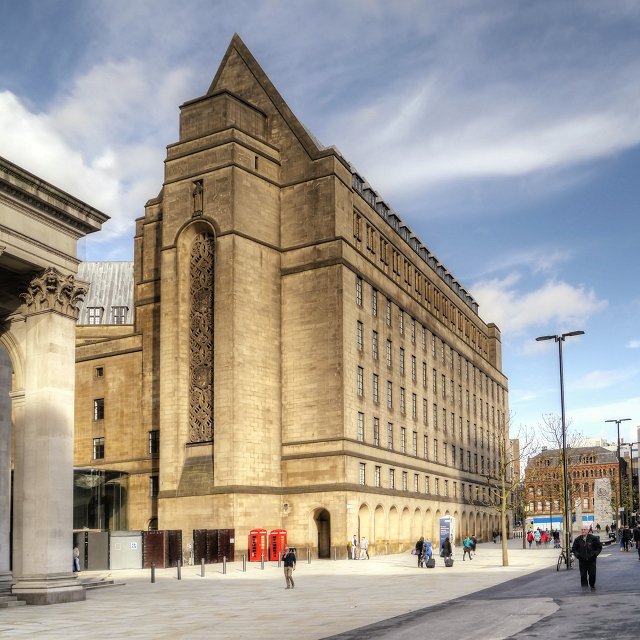
A purposeful bridge between Manchester’s ornate Gothic Revival heritage and classical modernism, this civic building expanded local government capacity while mediating two architectural languages.
At a glance
Constructed between 1934 and 1938, Manchester Town Hall Extension occupies the strategic site between St Peter’s Square and Lloyd Street in the city centre. English Heritage designated it grade II* listed status in 1974, recognizing its architectural and historical merit.
History
The Extension arose from a pragmatic need: Manchester’s local government services had outgrown the original Town Hall. Rather than demolish or overshadow the Victorian landmark, architects designed a building that would acknowledge both the Gothic Revival ornament of its senior partner and the Classical restraint of the nearby Central Library. Construction spanned four years during the 1930s.
What you see
The Extension’s eclectic style avoids pure imitation of either neighbour. Instead, it synthesizes Gothic and Classical vocabularies—a deliberate architectural statement that mediates between two epochs of Manchester’s civic ambition. The building respects the city’s streetscape while asserting its own identity.
Cultural significance
The Extension embodies mid-twentieth-century British thinking about urban continuity. Rather than erasing the past or surrendering to it, the design accepts coexistence. It demonstrates how institutional architecture can expand without dominating, and how new buildings might dialogue with historic neighbours.
Key facts
- Built 1934–1938
- Location: between St Peter’s Square and Lloyd Street, Manchester city centre
- Grade II* listed (2 October 1974)
- Coordinates: 53.4786°N, 2.2443°W
- Country: United Kingdom
Practical information & getting there
Manchester Town Hall Extension forms part of the city’s civic core, easily accessible by public transport. The building remains in use for local government functions. Visitors interested in Manchester’s architectural heritage should also explore the adjacent Town Hall and Central Library to appreciate the deliberate design dialogue.
Sources & resources
Find it on the map
See this place and what’s around it →📷 Become a Cultural Heritage Online photographer
Share your photos of places: they stay published under your name as the author. The more they're seen, the more you get noticed — and soon a contest will reward the most appreciated photos.
Log in or sign up free to add a photoIs this page about you?
This page is read by travellers and heritage enthusiasts who find it on Google. Tell us how you are connected to this place and we will take it from there.