
Maison GoDoT is a small theatre in Ragusa, in the late Baroque Val di Noto of south-eastern Sicily, and the winter home of the theatre company Compagnia G.o.D.o.T. The company’s summer season is staged elsewhere, in the grounds and rooms of the Castello di Donnafugata outside the city. The building stands in the UNESCO landscape rebuilt after the earthquake of 1693.
At a glance
- Type
- Historic building and cultural venue
- Period
- 18th century (post-1693 earthquake reconstruction)
- Style
- Sicilian Baroque
- Location
- Ragusa, Val di Noto, Sicily, Italy
- Coordinates
- 36.9168° N, 14.7213° E
Overview
Ragusa occupies a dramatic position on two adjacent rocky spurs in the Iblean plateau of southeastern Sicily. The city divides into the medieval Ragusa Ibla — the lower town, rebuilt entirely in Sicilian Baroque after the 1693 earthquake — and the upper Baroque town of Ragusa Superiore, planned on a grid in the eighteenth century. Together they form part of the Late Baroque Towns of the Val di Noto, inscribed on the UNESCO World Heritage List in 2002. Maison GoDoT is situated within this exceptional heritage environment, combining architectural history with contemporary cultural use.
History
The Val di Noto was devastated by a magnitude-7.4 earthquake on 11 January 1693, which destroyed virtually the entire built fabric of the region. Reconstruction began almost immediately, and the towns that rose from the rubble — Ragusa, Noto, Modica, Scicli, Caltagirone, and others — were rebuilt in a unified late Baroque idiom that drew on both Roman and local Sicilian traditions. Ragusa Ibla was reconstructed on the original medieval footprint, producing the densely layered Baroque townscape visible today. Buildings such as Maison GoDoT reflect the domestic architectural language of prosperous Sicilian landowners and merchants of the eighteenth and nineteenth centuries.
What you see
The fabric of Ragusa Ibla is defined by golden limestone facades decorated with wrought-iron balconies supported by carved stone consoles — a signature feature of Sicilian Baroque domestic architecture. Narrow vicoli (lanes) connect the main streets and piazzas, with sudden views opening over the valley below. The area around Maison GoDoT shares this character, with historic stone buildings that preserve the scale and texture of the eighteenth-century reconstruction. The surrounding streets lead within a few minutes’ walk to landmark monuments including the Cathedral of San Giorgio and the Giardino Ibleo.
Cultural significance
Ragusa Ibla forms part of a UNESCO World Heritage Site recognised for the outstanding quality of its late Baroque town planning and architecture following the 1693 earthquake. The reconstruction effort represented one of the most ambitious and coherent urban rebuilding programmes in European history, producing a landscape of exceptional artistic and historical value. Buildings within this heritage zone contribute to an urban fabric that has remained remarkably intact for over three centuries.
Practical information
- Location
- Ragusa, Provincia di Ragusa, Sicily, Italy
- Nearby landmarks
- Cathedral of San Giorgio (Ragusa Ibla); Giardino Ibleo; Palazzo Cosentini
Getting there
Ragusa is served by the Catania–Ragusa railway line, with Ragusa station on the upper plateau. From the station, local buses or a short taxi ride descend to Ragusa Ibla. By car from Catania airport the drive is approximately 1.5 hours via the SP94 and SS194. Street parking is limited in the historic centre; paid car parks are available on the plateau above Ibla.
Compagnia G.o.D.o.T.
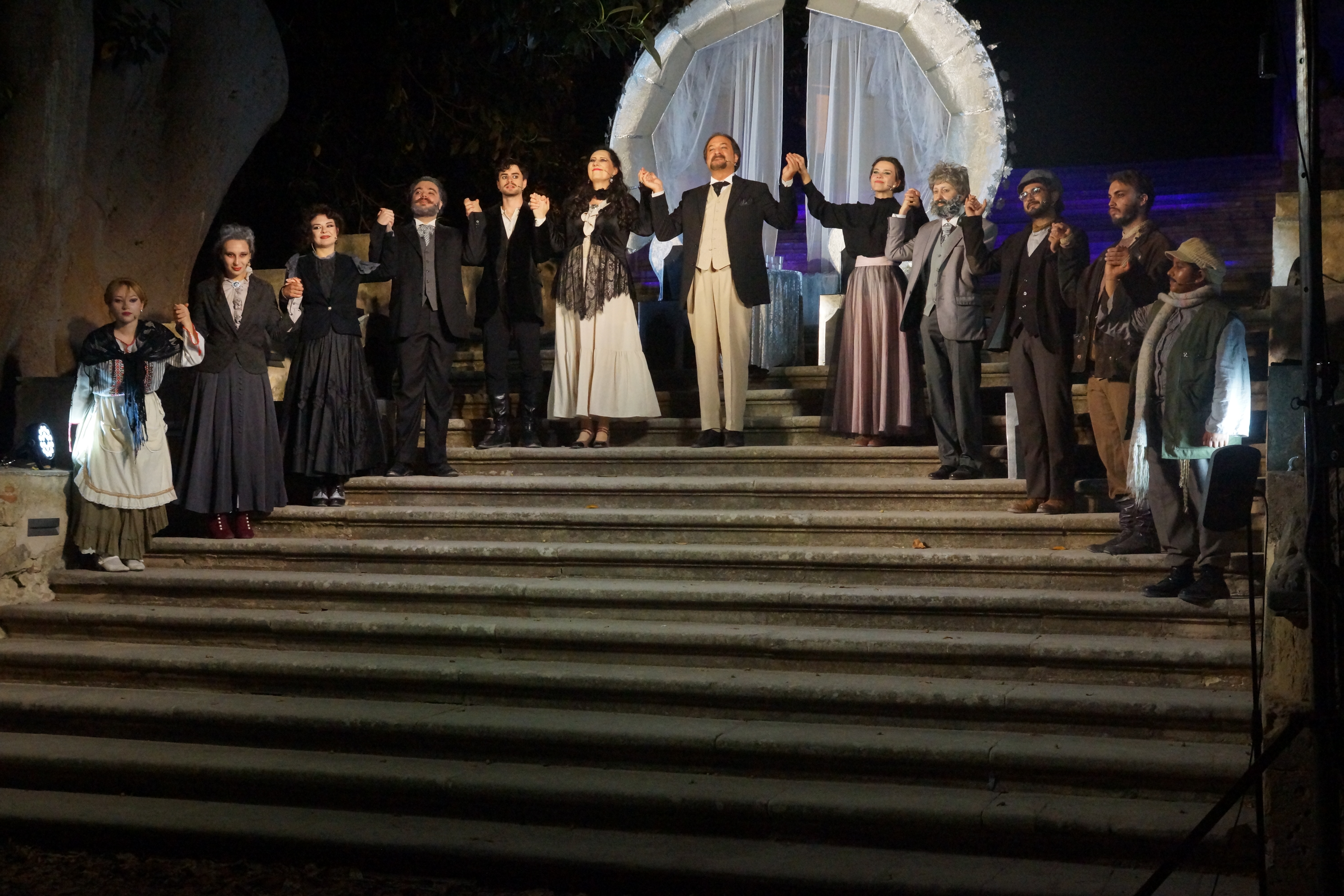
For sixteen years, Compagnia G.o.D.o.T. has made the nearby Castello di Donnafugata one of the defining stages of its work, turning the castle’s rooms and grounds into natural sets. The company was the first to use the castle’s grand staircase as a stage in its own right, a device that has since become one of the site’s most recognisable features for visitors who catch a performance there. Its repertoire draws on the classics of world theatre — Aeschylus, Sophocles and Euripides through to Shakespeare, Molière, Goldoni and Pirandello — staged across a range of styles and periods.
The two venues divide the year. Maison G.o.D.o.T., the building this page describes, is the company’s winter house: a small theatre in the city, where it runs Palchi Diversi, a twenty-year-old season of production, training and programming. The summer season moves out to the Castello di Donnafugata, the historic residence in contrada Donnafugata, a few kilometres west of Ragusa. The company is directed by Federica Bisegna and Vittorio Bonaccorso. These details come from the company itself, in its own account of its history sent to Cultural Heritage Online in August 2026 and corrected by the company in September 2026.
Sources & resources
See the place
Find it on the map
See this place and what’s around it →Historical events at this place (1)
- 2022 Varietà GoDoT
📷 Become a Cultural Heritage Online photographer
Share your photos of places: they stay published under your name as the author. The more they're seen, the more you get noticed — and soon a contest will reward the most appreciated photos.
Log in or sign up free to add a photoIs this page about you?
This page is read by travellers and heritage enthusiasts who find it on Google. Tell us how you are connected to this place and we will take it from there.