
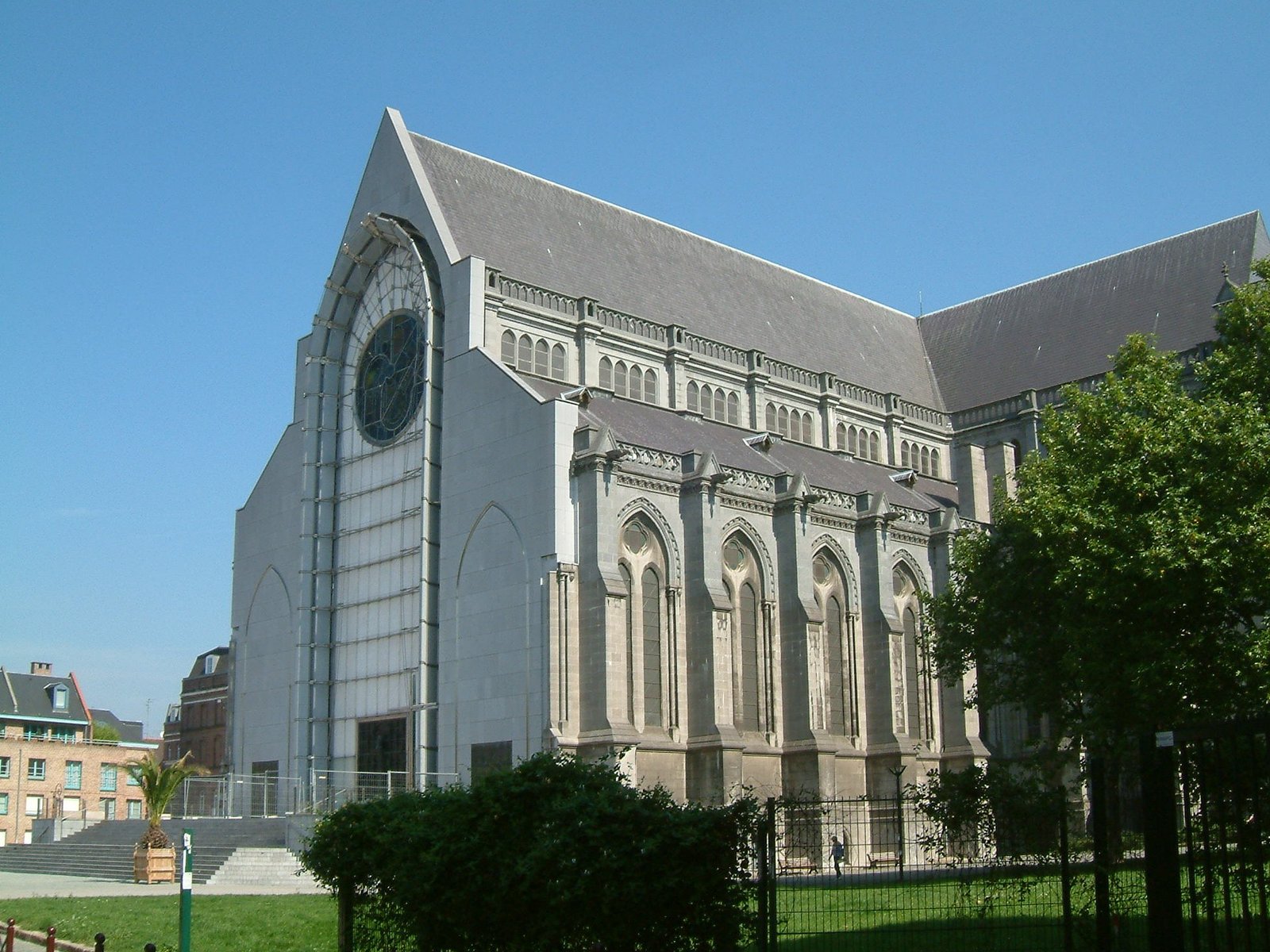
The Basilica of Notre-Dame-de-la-Treille is a Gothic Revival cathedral built over 145 years to house a 12th-century Marian statue and establish Lille as a religious capital during the Industrial Revolution.
At a glance
Lille Cathedral stands as a Roman Catholic basilica and the metropolitan cathedral of the Archdiocese of Lille. Its construction began in 1854 and was not completed until 1999, making it one of France’s longest building projects. The cathedral was built to replace the Collegiate Church of Saint Peter, destroyed during the French Revolution, and to serve as the spiritual seat for a rapidly expanding industrial city.
History
The cathedral’s origins lie in the veneration of a 12th-century statue of the Virgin Mary known as Our Lady of the Treille, formerly housed in the demolished Collegiate Church of Saint Peter. In 1854, a foundation stone was laid and an international design competition was launched, attracting 41 submissions. The top two prizes went to English architects, but concerns about entrusting a Marian church to Anglican designers led instead to Lille architect Charles Leroy directing the project.
Financial constraints and changing architectural leadership extended the work across nearly a century and a half. Pope Pius IX authorized the coronation of the Marian statue in 1874, an honor performed by the Archbishop of Cambrai as papal legate. Pius X elevated the church to minor basilica status in 1904 and, a decade later, designated it the cathedral of the newly created Diocese of Lille. In 2008, following ecclesiastical reorganization, the diocese became a metropolitan archdiocese. A modern facade designed by architect Pierre-Louis Carlier and engineer Peter Rice finally completed the cathedral in 1999.
What you see
The cathedral exemplifies Gothic Revival design, inspired by 13th-century Gothic architecture. Its construction involved multiple generations of builders and architects working in stages from 1856 to 1975, resulting in stylistic coherence despite the protracted timeline. The final decade brought a striking intervention: the contemporary facade installed in 1999 represents a departure from the original Victorian Gothic intentions, introducing modern materials and forms while respecting the building’s spiritual purpose.
Cultural significance
Lille Cathedral reflects the ambitions of 19th-century France to expand its ecclesiastical authority and modernize its industrial centers. The building symbolizes the city’s transformation from a northern textile hub into a major metropolitan religious seat. Its 145-year construction history documents changing architectural tastes, engineering capabilities, and Catholic priorities across five decades.
Key facts
- Country: France
- City: Lille
- Coordinates: 50.64° N, 3.06° E
- Construction: 1854–1999
- Style: Gothic Revival
- Status: National monument; metropolitan cathedral
Practical information & getting there
The cathedral is located in central Lille and serves as an active place of worship. As a major ecclesiastical monument, visiting hours and access may vary. You are advised to check current opening times and any liturgical schedules before planning a visit. The cathedral remains an important pilgrimage destination for devotees of Notre-Dame-de-la-Treille.
Sources & resources
Find it on the map
See this place and what’s around it →📷 Become a Cultural Heritage Online photographer
Share your photos of places: they stay published under your name as the author. The more they're seen, the more you get noticed — and soon a contest will reward the most appreciated photos.
Log in or sign up free to add a photoIs this page about you?
This page is read by travellers and heritage enthusiasts who find it on Google. Tell us how you are connected to this place and we will take it from there.