
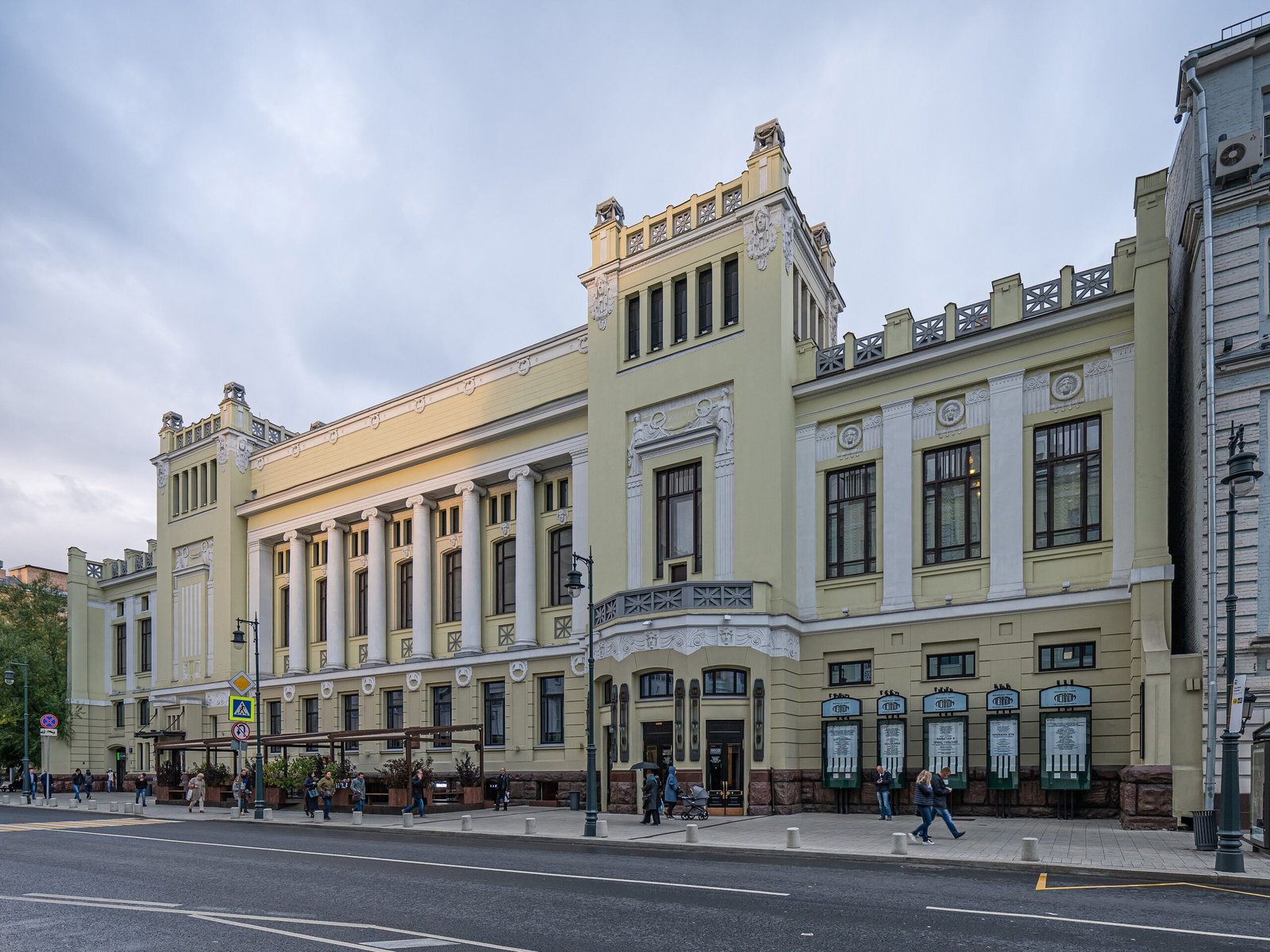
Behind a merchant-club facade on the Garden Ring, one of Moscow’s most restless stages has spent a century changing names, causes and audiences.
At a glance
Lenkom Theatre occupies a building designed by architect Illarion Ivanov-Schitz and constructed between 1907 and 1909 for a Merchant’s Club. It became a theatre in 1927, when the Theatre for Working Youth (TRAM) moved in. The site is heritage-listed today.
History
The building’s first life was brief. Barely a decade after opening as a club for Moscow’s merchants, it was swept up in the February Revolution of 1917. Anarchists seized it and renamed it the House of Anarchy. That episode did not last. The Central School for Soviet and Party Work moved in soon after, becoming the Sverdlov Communist University following Yakov Sverdlov’s death in 1919. Only in 1927 did the building settle into theatrical use, when the Theatre for Working Youth took up residence and set the tone for what followed: a stage made for the young. Renamed for the Communist youth league founded under Lenin, the theatre carried that identity through the Soviet era and into the Russia of today.
What you see
Ivanov-Schitz built for commerce, not drama. The result is a building with the civic weight of a club, not the ornament of a purpose-built playhouse. Its rooms were made to host meetings, concerts and gatherings, a versatility that let anarchists, party functionaries and, finally, actors all claim it in turn. Little in the fabric announces itself as theatrical. That understatement is part of the point.
Cultural significance
Lenkom’s reputation rests on people as much as bricks. Over eight decades it became a byword for experimental Soviet and Russian theatre, a place where new forms of staging found room to breathe. Aleksandr Abdulov, Leonid Bronevoy, Inna Churikova, Nikolai Karachentsov, Yevgeny Leonov, Tatyana Pelttser, Andrei Tarkovsky and Oleg Yankovsky all worked here. Mark Zakharov led the company as artistic director from 1973 until his death in 2019, shaping its identity for nearly half a century. Few Moscow stages can claim so continuous a lineage of talent.
Key facts
- Architect: Illarion Ivanov-Schitz
- Building constructed: 1907–1909
- Theatre established: 1927
- Original use: Merchant’s Club
- Interim uses: House of Anarchy; Sverdlov Communist University
- Location: Moscow, Russia
- Heritage status: Listed
Practical information & getting there
The theatre sits within central Moscow, reachable by the city’s metro network. Performances continue on the Lenkom stage, and current schedules and ticketing are best checked through the official theatre website before you travel. As with most working Russian theatres, seasons pause over summer, so plan a visit around the active repertoire.
Sources & resources
Find it on the map
See this place and what’s around it →📷 Become a Cultural Heritage Online photographer
Share your photos of places: they stay published under your name as the author. The more they're seen, the more you get noticed — and soon a contest will reward the most appreciated photos.
Log in or sign up free to add a photoIs this page about you?
This page is read by travellers and heritage enthusiasts who find it on Google. Tell us how you are connected to this place and we will take it from there.