

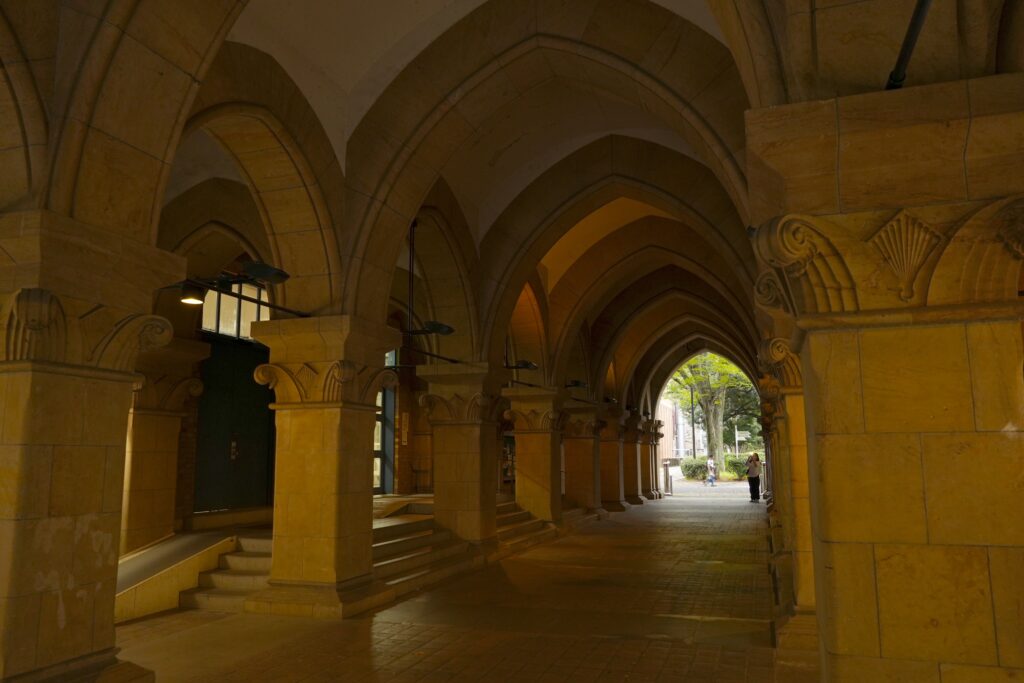
The Law and Letters Building No. 1 stands on the main axis of the University of Tokyo's Hongo campus. Built in 1935 to the design of Uchida Yoshikazu, it serves the faculties of law and of letters.
At a glance
The building faces the east-west axis that joins the campus main gate to the Great Hall. It is a reinforced concrete structure. Three storeys rise, four on one part, over 2,695 square metres. Both faculties still work here, and the law faculty keeps its administrative office inside. The Agency for Cultural Affairs entered the block in the national register of tangible cultural properties in 1998.
Key facts
- 7-3-1 Hongo, Bunkyo ward, on the Hongo campus
- Built in 1935, the tenth year of the Showa era
- Reinforced concrete, three storeys with a fourth on part of the block
- Floor area of 2,695 square metres
- Designed by Uchida Yoshikazu
- Registered tangible cultural property since 1998
- Holdings: Faculty of Law administrative office, Faculty of Letters research rooms
History
The University of Tokyo was founded in April 1877, when the Tokyo Kaisei School was reorganised into three faculties, of law, science and letters, and the Tokyo School of Medicine became the faculty of medicine. Law came from older ground. Its origins reach back to the Hogakko, a law school of the Ministry of Justice founded in July 1872, and to the department of law opened at the Kaisei School in April 1873.
The building went up in 1935, one of the blocks raised along the line between the main gate and the Great Hall. The national register names the architect: Uchida Yoshikazu. The first floor carries a Gothic arcade of three aisles, like the interior of a church, and the passage running north to south passes under it. The finials on the entrance porch were taken from the previous school building on the site.
The Hongo buildings escaped serious damage in the bombing of Tokyo in March 1945. The post-war university was established in 1949. Law and letters have shared the block since, and both faculties still work here.
What you see
Look for the arcade on the ground floor. Three aisles of Gothic arches run beneath the block, and the passage between the two sides of the campus goes through them. Above, the concrete rises three storeys, four on one part. The porch keeps its finials, salvaged from the building that stood here before. The Great Hall closes the axis.
Inside, the building is working space. Offices and research rooms fill the floors, with portraits of former professors on the walls of the law side. The Faculty of Letters uses rooms here for its research staff.
Practical information
- Address: 7-3-1 Hongo, Bunkyo-ku, Tokyo 113-0033
- Faculty of Law administrative office: Law and Letters Building No. 1
- A working faculty building: offices and research rooms, not a museum
- Pedestrian passage through the ground floor arcade, between the two sides of the campus
- Todai-mae station on the Namboku line is one minute away on foot
Getting there
The block stands inside the Hongo campus, between the main gate and the Great Hall. Todai-mae station on the Namboku line is a minute away on foot.
Nearby
- The Great Hall (Yasuda Auditorium), at one end of the axis
- The main gate of the Hongo campus
- Akamon, the red gate of the former Maeda residence
- Sanshiro Pond, in the old garden behind the faculties
Sources
Find it on the map
See this place and what’s around it →📷 Become a Cultural Heritage Online photographer
Share your photos of places: they stay published under your name as the author. The more they're seen, the more you get noticed — and soon a contest will reward the most appreciated photos.
Log in or sign up free to add a photoIs this page about you?
This page is read by travellers and heritage enthusiasts who find it on Google. Tell us how you are connected to this place and we will take it from there.
This entry stays online and free either way — and a free account lets you add to it yourself.