
Situated along Rue Victor Lafuma in the northern Drôme village of Anneyron, the historic production manufacture of Lafuma represents the foundational cradle of modern French outdoor and alpine equipment. Invented here by the Lafuma brothers in 1930, the external-frame canvas backpack transformed mountaineering expeditions and interwar mass leisure travel across Europe.
At a glance
In the Drôme valley community of Anneyron, the Lafuma manufacturing complex has remained the central heartbeat of the town since 1930. Founded by three brothers—Victor, Alfred, and Gabriel Lafuma—who adapted ancestral leather-working and saddlery skills to emerging alpine sports, the site grew from an artisanal tanning shed into an expansive industrial campus. The manufacture is celebrated internationally as the birthplace of the patented load-bearing metal-framed backpack (1936), which equipped pioneering French Himalayan climbs, including the 1950 Annapurna expedition. Today, the complex combines operational design workshops and administrative headquarters with the popular Village de Marques factory outlet store.
Key facts
- Location: 6 Rue Victor Lafuma, 26140 Anneyron, Drôme, Auvergne-Rhône-Alpes, France
- Established: 1930, by brothers Victor, Alfred, and Gabriel Lafuma
- Industrial innovation: External tubular steel framed backpack (patented 1936) and lightweight folding camping furniture (1954)
- Architectural elements: Interwar masonry textile sheds, tubular bending workshops, modernist warehouse wings, and commercial factory outlet
- Public attraction: Village de Marques factory store, open year-round to visitors and outdoor enthusiasts
- Current status: Active brand headquarters and regional commercial hub; exterior factory architecture visible from municipal streets
- Coordinates: 45.27125, 4.87785 · open in Google Maps
History and industrial heritage
During the early twentieth century, Anneyron maintained an active local economy based on agricultural fruit cultivation, leather tanning, and regional transport. In 1930, recognizing that the growth of youth hostelling and alpine tourism required sturdy personal gear, the Lafuma brothers opened their initial manufacturing workshop. The critical turning point occurred in 1936, when Victor Lafuma registered French patent No. 815,640 for an external tubular steel frame that transferred rucksack weight from the spinal column to the hips.
This ergonomic revolution arrived just as the landmark 1936 Matignon Accords introduced paid holidays (congés payés) for French workers, turning the Lafuma pack into the defining physical symbol of working-class outdoor discovery and summer camping. In the post-war era, the plant produced specialized alpine packs for the French Alpine Club and supplied the Maurice Herzog expedition during the historic 1950 first ascent of Annapurna. In 1954, the Anneyron workshops diversified into tubular metal folding camping chairs, creating furniture classics that became omnipresent on European campsites.
Architecture and the factory site
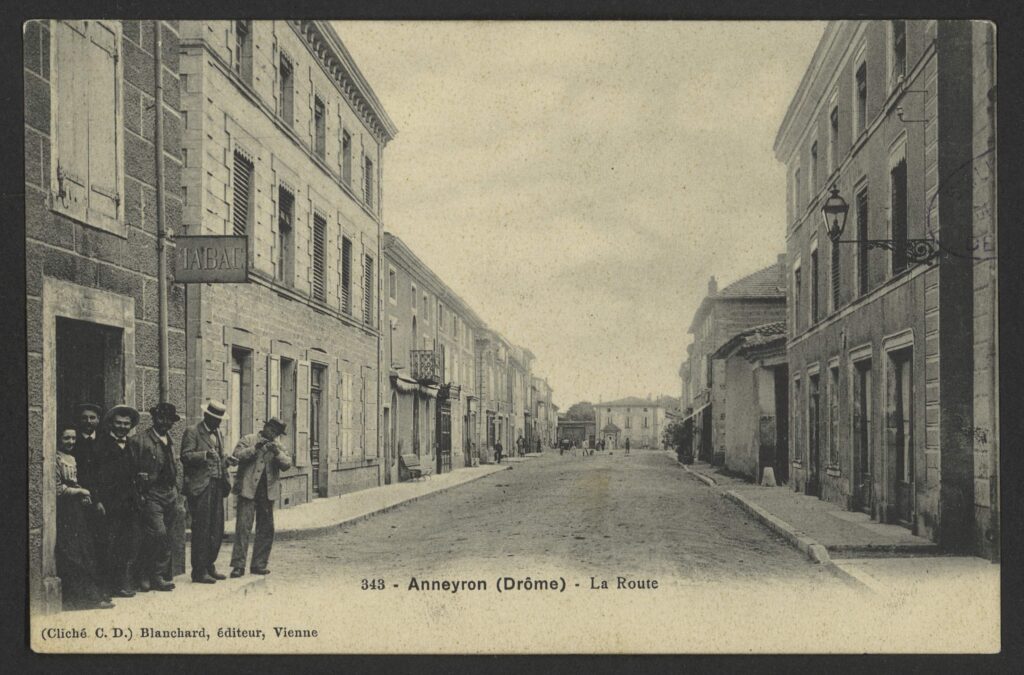
The industrial plot on Rue Victor Lafuma spans several hectares between the village center and surrounding orchard slopes. The architecture reflects the pragmatic functional evolution of twentieth-century light manufacturing: saw-tooth roof sheds (toits en shed) maximize uniform southern daylight across the textile stitching floors, while reinforced concrete portals support high-clearance metal fabrication wings.
Along the street frontage, original red-brick window surrounds, historic company entrance gates, and mature plane trees maintain the scale of an interwar company town. The municipal thoroughfare itself was renamed in honor of Victor Lafuma by the commune, acknowledging the decisive civic role played by the family in providing employment to generations of Drôme residents.
What you see today
Approaching the complex from the center of Anneyron, travelers encounter an active industrial and retail destination. While security and occupational safety standards limit unescorted access to the active prototyping and logistics bays, the exterior buildings, historic gables, and loading yards are clearly visible from Rue Victor Lafuma and Rue de Saleton.
Directly integrated into the historic site is the Village de Marques, an expansive factory boutique where visitors can purchase gear, examine archival outdoor clothing displays, and explore the ongoing craftsmanship of the Lafuma, Millet, and Eider outdoor brands. The venue welcomes tens of thousands of shoppers and hikers annually from the greater Lyon and Valence metropolitan areas.
Practical information and visits
- Visiting the factory store: The Village de Marques outlet is open Monday through Saturday from 10:00 to 19:00. Free public parking is provided on site.
- Industrial heritage trail: The municipal heritage path of Anneyron features information plaques detailing the history of the Lafuma family workshops and the development of local textile trades.
- Nearby amenities: The village center offers traditional Rhône bakeries, cafes, and access to local cycling routes across the Drôme des Collines.
Getting there
Anneyron is located approximately 65 kilometers south of Lyon and 40 kilometers north of Valence. By road, take the A7 autoroute (Autoroute du Soleil) exiting at Chanas (Exit 12), then follow the D1082 and D112 southward directly into Anneyron. The nearest regional railway stations are Saint-Rambert-d’Albon and Le Péage-de-Roussillon, which are served regularly by TER Auvergne-Rhône-Alpes trains from Lyon-Part-Dieu.
Related enterprise history
This place card documents the physical manufacturing complex, factory store, and urban site in Anneyron. For the commercial history, early tanning patents, and alpine expedition lore, read our companion magazine feature on the founding history of Lafuma (1930).
Sources
- Archives Départementales de la Drôme: Industrial census records, business registrations, and labor documentation relating to the Lafuma brothers’ workshop in Anneyron (1930–1940).
- Mairie d’Anneyron, Patrimoine Industriel Local: Municipal records documenting the expansion of the industrial district on Rue Victor Lafuma and the Village de Marques outlet center.
- Institut National de la Propriété Industrielle (INPI): Official patent records for Victor Lafuma’s landmark 1936 external-frame rucksack (brevet d’invention n° 815.640).
- OpenStreetMap: Parcel alignment and architectural building layout of Rue Victor Lafuma, Anneyron (Way 452712489).
Find it on the map
See this place and what’s around it →📷 Become a Cultural Heritage Online photographer
Share your photos of places: they stay published under your name as the author. The more they're seen, the more you get noticed — and soon a contest will reward the most appreciated photos.
Log in or sign up free to add a photo