
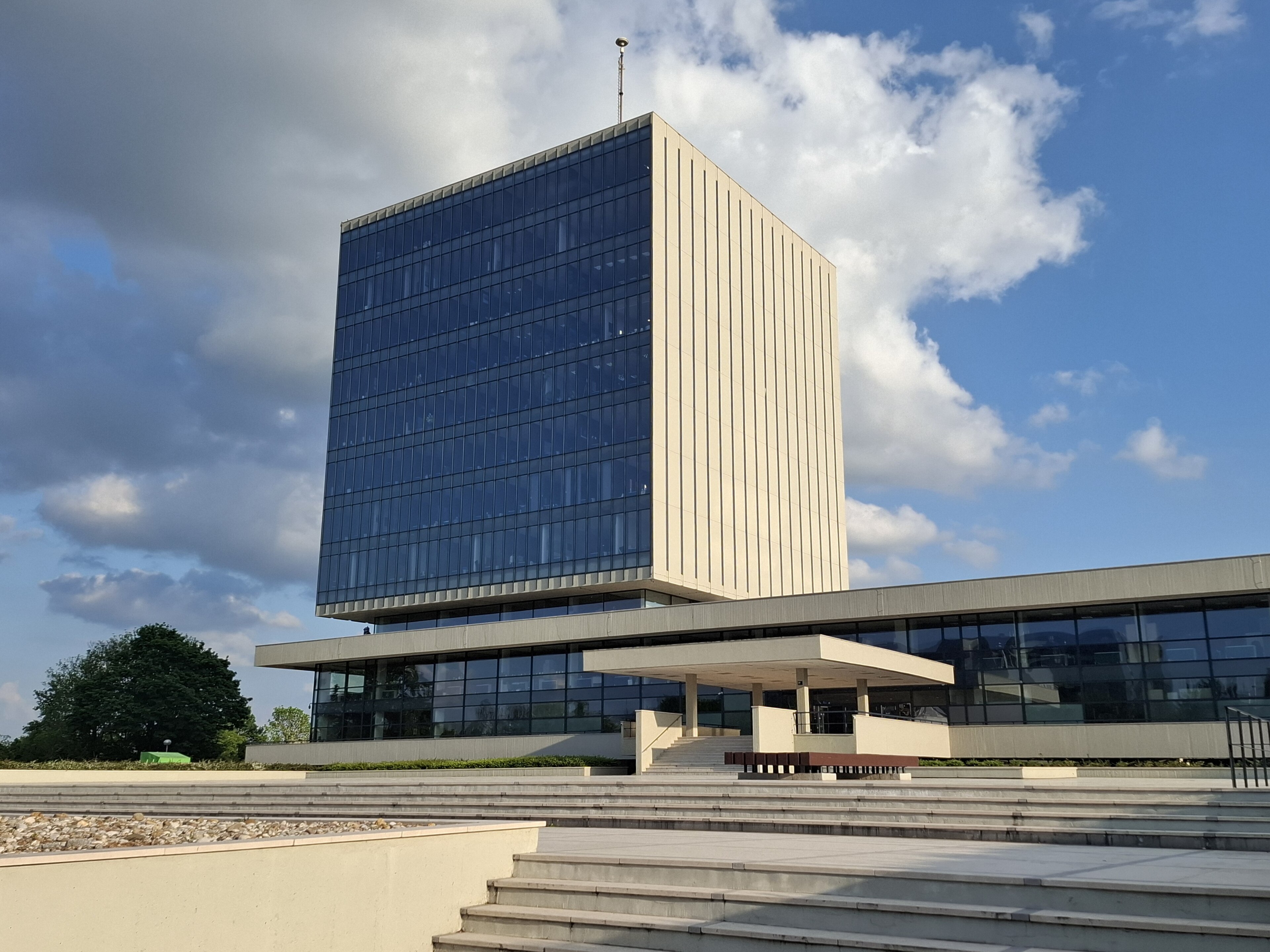
A ten-story modernist office building whose name—Croatian for “little cube”—captures its geometric form. Originally conceived as the nerve center of communist Yugoslavia, Kockica now houses Croatia’s maritime and tourism ministries.
At a glance
Kockica is a mixed-use structure of ten stories at Prisavlje 14 in Zagreb’s Trnje district. Designed by Croatian architect Ivan Vitić, it represents mid-century modernist architecture adapted to political purpose.
History
Construction began in 1963 under Yugoslavia’s communist regime, with the building intended to serve as headquarters for the Central Committee of the League of Communists of Croatia. The ambitious project faced an unexpected setback: the devastating 1964 Zagreb flood delayed progress significantly. Work resumed and the building was completed in 1968, surviving the political upheavals that would transform the region within two decades.
What you see
The building’s stark, rectilinear form—reflected in its playful name—exemplifies the functionalist aesthetic favored by socialist modernism. Ten stories rise from the street with clear horizontal and vertical lines, the cube-like structure dominating its corner site.
Cultural significance
Kockica embodies the architectural ambitions of mid-20th-century Yugoslavia and its capital. The building survived the transition from socialist federation to independent Croatia, adapting its purpose while retaining its distinctive modernist silhouette—a physical marker of historical continuity amid radical political change.
Key facts
- Location: Prisavlje 14, Zagreb, Trnje, Croatia
- Architect: Ivan Vitić
- Construction: 1963–1968
- Stories: 10
- Coordinates: 45.7907, 15.9688
- Current use: Ministry of Maritime Affairs, Transport and Infrastructure; Ministry of Tourism of Croatia
Practical information & getting there
Kockica is located on Prisavlje in Zagreb’s Trnje neighborhood, accessible by public transport. The building remains in active government use and is not open to general public visits.
Sources & resources
Find it on the map
See this place and what’s around it →📷 Become a Cultural Heritage Online photographer
Share your photos of places: they stay published under your name as the author. The more they're seen, the more you get noticed — and soon a contest will reward the most appreciated photos.
Log in or sign up free to add a photoIs this page about you?
This page is read by travellers and heritage enthusiasts who find it on Google. Tell us how you are connected to this place and we will take it from there.