

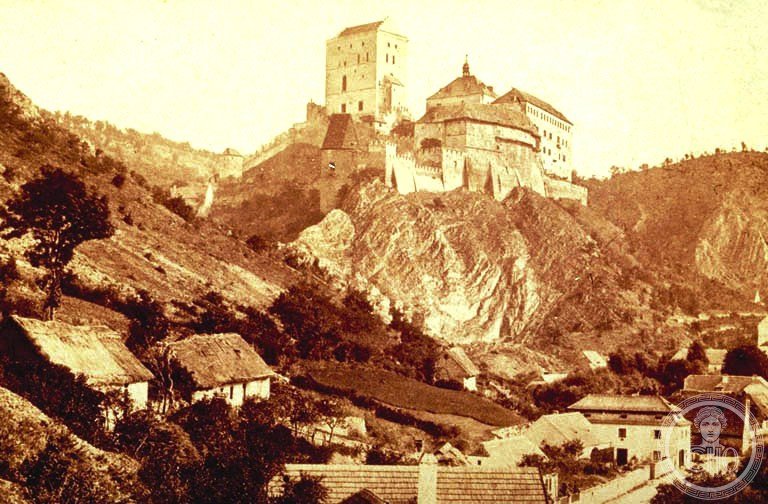
Charles IV did not build Karlštejn to live in. He built it as a strongbox: a castle rising in three stages up a limestone ridge, with the imperial regalia and the holy relics kept at the top, in a chapel whose walls are set with gemstones and hung with the largest surviving group of panel paintings by a single medieval workshop.
At a glance
- Type
- Royal castle, state-owned, administered by the Czech National Heritage Institute
- Where
- Karlštejn, Beroun district, Central Bohemian Region
- Coordinates
- 49.9401° N, 14.1874° E
- Founded
- 1348, by Charles IV, King of Bohemia and Holy Roman Emperor
- Finished
- 1365 — the Chapel of the Holy Cross consecrated on 9 February
- The chapel
- 129 panel paintings from the workshop of Master Theodoric
Overview
Karlštejn stands about 30 kilometres south-west of Prague, above the Berounka valley, and is among the most visited monuments in the country. Its shape is its purpose: the buildings climb the ridge in three stages, the Imperial Palace lowest, then the Church of Our Lady, and at the summit the Great Tower. What mattered most was kept highest and hardest to reach.
History
Charles IV founded the castle in 1348 as the place of deposit for the royal treasures — the collections of holy relics and the coronation jewels of the Empire. By 1355 he was staying here himself, overseeing the completion of the building and the decoration of the chapels. The castle was structurally finished in 1365, when the Chapel of the Holy Cross in the Great Tower was consecrated on 9 February.
The regalia did not stay as long as the castle’s reputation suggests. In 1421 Emperor Sigismund had the imperial and Bohemian crown jewels taken to Hungary; in the same year, and again in 1422, the Prague forces besieged Karlštejn without taking it. The royal furnishings were moved away for safety once more in 1619, during the Thirty Years’ War, and in 1620 the castle was taken by Field Marshal Karel Bonaventura Buquoy and placed under the imperial authority of Ferdinand II.
The building was altered repeatedly. Late Gothic work followed 1480; Renaissance interventions came in the later sixteenth century; the Burgrave’s Palace was extended with a wing built into the fortress well in the late Gothic manner of Saxony. On the date of that wing the sources part company: the castle administration puts the extension after 1500, while the Cultural Heritage Online archive entry dates the Burgrave’s Palace to the years 1520–1530. Both readings are recorded here rather than one being chosen.
The face the castle now presents is largely a nineteenth-century reconstruction. Work began in 1887 on designs prepared by Friedrich Schmidt in 1870; Josef Mocker directed it between 1892 and 1899, in the purist manner — that is, restoring the building to an idea of its original Gothic rather than to its accumulated state — and the campaign, including the roofing of the towers and the rebuilding of the connecting bridge, ran on to 1905.
What you see
The three levels are visited on separate routes. The Imperial Palace holds the residential halls; the Church of Our Lady in the middle tier keeps its wall paintings, among them the Apocalypse cycle; the Great Tower at the summit holds the Chapel of the Holy Cross.
The chapel is the reason the castle exists. Its lower walls are incrusted with semi-precious stones set into gilded and stamped pastiglia; above them runs a coffered wooden lining carrying the panel paintings from the Prague workshop of Master Theodoric, 129 of them, the largest such ensemble anywhere, completed by a triptych attributed to Tommaso da Modena. Access to the chapel is limited and must be booked in advance: the medieval interior cannot take large numbers.
Cultural significance
Karlštejn is the clearest surviving statement of what Bohemia meant inside the fourteenth-century Empire. Charles IV, who founded Prague’s university and began St Vitus Cathedral, made this castle the reliquary of his realm, and the painting in the Great Tower is not decoration but part of the argument: a chamber of saints, guarding the objects on which the imperial title rested.
Practical information
- Address: Karlštejn 172, 267 18 Karlštejn, Czechia.
- Several tour routes are sold separately. The Chapel of the Holy Cross is on a restricted route with a daily cap and must be reserved ahead.
- Opening is seasonal and the castle is generally closed on Mondays; check the official site, hrad-karlstejn.cz, for the current calendar and prices.
- The walk up from the village is steep and paved; allow twenty to twenty-five minutes.
Getting there
Trains run from Praha hlavní nádraží on the Prague–Beroun line to Karlštejn station in about forty minutes; from the station a signposted path crosses the river and climbs through the village to the gate. By car it is roughly 35 to 45 minutes from Prague via the D5.
Sources
- Správa státního hradu Karlštejn / Národní památkový ústav — official history of the castle
- Cultural Heritage Online historical archive — original Italian entry on beniculturalionline.it, verified and rewritten in August 2026.
Find it on the map
See this place and what’s around it →
Advertisement. Pictured, from the Cleveland Museum of Art (CC0) and not for sale: a parure of about 1850, a Lalique brooch, a Castellani bangle. How we handle this
📷 Become a Cultural Heritage Online photographer
Share your photos of places: they stay published under your name as the author. The more they're seen, the more you get noticed — and soon a contest will reward the most appreciated photos.
Log in or sign up free to add a photo