
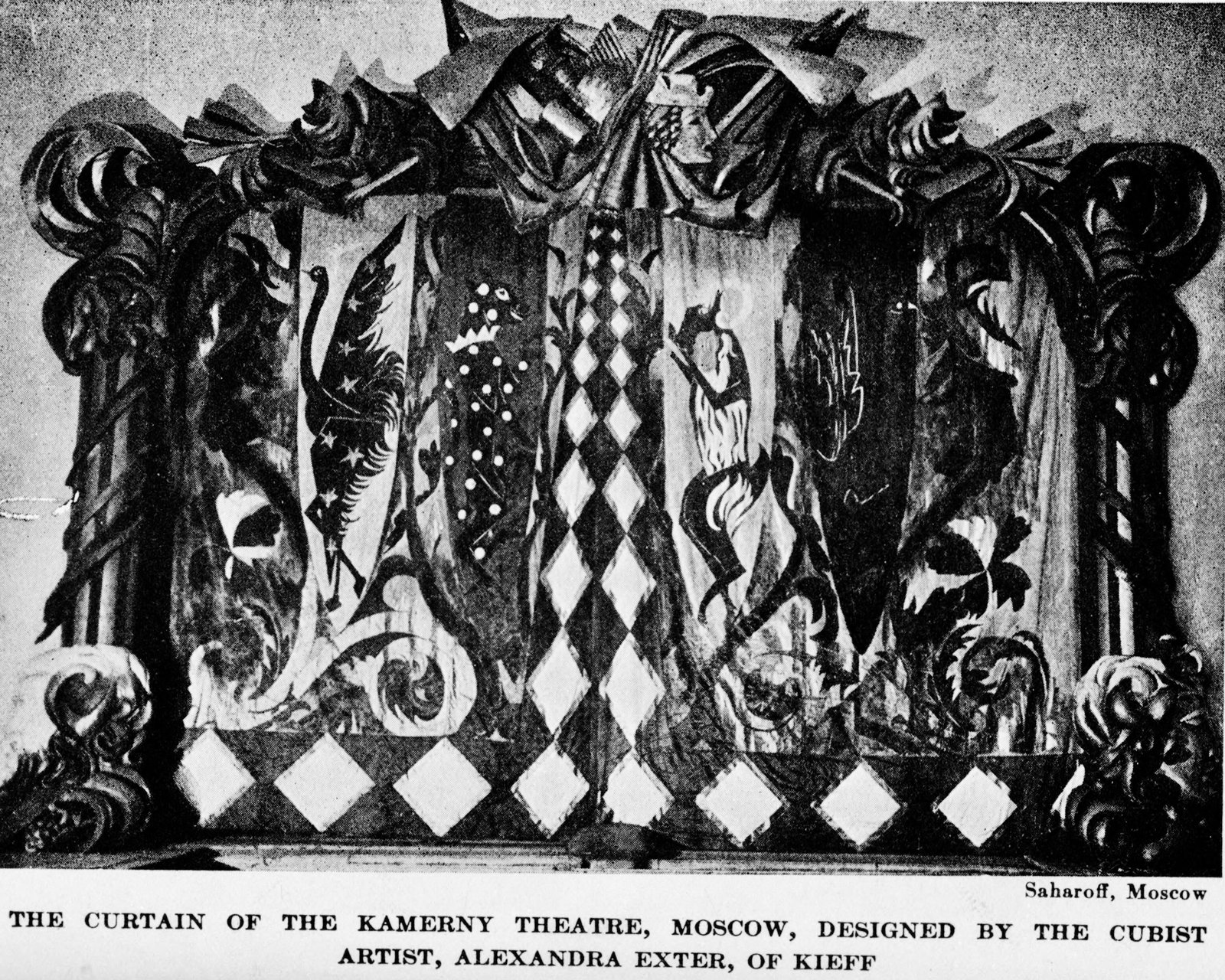
A small stage in Moscow became one of Russian theater’s boldest experiments, before politics closed its curtain for good.
At a glance
Founded in 1914 by director Alexander Tairov, the Kamerny Theatre operated for 35 years as an intimate chamber house. It grew into a recognized force in Russian theater, prized for its stylized productions and refusal of naturalism. The theater no longer exists as an institution, but its history remains a touchstone for scholars of Soviet-era stagecraft.
History
Tairov opened the Kamerny in 1914 with a clear ambition: reject both realism and crude melodrama. The company staged Princess Brambilla in 1920, then Phèdre and Giroflé-Girofla in 1922. Desire Under the Elms and Day and Night followed in 1926. The Negro appeared in 1929, The Beggars’ Opera in 1930, and Vishnevsky’s An Optimistic Tragedy in 1933. Through the upheaval of revolution and civil war, the theater kept politics at arm’s length. It leaned instead on a romantic idealism, drawing freely on classical material from east and west. That neutrality did not last. In 1928 the Kamerny staged Bulgakov’s Crimson Island, a satire that mocked the Soviet government openly. Stalin responded by branding it “a real bourgeois theater.” Suspicion of Tairov deepened; officials called him the last representative of “bourgeois aestheticism.” In 1937 the Realistic Theater was folded into the Kamerny. War brought further damage. Bombing during the siege of Moscow shut the theater down; it reopened only on December 25, 1943. Its final production, Chekhov’s The Seagull, opened in 1946. That same year the Communist Party condemned formalism in the arts. The Kamerny was shuttered in 1949 under the Zhdanov Doctrine.
What you see
The Kamerny was defined less by its architecture than by what happened onstage. Aleksandra Ekster, Tairov’s principal collaborator on set design, built environments in the constructivist idiom of the period. Angular platforms and abstracted forms replaced painted backdrops. Konstantin Medunetsky designed the theater’s decor. Together they gave the small house a visual language distinct from the naturalistic staging common elsewhere in Moscow.
Cultural significance
The Kamerny is remembered as a laboratory for anti-realist Russian theater. It bridged pre-revolutionary experimentation and the harsher cultural politics of Stalinism. Its closure in 1949 marks one endpoint of the Zhdanov Doctrine’s campaign against formalism. For theater historians, the Kamerny stands alongside Ekster’s stage designs as a case study in how constructivist visual art migrated onto the stage, and how quickly artistic independence could collide with state ideology.
Key facts
- Founded: 1914, by Alexander Tairov
- Location: Moscow, Russia
- Closed: 1949, under the Zhdanov Doctrine
- Key designer: Aleksandra Ekster (sets), Konstantin Medunetsky (decor)
- Final production: The Seagull, 1946
- Reopened after WWII damage: December 25, 1943
Practical information & getting there
The Kamerny Theatre no longer operates; the institution was dissolved in 1949. Visitors interested in its history should turn to archives, theater museums, and scholarship on Soviet-era Moscow rather than expect a surviving venue. Coordinates for the historical site place it in central Moscow, at 55.7619, 37.6025.
Sources & resources
Find it on the map
See this place and what’s around it →📷 Become a Cultural Heritage Online photographer
Share your photos of places: they stay published under your name as the author. The more they're seen, the more you get noticed — and soon a contest will reward the most appreciated photos.
Log in or sign up free to add a photoIs this page about you?
This page is read by travellers and heritage enthusiasts who find it on Google. Tell us how you are connected to this place and we will take it from there.