

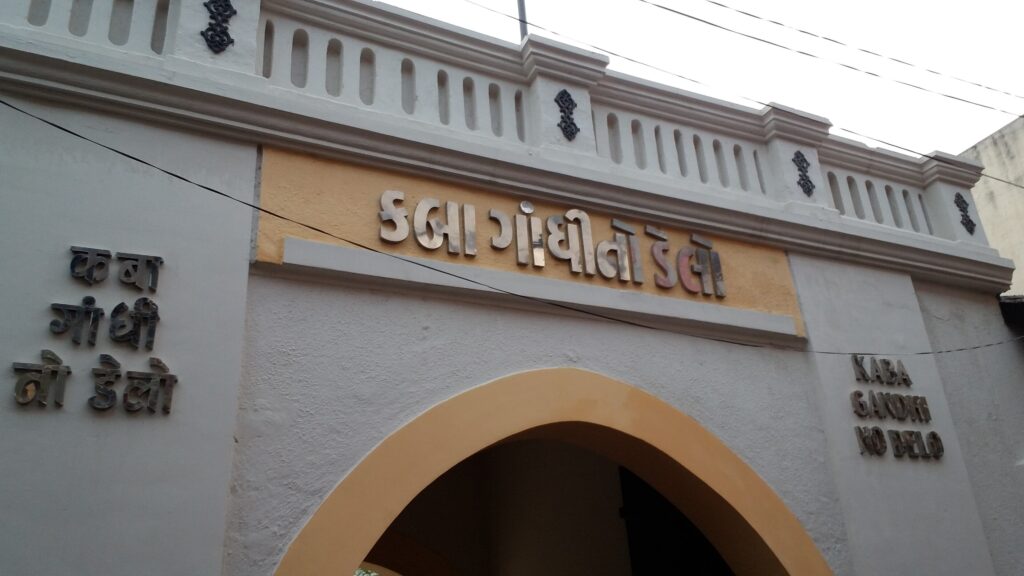
The family home where Mahatma Gandhi lived during formative years of his life, now a museum devoted to his memory and legacy.
At a glance
Kaba Gandhi No Delo—literally ‘Kaba Gandhi’s residence’—stands in Rajkot as both a domestic monument and a living archive. Built in traditional Saurashtrian style, the house served as Mahatma Gandhi’s family home from 1881 to 1887. Today it operates as a museum anchored by a permanent pictorial exhibition titled Gandhi Smriti.
History
The house became Gandhi’s residence in 1881, during a crucial period of his early life. According to Gujarat Tourism, Mahatma Gandhi lived here from 1881 to 1887 AD, the years of his boyhood in Rajkot. The home’s significance lies not in grand historical events but in the daily life and intellectual development of one of the twentieth century’s most consequential figures.
What you see
The building exemplifies traditional Saurashtrian architectural principles, the regional style of Gujarat’s Saurashtra peninsula. Its design reflects the domestic vernacular of merchant families in nineteenth-century Rajkot. The structure maintains period character while accommodating modern curatorial functions.
Cultural significance
Kaba Gandhi No Delo preserves the domestic context of Gandhi’s early years—a perspective often overshadowed by his later public prominence. The house connects visitors to Gandhi as a family member and developing intellectual, not merely as a historical icon. It anchors understanding of how personal and domestic spaces shaped one of history’s most influential leaders.
Key facts
- Country: India
- City: Rajkot, Gujarat
- Coordinates: 22.29706667, 70.80499722
- Residence period: 1881–1887
- Exhibition: Gandhi Smriti (permanent pictorial display)
Practical information & getting there
The museum is located in Rajkot, a city in western Gujarat. For current visiting hours, admission details, and access information, consult the museum directly or official tourism resources for Rajkot.
The house was the Rajkot residence of Gandhi’s father Karamchand, who lived there when he was appointed Diwan of Rajkot State.
Sources & resources
Find it on the map
See this place and what’s around it →📷 Become a Cultural Heritage Online photographer
Share your photos of places: they stay published under your name as the author. The more they're seen, the more you get noticed — and soon a contest will reward the most appreciated photos.
Log in or sign up free to add a photoIs this page about you?
This page is read by travellers and heritage enthusiasts who find it on Google. Tell us how you are connected to this place and we will take it from there.
This entry stays online and free either way — and a free account lets you add to it yourself.