

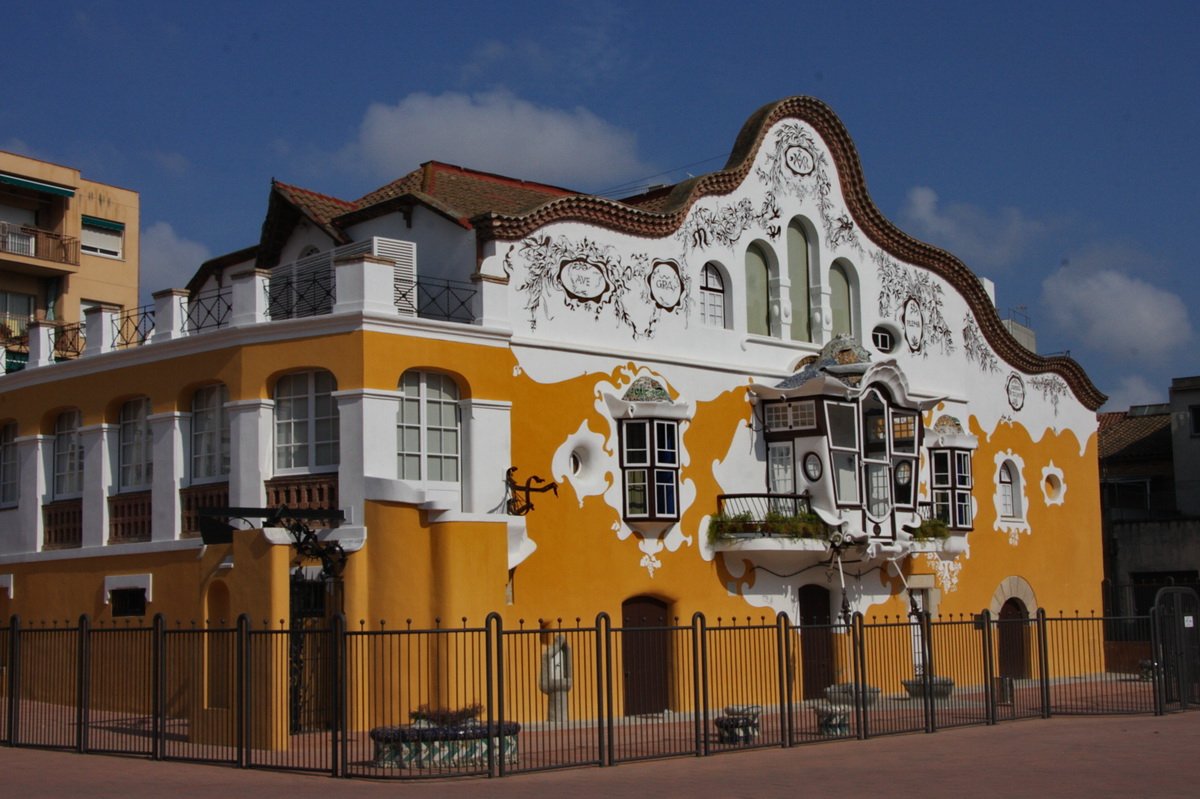
A 17th-century Catalan farmhouse transformed by Art Nouveau architect Josep Maria Jujol into a landmark of early modernist design.
At a glance
Can Negre began as a traditional masia, the robust farmhouse type of rural Catalonia. Between 1915 and 1930, Josep Maria Jujol undertook a comprehensive renovation that merged the building’s agricultural heritage with the fluid, organic principles of Art Nouveau. Today it operates as a cultural centre dedicated to his legacy.
History
The original structure dates to the 17th century, when it served as a working farmhouse in Sant Joan Despí, a village outside Barcelona. Jujol’s intervention in the early 20th century coincided with Catalonia’s creative ferment. His fifteen-year renovation project repurposed the masia as both residence and artistic statement, embedding modernist principles into vernacular architecture.
What you see
Jujol’s hand shaped every detail of Can Negre’s transformation. The renovation preserves the masia’s essential form while introducing Art Nouveau’s characteristic curves, decorative tile work, and integration of natural light. Interior and exterior spaces reflect Jujol’s belief in harmony between building and landscape—a signature approach of Catalan modernisme.
Cultural significance
Can Negre exemplifies the dialogue between tradition and innovation that defined early 20th-century Catalan design. Jujol’s work here demonstrates how modernist architects engaged with regional vernacular, elevating rural building types through artistic vision. The site now functions as a centre for understanding his broader architectural philosophy.
Key facts
- Country: Spain
- City: Sant Joan Despí
- Coordinates: 41.36743, 2.05784
- Original construction: 17th century
- Renovation by Josep Maria Jujol: 1915–1930
Practical information & getting there
Can Negre is located in Sant Joan Despí, a suburb southwest of Barcelona. The site now operates as the Jujol Centre, a cultural institution. Visit the Wikipedia article or Cultural Heritage Online for current opening hours and visiting details.
Sources & resources
Find it on the map
See this place and what’s around it →📷 Become a Cultural Heritage Online photographer
Share your photos of places: they stay published under your name as the author. The more they're seen, the more you get noticed — and soon a contest will reward the most appreciated photos.
Log in or sign up free to add a photoIs this page about you?
This page is read by travellers and heritage enthusiasts who find it on Google. Tell us how you are connected to this place and we will take it from there.