

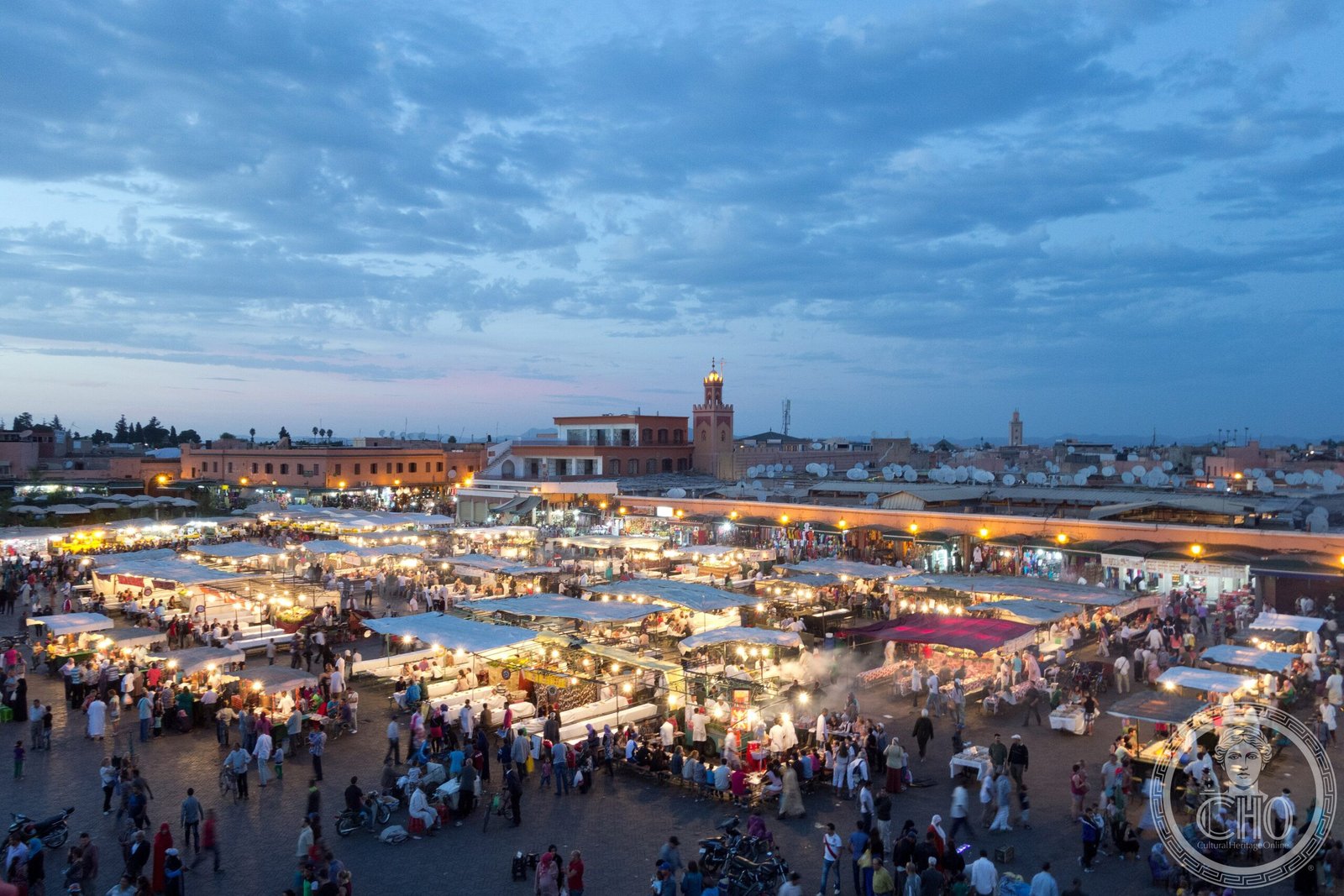
A bustling square at the heart of Marrakech’s medina, Jemaa el-Fnaa serves as the city’s primary gathering place—a living intersection of commerce, performance, and daily life where locals and visitors converge around food stalls, storytellers, musicians, and craftspeople.
At a glance
Jemaa el-Fnaa is the main square of Marrakech’s old city, functioning simultaneously as a marketplace, performance venue, and social hub. By day, the square fills with merchants selling food, spices, and goods; by evening, it transforms into a stage for musicians, acrobats, healers, and storytellers who draw audiences from across the city and beyond.
Origins and history
The square’s name translates to “Assembly of the Deceased” or “Mosque of the Lamp.” Its exact origins remain uncertain, though Jemaa el-Fnaa has long served as the medina’s central marketplace and gathering space, reflecting centuries of Marrakech’s urban life and commercial traditions.
The tradition today
Each day, the square pulses with activity. Food vendors arrange themselves in clusters offering tagines, grilled meats, and fresh juices. Snake charmers, henna artists, healers, and fortune-tellers occupy traditional spots. Musicians perform Moroccan folk songs and classical pieces. Storytellers in the evenings draw crowds speaking in Moroccan Arabic and Berber dialects, continuing oral traditions that have shaped the region for generations.
Cultural significance
Jemaa el-Fnaa embodies Morocco’s intangible cultural heritage—a democratic space where social classes mix, where commerce meets art, and where age-old performance traditions remain vibrant. It represents the continuity of Moroccan oral culture, street performance, and communal gathering in the modern world.
Key facts
- Country: Morocco
- Anchor community: Marrakech
- UNESCO Intangible Cultural Heritage (Representative List): Cultural Space of Jemaa el-Fna Square
- Location: Medina (old city) of Marrakech
- Primary users: Locals and tourists
Where to experience it
You can visit Jemaa el-Fnaa at any time of day or evening. The square is most vibrant in late afternoon and evening, when performers and crowds are at their peak. Entry is free; vendors and performers work informally, and engaging with them directly supports their livelihoods.
Sources & resources
Find it on the map
See this place and what’s around it →📷 Become a Cultural Heritage Online photographer
Share your photos of places: they stay published under your name as the author. The more they're seen, the more you get noticed — and soon a contest will reward the most appreciated photos.
Log in or sign up free to add a photo