
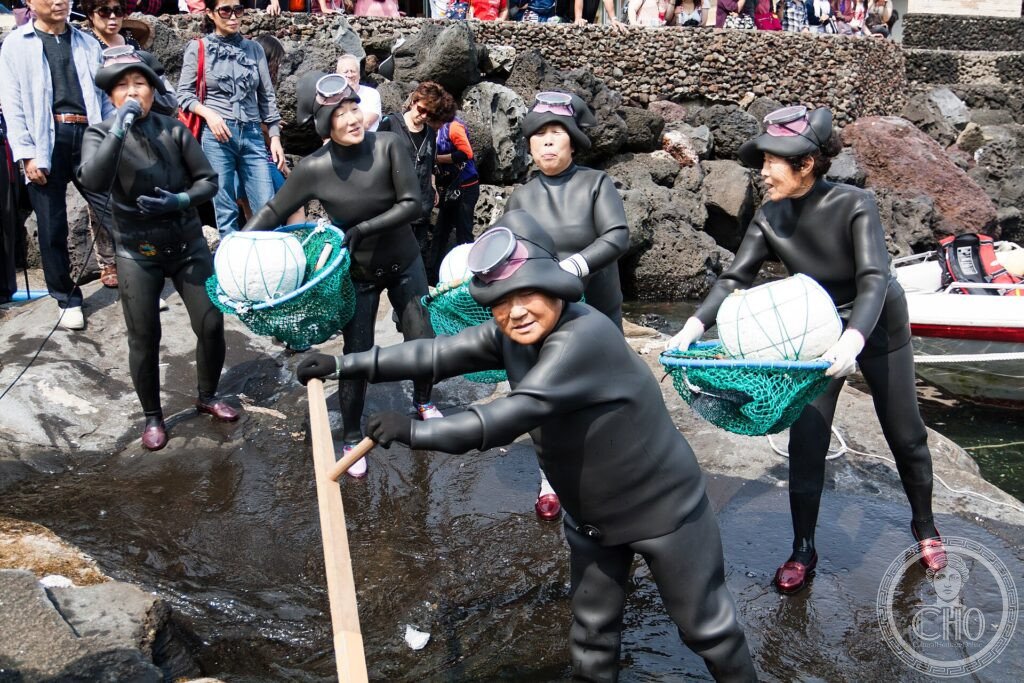
For generations, the haenyeo of Jeju have sustained their families through deep-sea diving, harvesting mollusks, seaweed, and other marine life without mechanical aids. Their practice embodies independence, resilience, and a distinctive semi-matriarchal way of life.
In UNESCO’s words
In Jeju Island, there is a community of women, some aged in their 80s, which goes diving 10m under the sea to gather shellfish, such as abalone or sea urchins for a living without the help of oxygen masks. With knowledge of the sea and marine life, the Jeju haenyeo (female divers) harvest for up to seven hours a day, 90 days of the year holding their breath for just one minute for every dive and making a unique verbal sound when resurfacing. Divers are categorised into three groups according to level of experience: hagun, junggun and sanggun with the sanggun offering guidance to the others. Before a dive, prayers are said to the Jamsugut, goddess of the sea, to ask for safety and an abundant catch. Knowledge is passed down to younger generations in families, schools, local fishery cooperatives which have the area’s fishing rights, haenyeo associations, The Haenyeo School and Haenyeo Museum. Designated by the provincial government as representating the island’s character and people’s spirit, the culture of Jeju haenyeo has also contributed to the advancement of women’s status in the community and promoted environmental sustainability with its eco-friendly methods and community involvement in management of fishing practices.
Official description, UNESCO Intangible Cultural Heritage List — Culture of Jeju Haenyeo (women divers)
At a glance
Jeju haenyeo are women divers who harvest shellfish such as abalone and sea urchins by diving to depths of 10 meters without oxygen masks. They work by holding their breath for approximately one minute per dive and make a distinctive verbal sound when resurfacing. Some divers continue this work into their 80s, spending up to seven hours a day in the water during a season of about 90 days per year. The haenyeo rely on their knowledge of the sea and marine life to sustain their livelihood.
Origins & history
Knowledge of haenyeo diving is passed down through families, schools, local fishery cooperatives, haenyeo associations, the Haenyeo School, and the Haenyeo Museum, ensuring the tradition reaches younger generations. The practice has been designated by the provincial government as representing Jeju Island's character and the spirit of its people. The haenyeo culture has contributed to advancing women's status in the community while promoting environmental sustainability through eco-friendly methods and community involvement in managing fishing practices.
The practice
Divers are organized into three skill levels: hagun, junggun, and sanggun, with the sanggun providing guidance to less experienced divers. Before diving, prayers are offered to Jamsugut, the goddess of the sea, requesting safety and an abundant catch. Each diver descends to the seafloor and works to gather shellfish using practiced techniques and knowledge of marine environments, holding their breath for roughly one minute during each dive.
Cultural significance
The haenyeo tradition represents a distinctive livelihood that has shaped Jeju society and elevated women's economic role in the community. Through controlling their own labor and income, these divers have maintained a form of independence. The practice demonstrates a sustainable approach to marine resources, combining traditional ecological knowledge with community stewardship of fishing grounds. Recognition as UNESCO Intangible Cultural Heritage acknowledges its importance to preserving Jeju's distinct identity and cultural legacy.
Key facts
- Country: Republic of Korea
- Inscribed: 2016
- UNESCO list: Representative List of the Intangible Cultural Heritage of Humanity
- UNESCO reference: 01068
- UNESCO vocabulary: Women workers
- Map: Jeju Island — the locality named in UNESCO’s official description of this element
- Related World Heritage site: Jeju Volcanic Island and Lava Tubes (a different UNESCO designation, not the place of the tradition)
Where to experience it
On Jeju Island, visitors can encounter haenyeo divers at work during daylight hours, particularly in summer months when water conditions are favorable. The Haenyeo Museum and The Haenyeo School offer opportunities to learn about this distinctive practice and meet practitioners who represent different experience levels, from hagun to the most skilled sanggun divers. Local fishery cooperatives and haenyeo associations throughout the island also preserve and teach the tradition, passing knowledge to younger generations while maintaining the community's deep connection to the sea and its sustainable practices.
Sources & resources
- UNESCO — official element page: Culture of Jeju Haenyeo (women divers)
- UNESCO — open data record: Intangible Heritage List, reference 01068
- UNESCO — official video: UNESCO film on this element — embedded on this page
- UNESCO — official photograph: Jeju haenyeo head to sea for the muljil — Jeju photography members — Haenyeo Museum, 2005
- Reference — Wikipedia (secondary): Haenyeo — consulted as a secondary reference, not as confirmation
- Cultural Heritage Online: Our archive and city guides

Find it on the map
See this place and what’s around it →📷 Become a Cultural Heritage Online photographer
Share your photos of places: they stay published under your name as the author. The more they're seen, the more you get noticed — and soon a contest will reward the most appreciated photos.
Log in or sign up free to add a photo