
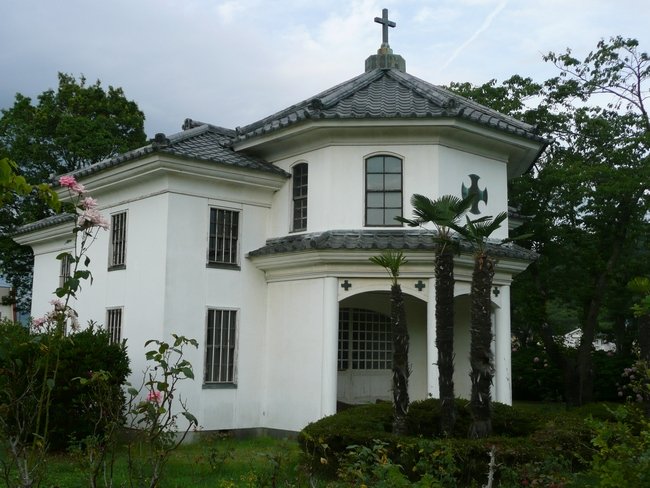
Japan’s oldest surviving wooden church, this Meiji-era Orthodox sanctuary stands as a remarkable testament to the early spread of Christianity in the Tōhoku region and to resilience in the face of natural disaster.
At a glance
Dedicated to St. John the Apostle, this wooden Orthodox church was completed in 1880 in Ishinomaki, Miyagi Prefecture. Its cross-shaped floor plan and octagonal portico reflect the architectural language of Western-style Meiji buildings adapted to local materials and sensibilities. The sanctuary occupies the second floor, connected to a tatami-matted first-floor meeting room by a steep staircase.
History
The church emerged from the missionary work of Ivan Dmitrievich Kasatkin (1836–1912), later canonized as St. Nicholas of Japan, who established the Japanese Orthodox Church in Tokyo during the early Meiji period. In 1877, 29 men from the Oshika District were baptized; a year later, 22 more converted to Orthodox Christianity. Within two decades, ten churches were built across the region.
Geopolitical upheaval devastated the fledgling community. The Russo-Japanese War (1904–1905) and the Soviet Union’s establishment in 1917 sparked anti-Russian sentiment, forcing many churches to close. The Saint John church, however, endured. After damage from the 1978 Miyagi earthquake, it was relocated to an island in the Kitakami River within a cultural park. The 2011 Tōhoku earthquake and tsunami caused severe flooding to the second story; restoration was completed in 2016.
What you see
The whitewashed wooden structure features a distinctive columned octagonal portico typical of Meiji-era Western architecture. Its cross-shaped floor plan gives the building symbolic resonance with Orthodox tradition. The roof is tiled; the interior divides into two functional zones—the tatami-covered first floor for gatherings and the carpeted sanctuary above, accessed by a narrow, steeply inclined staircase.
The architect remains unknown, possibly a local parishioner whose identity was not recorded.
Cultural significance
This church represents a rare and precious moment in Japanese religious history: the establishment of an Orthodox Christian community in the 1870s during Japan’s rapid Westernization. Its survival makes it the oldest wooden church building among existing wooden churches in Japan. The structure embodies both Orthodox theology and Japanese sensibilities—a fusion visible in its hybrid architectural language and spatial arrangement.
Designated an Important Cultural Property of Ishinomaki City in 1990, it reopened to the public in 2001 and continues to document the resilience of a small, vulnerable faith community across a century of challenge.
Key facts
- Country: Japan
- Location: Ishinomaki, Miyagi Prefecture, Tōhoku region
- Coordinates: 38.429144, 141.311113
- Built: 1880
- Designation: Important Cultural Property of Ishinomaki City (1990)
- Oldest surviving wooden church in Japan
Practical information & getting there
The church is located on an island in the Kitakami River as part of a cultural park that includes the Ishinomori Manga Museum. Ishinomaki is accessible by train and car from Sendai. Specific hours and admission details are best confirmed in advance, particularly following the 2016 restoration.
Sources & resources
Find it on the map
See this place and what’s around it →📷 Become a Cultural Heritage Online photographer
Share your photos of places: they stay published under your name as the author. The more they're seen, the more you get noticed — and soon a contest will reward the most appreciated photos.
Log in or sign up free to add a photoIs this page about you?
This page is read by travellers and heritage enthusiasts who find it on Google. Tell us how you are connected to this place and we will take it from there.