

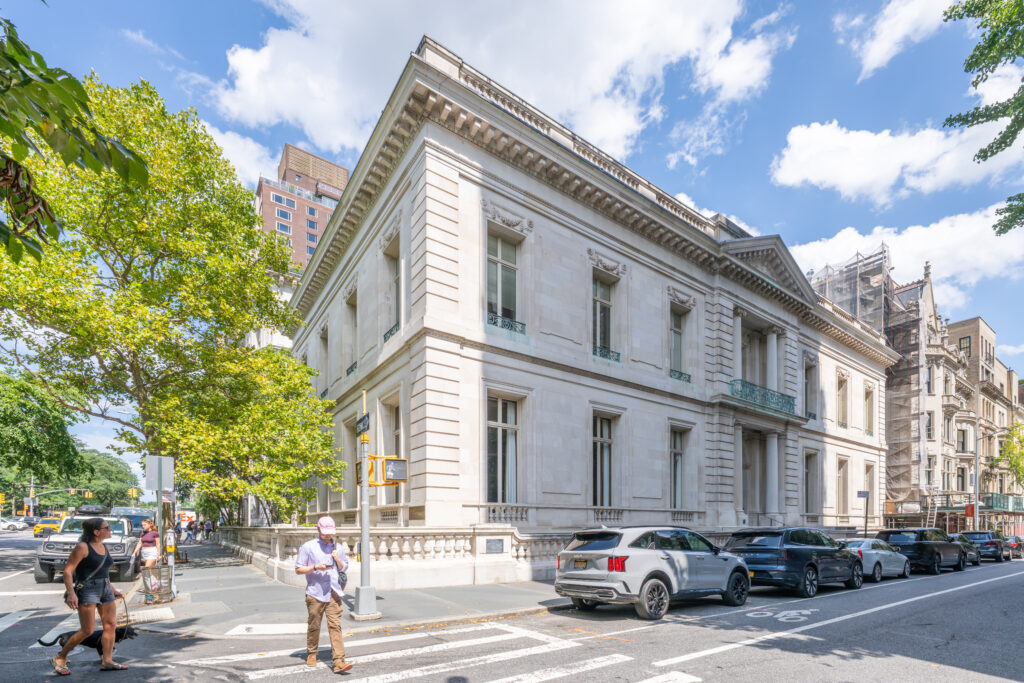
The Institute of Fine Arts, New York University's graduate school of art history and conservation, has worked since 1959 from the James B. Duke House, a limestone mansion of 1912 on East 78th Street.
At a glance
The Institute of Fine Arts stands at 1 East 78th Street, on the Upper East Side of Manhattan, in a house built for the Duke family in 1912. It teaches art history, conservation, archaeology and curatorial studies, and it takes graduate students only. A second building across the street, the Stephen Chan House, holds the Conservation Center.
Key facts
- Graduate institute of New York University
- In the James B. Duke House, completed in 1912
- House designed by Horace Trumbauer in the French Classical style
- Given to NYU by Nanaline and Doris Duke in 1958
- Teaching in the house since 1959
- Conservation Center across the street since 1983
- Excavations at Abydos, Aphrodisias and Selinunte
History
The institute traces its line back to the university itself. In 1831 the painter Samuel F. B. Morse became NYU's first professor of fine arts, teaching both the practice and the history of art. Art history became a field of study in 1922, when Fiske Kimball set out to build a programme in it. The graduate programme moved to the Upper East Side in 1932 so that it could teach inside the collections of the Metropolitan Museum. It took the name Institute of Fine Arts in 1937. Refugee scholars from Germany and Austria, Erwin Panofsky and Richard Krautheimer among them, gave it its character.
The house came later. Horace Trumbauer designed the James B. Duke House in 1912 in the French Classical style, taking the Château Labottière in Bordeaux as the model. It was one of the early works of the African American architect Julian Abele. The house was the private residence of the tobacco magnate James Buchanan Duke. In 1958 his widow and daughter gave it to NYU. Robert Venturi remodelled it for teaching before the year was out.
Conservation was added early. Two years after the gift, the institute became the first graduate programme to offer university training in conservation. The work began in the old kitchen and wine cellar of the Duke House. In 1983 the Conservation Center moved to the Stephen Chan House across the street, which gave it laboratories, classrooms and a library of its own. In 1973 the National Endowment for the Humanities called the institute a national asset. Its staff and students still dig, at Abydos in Egypt, at Aphrodisias in Turkey and at Selinunte in Italy.
What you see
The house reads as a mansion rather than a school. Two storeys of pale limestone face the street, and the ground floor is rusticated. Tall windows on the upper floor carry iron balconies, and a cornice runs below a balustrade at the roof. The corner turns into Fifth Avenue with the same detail as the street front.
The rooms behind that front are classrooms, offices and part of the institute's library. The Conservation Center works across the street at 14 East 78th Street, in laboratories, teaching rooms and a specialist library. Neither building is a museum. This is a graduate school at work, and the public sees it from the pavement.
Practical information
- 1 East 78th Street, New York, NY 10075, at the corner of Fifth Avenue
- A graduate institute of NYU, not a museum; the house is seen from the street
- The library and the Conservation Center serve students and researchers
- The Metropolitan Museum is a few blocks north, and the 6 train stops at 77th Street
Getting there
The house stands on East 78th Street where it meets Fifth Avenue, on the Upper East Side. The 6 train at 77th Street is three blocks east. The Metropolitan Museum is a short walk north along Fifth Avenue.
Nearby
- Metropolitan Museum of Art
- Central Park
- The Frick Collection
- Asia Society
Sources
Find it on the map
See this place and what’s around it →📷 Become a Cultural Heritage Online photographer
Share your photos of places: they stay published under your name as the author. The more they're seen, the more you get noticed — and soon a contest will reward the most appreciated photos.
Log in or sign up free to add a photoIs this page about you?
This page is read by travellers and heritage enthusiasts who find it on Google. Tell us how you are connected to this place and we will take it from there.
This entry stays online and free either way — and a free account lets you add to it yourself.