

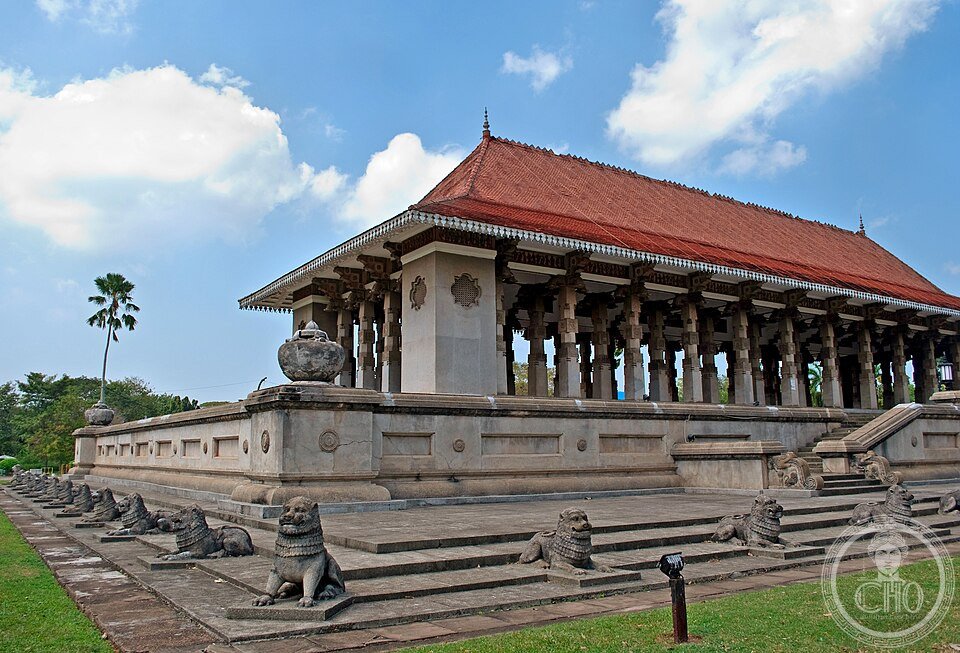
Built in the form of an ancient Kandyan throne room, this Colombo landmark is where the Sri Lankan flag was first raised on independence day — a deliberate architectural act of reclaiming Sinhalese heritage over colonial legacy.
At a glance
- Type
- National memorial hall
- Period
- 1953
- Style
- Sri Lankan Traditional / British Colonial
- Location
- Independence Square, Colombo 7, Sri Lanka
- Coordinates
- 6.9054, 79.8624
- Architect
- Shirley de Alwis
Overview
The Independence Memorial Hall stands in Colombo’s Independence Square as the principal monument of Sri Lankan nationhood. Completed in 1953 — five years after Ceylon gained independence from Britain on February 4, 1948 — the hall was designed by architect Shirley de Alwis as a deliberate architectural reference to the ancient Magul Maduwa, the Audience Hall of the Kandyan royal palace at Kandy. An open-sided pavilion of reinforced concrete, flanked by stone lions and surrounded by national statues, the hall is where the independence flag was first raised and where annual independence day celebrations are still held each February 4.
History
Ceylon declared independence on February 4, 1948, becoming a self-governing dominion within the British Commonwealth. At the time no permanent monument marked the event. Five years later, in 1953, the government commissioned and completed the Independence Memorial Hall as the physical embodiment of nationhood. The site chosen — Independence Square (then Royal College grounds) in Colombo’s Cinnamon Gardens district — was a deliberate displacement of the colonial social landscape: the green lawns of the colonial elite now hosting the nation’s founding symbol. The hall has since been the site of every official independence ceremony and numerous state functions. A major restoration in the early 2000s upgraded the landscaping of Independence Square and added fountains and pavilions to the surrounding park.
Architecture and Design
Architect Shirley de Alwis modelled the hall directly on the Magul Maduwa — the traditional open-sided audience hall of Kandyan kings — but built it in reinforced concrete to modern structural standards. The result is a hybrid: ancient in form, modern in material. Rows of timber-effect concrete columns support an elaborately bracketed roof of traditional Kandyan profile, with curved ridges and deep overhanging eaves. The interior is open on all sides, following the Kandyan tradition of a hall without walls — a space defined by columns and roof rather than enclosure. The floor is stone. Eight stone lions guard the four approaches. Bronze statues of national heroes flank the main axis. The surrounding Independence Square park, redesigned in the 2000s, frames the hall with reflecting pools and formal lawns.
Cultural significance
The hall embodies a specific post-colonial architectural politics: the conscious rejection of British colonial building typologies in favour of a pre-colonial Sinhalese form. This was not nostalgia but assertion — a statement that Sri Lankan independence meant the restoration of a distinctively Sinhalese cultural identity. The choice of the Kandyan throne room as model explicitly references the last independent Sinhalese kingdom, which the British finally conquered in 1815. The hall thus connects 1948 to 1815 as two moments in a continuous national narrative. That political framing has also attracted criticism, as it privileges Sinhalese-Buddhist heritage in a multi-ethnic, multi-religious nation. The Independence Memorial Hall remains central to public debate about Sri Lankan national identity.
Visiting today
Independence Square and the hall are open to the public daily and are among Colombo’s most pleasant public spaces. The surrounding park has jogging paths, a cafe pavilion, and fountains that are illuminated at night. The hall itself can be entered and walked through freely. Weekday mornings are quiet; weekends bring families and joggers. February 4 sees major ceremonies and is worth attending if in Colombo. Evening visits, when the hall and pools are lit, are particularly atmospheric. No entrance fee.
Getting there
Independence Square is in Colombo 7 (Cinnamon Gardens), the city’s most upscale district, about 4 km south-east of Fort (the colonial centre). Tuk-tuks and ride-share apps (PickMe, Uber) are the easiest way to arrive; specify “Independence Square Colombo.” The nearest bus routes stop on Baudhaloka Mawatha, a short walk from the square’s main gate. From Bandaranaike International Airport the journey is approximately 45-60 minutes. The square is walkable from the National Museum of Colombo (500 metres) and the Colombo National Hospital (1 km).
Sources and resources
Find it on the map
See this place and what’s around it →📷 Become a Cultural Heritage Online photographer
Share your photos of places: they stay published under your name as the author. The more they're seen, the more you get noticed — and soon a contest will reward the most appreciated photos.
Log in or sign up free to add a photoIs this page about you?
This page is read by travellers and heritage enthusiasts who find it on Google. Tell us how you are connected to this place and we will take it from there.