
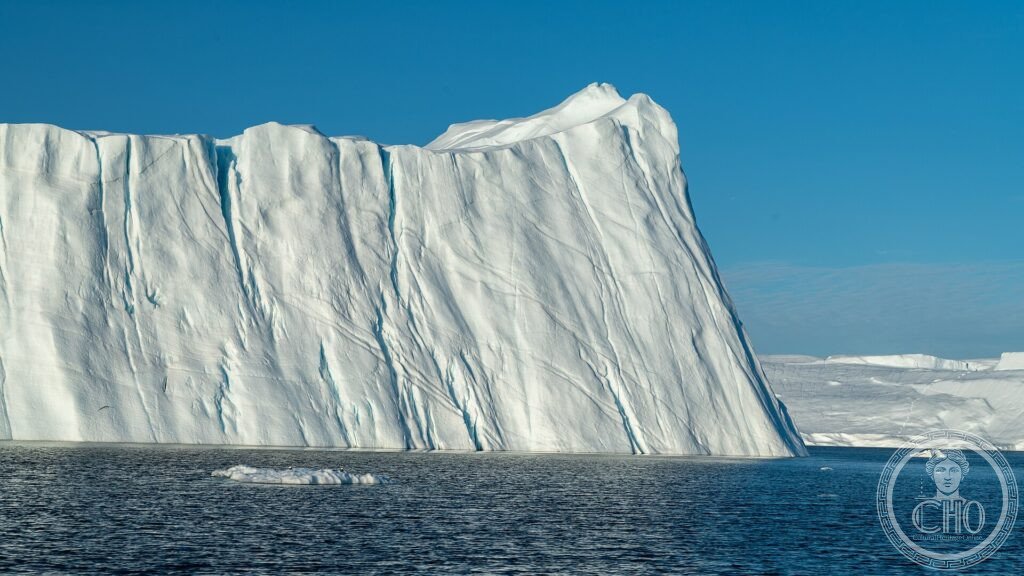
On the west coast of Greenland, one of the fastest and most active glaciers in the world pours into the sea, filling a fjord with colossal icebergs. The Ilulissat Icefjord is a grand spectacle and a laboratory of climate science: here the breathing of the great ice sheet can be watched as it happens.
At a glance
The Ilulissat Icefjord, on the west coast of Greenland, is where Sermeq Kujalleq, one of the fastest and most active glaciers in the world, meets the sea. The glacier pours huge quantities of ice into the fjord, which fills with colossal icebergs that drift slowly toward the open ocean. A scene of immense beauty and a key site for the study of ice and climate, the icefjord was inscribed by UNESCO in 2004.
Key facts
- UNESCO: World Heritage since 2004 (Ilulissat Icefjord)
- Sermeq Kujalleq: one of the world’s fastest-flowing glaciers
- Iceberg factory: the glacier calves vast amounts of ice
- Huge icebergs: some hundreds of metres tall, filling the fjord
- Climate science: a key site for studying ice and climate change
- Ancient settlement: long inhabited by Inuit hunters
History
The Greenland ice sheet, the largest body of ice outside Antarctica, drains in places through fast-moving outlet glaciers, and Sermeq Kujalleq is among the most productive of all, sending a great river of ice down to the sea at Ilulissat. The icebergs it calves are so large that they ground on the shallows at the fjord mouth, jamming together before breaking free to drift out to sea.
The area has been inhabited by Inuit hunters for thousands of years, drawn by the rich wildlife. In modern times the icefjord became central to glaciology and to the study of climate change, its glacier carefully monitored as it speeds up and retreats. It was inscribed by UNESCO in 2004 for both its beauty and its scientific importance.
What you see
From the town of Ilulissat, boardwalks and trails lead to viewpoints over the icefjord, where icebergs of every shape — sheer-walled, jagged, blue-veined — crowd the water below. Boat tours sail among the bergs and out toward the glacier front, and whales are often seen in the bay. In summer the midnight sun lights the ice through the night.
The scale and beauty of the icebergs, and the sense of witnessing the ice sheet at work, make Ilulissat unforgettable.
Practical information
- Site: boardwalks from Ilulissat town; boat tours among the icebergs
- Best time: summer, for the icebergs and midnight sun
- Time needed: one to two days
- Note: reached by air or sea; dress for the cold even in summer
Getting there
The Ilulissat Icefjord is by the town of Ilulissat on the west coast of Greenland, about 350 km north of the Arctic Circle, reached by air from Greenland and Denmark. GPS: 69.10° N, 51.10° W.
Nearby
- Ilulissat town — the colourful settlement beside the fjord
- Disko Bay — the iceberg-filled bay and its whales
- Greenland ice sheet — the vast ice cap feeding the glacier
Sources
- UNESCO World Heritage Centre — “Ilulissat Icefjord” (ref. 1149)
- Government of Greenland — official body
- Encyclopaedia Britannica — Greenland; Jakobshavn Glacier
Find it on the map
See this place and what’s around it →📷 Become a Cultural Heritage Online photographer
Share your photos of places: they stay published under your name as the author. The more they're seen, the more you get noticed — and soon a contest will reward the most appreciated photos.
Log in or sign up free to add a photo