
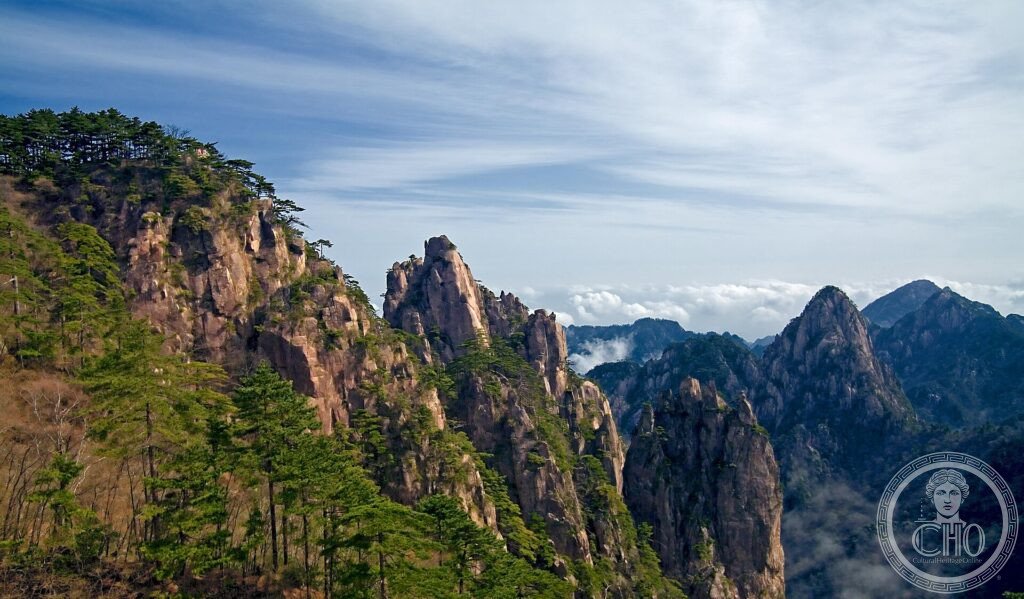
Granite peaks emerging from a sea of cloud, twisted pines clinging to the rock, hot springs: Mount Huangshan is the most celebrated mountain in China, sung by poets and painted by generations of artists. Its forms have shaped the very idea of landscape in Chinese painting.
At a glance
Mount Huangshan (“Yellow Mountain”) in Anhui is the most celebrated mountain in China, renowned for its granite peaks emerging from seas of cloud, its gnarled pines clinging to the rock, its hot springs and the play of mist and light. For more than a thousand years it has inspired Chinese poetry and painting, shaping the classic image of the mountain landscape. Both a natural wonder and a cultural icon, it was inscribed by UNESCO in 1990.
Key facts
- UNESCO: World Heritage since 1990, a mixed cultural and natural site
- Granite peaks: dozens of named summits of weathered granite
- Sea of clouds: the famous clouds that fill the valleys below the peaks
- Huangshan pines: gnarled pines rooted in the bare rock
- Cultural icon: the model of mountain landscape in Chinese art
- Hot springs: long valued for bathing at the mountain’s foot
History
Long a place of Daoist retreat, Huangshan gained lasting fame in the Tang and especially later dynasties, when poets and painters made pilgrimages to its peaks and immortalised them in verse and ink. The “Shanshui” (mountain-water) school of painting drew its ideal of the sublime landscape — sheer peaks, mist, twisted pines — from mountains like this one, so that Huangshan became as much a cultural as a natural monument.
Pavilions, stairways and inscriptions were carved into the rock over the centuries for pilgrims and travellers. Today cable cars and stone paths carry visitors to the summits, where the interplay of cloud and peak continues to draw photographers and artists.
What you see
Stone stairways and cable cars climb to the high ridges, where named peaks — the Lotus Peak, the Bright Summit, the Celestial Capital — rise above the clouds. Ancient pines such as the Welcoming Pine cling to the cliffs, and viewpoints frame the sea of clouds at dawn. Hot springs lie at the mountain’s base.
The shifting mist that wraps and reveals the peaks is the essence of the Huangshan experience.
Practical information
- Access: cable cars and stone paths to the summit area
- Time needed: one to two days, often with an overnight on the mountain
- Best time: for the sea of clouds, after rain or at dawn
- Note: can be crowded; weather changes quickly at altitude
Getting there
Mount Huangshan is in southern Anhui province, eastern China. Huangshan city (Tunxi) has rail and air links; buses and cable cars reach the mountain. GPS: 30.13° N, 118.16° E.
Nearby
- Hongcun and Xidi — the UNESCO ancient Huizhou villages nearby
- Tunxi old street — the historic street of Huangshan city
- Huizhou countryside — tea hills and old villages
Sources
- UNESCO World Heritage Centre — “Mount Huangshan” (ref. 547)
- Huangshan Scenic Area — official administration
- Encyclopaedia Britannica — Huang Mountains
Find it on the map
See this place and what’s around it →📷 Become a Cultural Heritage Online photographer
Share your photos of places: they stay published under your name as the author. The more they're seen, the more you get noticed — and soon a contest will reward the most appreciated photos.
Log in or sign up free to add a photo