
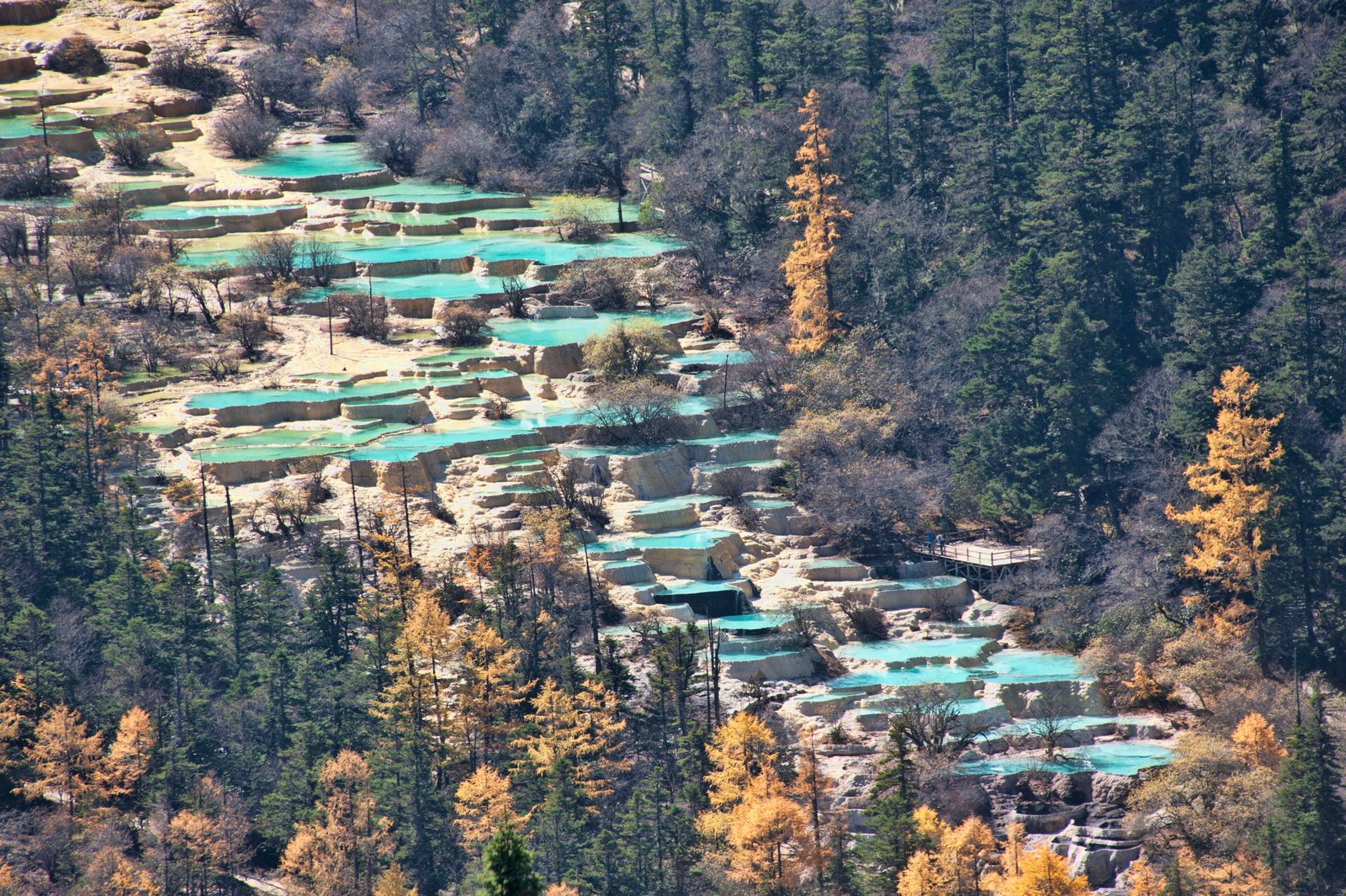
A landscape of extraordinary mineral pools and alpine wilderness in northwest Sichuan, where calcite deposits have painted the mountainside in shades of yellow, white, and jade.
At a glance
Huanglong—meaning “yellow dragon”—is a 3,400-meter alpine plateau renowned for its colorful travertine formations and intact forest ecosystems. Located 370 kilometers north-northwest of Chengdu in the Minshan mountains, the site encompasses dramatic natural features including cascading travertine pools, snow-capped peaks, and geothermal springs. The landscape supports diverse wildlife, including giant pandas and Sichuan golden snub-nosed monkeys.
History
Huanglong’s geological story spans millennia, shaped by mineral-rich waters flowing across limestone bedrock. The travertine terraces and pools have formed continuously through calcite deposition, creating the distinctive topography visible today. UNESCO recognized this outstanding natural laboratory in 1992, designating it a World Heritage Site for its travertine formations, waterfalls, and limestone geology—phenomena ranking among the three most exceptional examples worldwide.
What you see
The focal point is Huanglonggou (Yellow Dragon Gully), a ravine where mineral-laden water cascades over calcite barriers, forming pools of striking blue-green and yellow hues. Travertine terraces rise in stepped formations across the valley floor. Above this painted landscape, the terrain transitions to coniferous forest and alpine meadow, punctuated by waterfalls fed by snowmelt. Hot springs emerge from the bedrock, evidence of geothermal activity beneath the plateau.
Cultural significance
Huanglong represents a pristine example of travertine landscape evolution in a high-altitude setting. The site is equally important as habitat: it protects populations of endangered giant pandas, Sichuan golden snub-nosed monkeys, and a large endemic population of Cypripedium plectrochilum, a rare orchid species. The integration of dramatic geology with thriving biodiversity makes Huanglong significant for both earth science and conservation.
Key facts
- Country: China
- Region: Sichuan Province, Minshan mountain range
- Distance from Chengdu: 370 kilometers (230 miles) north-northwest
- Coordinates: 32.7432°N, 103.833°E
- UNESCO World Heritage Site: Designated 1992
- Notable species: Giant panda, Sichuan golden snub-nosed monkey, Cypripedium plectrochilum orchid
Practical information & getting there
Huanglong is accessible from Chengdu via regional transportation links to the site entrance. Most visitors approach from the town of Songpan. The high altitude—reaching 3,400 meters—requires acclimatization. Spring and autumn offer optimal conditions for visiting. Consult current travel advisories and UNESCO resources for access details and visitor facilities.
Sources & resources
Find it on the map
See this place and what’s around it →📷 Become a Cultural Heritage Online photographer
Share your photos of places: they stay published under your name as the author. The more they're seen, the more you get noticed — and soon a contest will reward the most appreciated photos.
Log in or sign up free to add a photo