
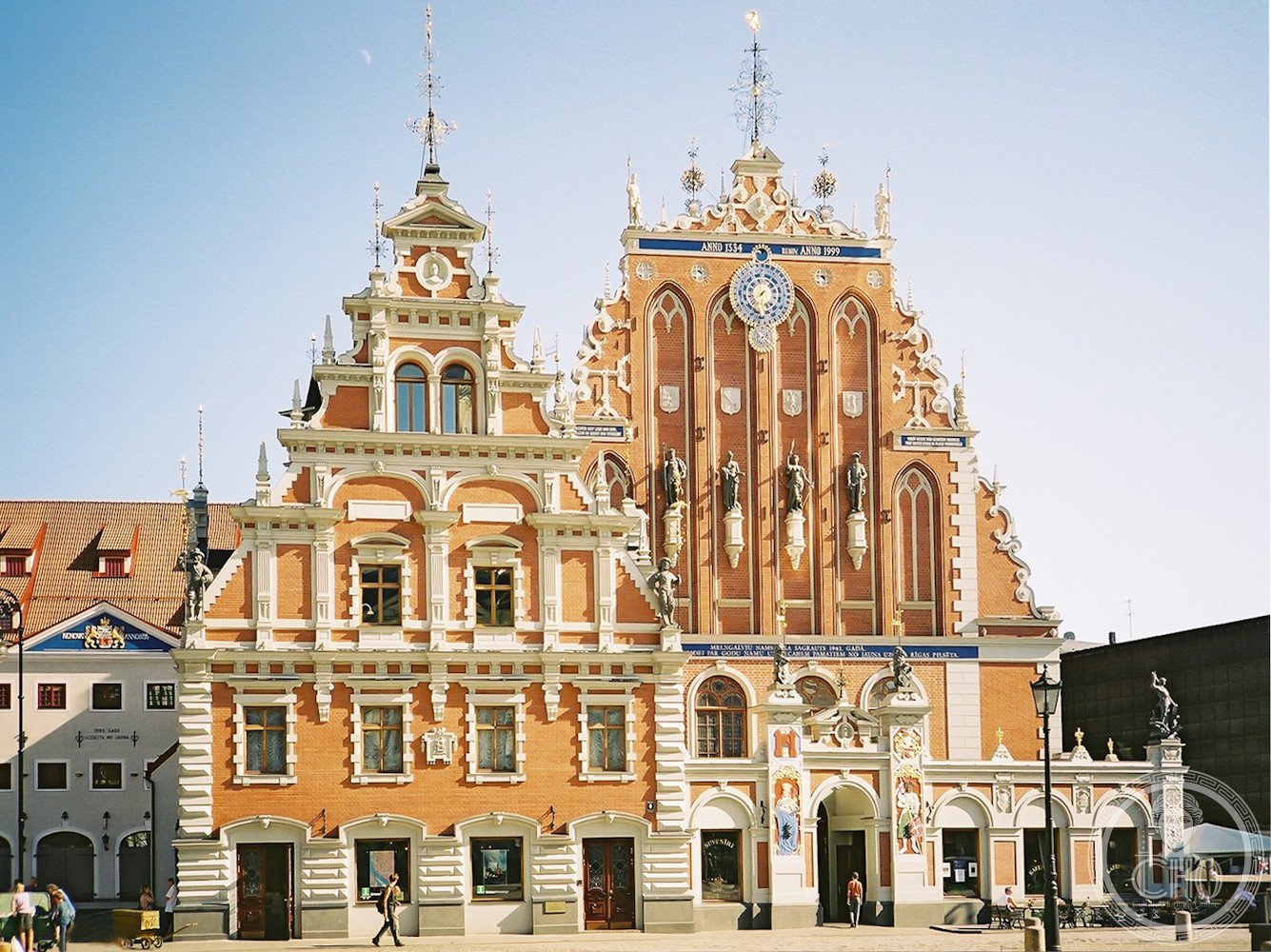
First recorded in 1334, blown up by the Soviet authorities in 1948 and rebuilt from the ground in the 1990s, the guild house on Riga’s town hall square carries an inscription that reads: if I were ever to collapse, raise me up once again.
At a glance
- First recorded
- 1334, as part of the town hall square ensemble
- Original name
- The New House of the Great Guild
- The brotherhood
- Compagnie der Schwarzen Häupter, recorded from 1413
- Destroyed
- Bombed in June 1941; the ruins detonated by the Soviet authorities in 1948
- Rebuilt
- Excavations 1992, construction from 1996, consecrated 9 December 1999
- Location
- Rātslaukums 7, Vec̄rīga, Riga
Overview
The building on the town hall square is the most photographed facade in Riga and one of the youngest: what stands there was completed in 1999. It is a full reconstruction of a house first recorded in 1334, rebuilt many times from 1522 onward, and destroyed within living memory.
It was built as the New House of the Great Guild, where merchants and burghers, predominantly of German descent, held their meetings. The Blackheads were tenants there from the middle of the fifteenth century and became its sole occupants in the seventeenth, taking full ownership only in 1713.
History
The name has nothing to do with hats, as is often written. The brotherhood took as its guardian Saint Maurice, commander of a Roman legion, an African who died a martyr by beheading; the image of a moor’s head became the association’s emblem and entered its coat of arms. The Blackheads were unmarried foreign merchants, chiefly of Low German descent — not, as is sometimes said, a guild of Latvian traders. Records of the brotherhood begin in 1413.
Their house received tsars, Swedish kings and Kaiser Wilhelm II. Richard Wagner, for three years Kapellmeister of the Riga city theatre, gave evening concerts in its hall; a plaque recalls it.
The brotherhood left Riga in 1940 on the Soviet annexation, resettling first in Hamburg and then Bremen, where it still exists and still uses its preserved statutes and its silver. The house itself was badly damaged in June 1941 during the German advance, and in 1948 the Soviet authorities detonated the ruins for ideological reasons.
Archaeological excavation of the site began in 1992. Construction, by Rīgas nami, began in 1996, part-funded by public donation, and the rebuilt house was consecrated on 9 December 1999, timed to the eight-hundredth anniversary of Riga.
What you see
The facade carries an astronomical clock and lions guarding Hanseatic coats of arms. Over the portal runs the inscription that has become the building’s motto: if I were ever to collapse, raise me up once again. It was written long before the events that gave it its second meaning.
Inside, the medieval cellars belong to the structure of 1334 and are the oldest thing here. The nineteenth-century-style cabinets hold the largest collection of silver in the Baltic states. Those rooms had a recent public use: from 2012 to 2016, while Riga Castle was being rebuilt, they served as the working residence of the President of Latvia.
Cultural significance
The building stands within the Historic Centre of Riga, inscribed on the UNESCO World Heritage List in 1997 under criteria (i) and (ii). The inscribed property is the whole central part of the city and expressly includes the well-preserved medieval core in which the town hall square lies. The house is not itself a listed World Heritage site; it stands inside one.
Practical information
- Address: Rātslaukums 7, Riga
- Open: daily 10:00–17:00
- Tickets: adults €10; pupils, students and seniors €6; pre-school children and visitors with 60% disability free; family tickets €18 and €23; groups of ten or more €9 and €5
- Audioguide €4 in twelve languages; guided tours €45 in Latvian, €55 in English
- Official site: melngalvjunams.lv
Sources
- Melngalvju nams, official history of the house and the brotherhood — melngalvjunams.lv
- Melngalvju nams, visiting information and admission
- Latvijas Sabiedriskie Mediji (LSM), Latvian public service media, on the brotherhood, the 1948 demolition and the reconstruction
- UNESCO World Heritage Centre, Historic Centre of Riga, inscribed 1997, ref. 852 — whc.unesco.org
Find it on the map
See this place and what’s around it →📷 Become a Cultural Heritage Online photographer
Share your photos of places: they stay published under your name as the author. The more they're seen, the more you get noticed — and soon a contest will reward the most appreciated photos.
Log in or sign up free to add a photoIs this page about you?
This page is read by travellers and heritage enthusiasts who find it on Google. Tell us how you are connected to this place and we will take it from there.