
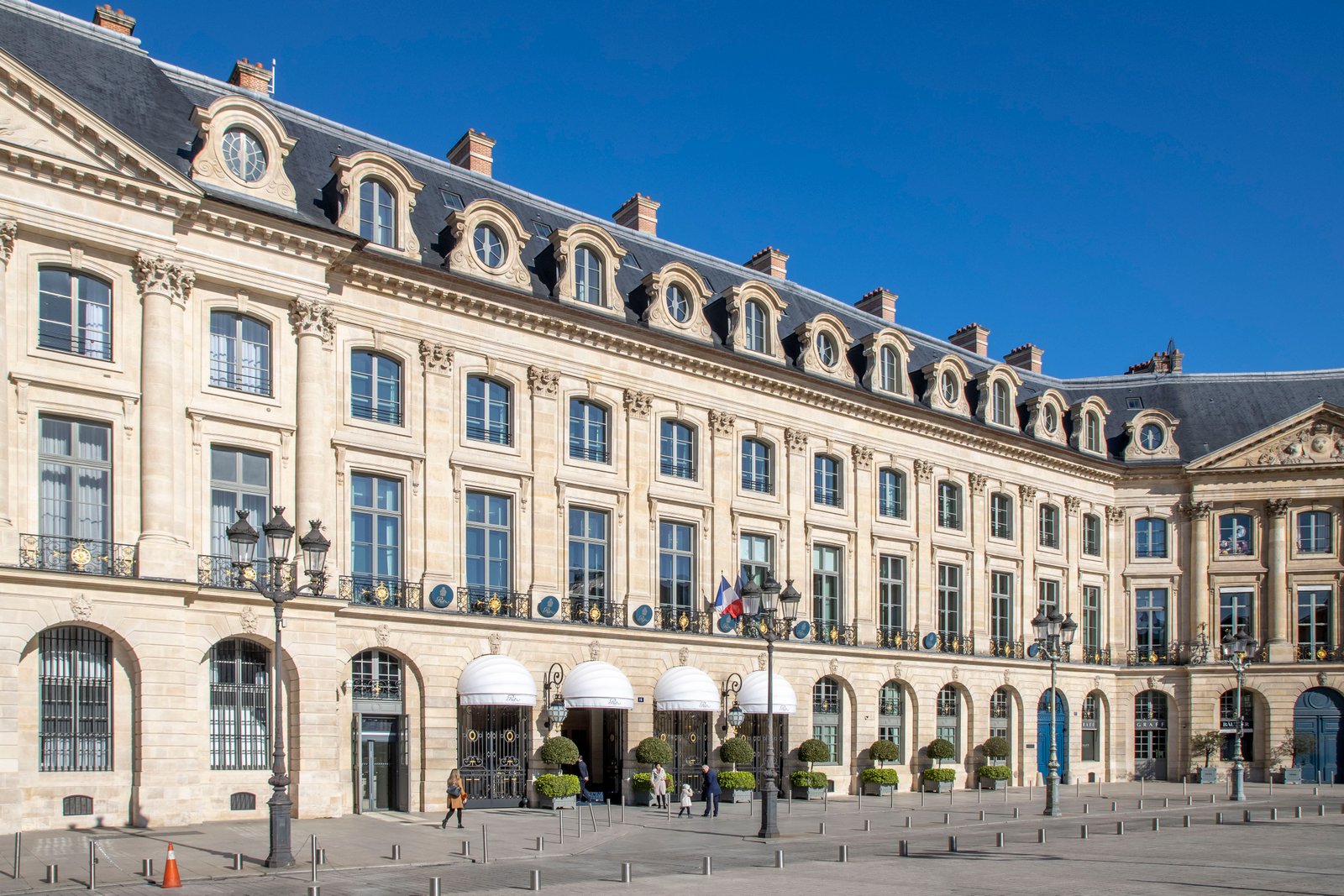
Since 1 June 1898 the Ritz has faced the Place Vendôme as the hotel that taught Europe what luxury could mean: a private bathroom behind every door, and a guest list that ran from Proust to Chanel.
At a glance
The Ritz Paris stands on the north side of the Place Vendôme, in the 1st arrondissement. César Ritz built it as a working argument that a hotel could be as hygienic as it was grand. It was among the first hotels in Europe to give every room electricity, a telephone, and a private bathroom, and it remains a member of The Leading Hotels of the World.
History
The Swiss hotelier César Ritz bought two eighteenth-century mansions on the square — the former residences of the Dukes of Lauzun and Gramont — together with a rear building facing the rue Cambon. He commissioned the architect Charles-Frédéric Mewès (1858–1914) to fuse them into a single hotel behind the protected Place Vendôme façade. The Ritz opened on 1 June 1898, with the chef Auguste Escoffier running its kitchens.
Mewès solved the problem of light and plumbing with interior ventilation courtyards, which let him give each suite its own bathroom — a first for a grand hotel. The reputation built quickly. Marcel Proust and Ernest Hemingway were early patrons, and Coco Chanel kept an apartment here for more than three decades. The hotel was renovated under Mohamed Al-Fayed from 1980 to 1987, and closed for a four-year restoration from 2012 to 2016.
What you see
The Place Vendôme front is a listed Historic Monument: columns, pediments and balustrades from the seventeenth and eighteenth centuries, kept so the hotel reads as part of the royal square rather than an intrusion on it. Behind that façade, Mewès’s interiors stage a restrained Belle Époque grandeur.
Fifteen prestige suites carry the names of former guests — Gabrielle Chanel, F. Scott Fitzgerald, the Duke and Duchess of Windsor, Charlie Chaplin, Maria Callas. The Suite Impériale is itself classified as a national monument, and the Bar Hemingway keeps the name of one of the hotel’s most devoted patrons.
Cultural significance
More than a hotel, the Ritz became shorthand for a certain idea of refined society. Its early guests included Marcel Proust, and its blend of discretion, cuisine and comfort set a template that later grand hotels across Europe would follow. A century on, it is still one of the small group of Paris hotels that define the city’s luxury tradition.
Key facts
- Founded: opened 1 June 1898 by César Ritz, with chef Auguste Escoffier
- Architect: Charles-Frédéric Mewès (1858–1914)
- Location: Place Vendôme, 1st arrondissement, Paris
- Innovation: among Europe’s first hotels with electricity, a telephone and a private bathroom in every room
- Status: listed Monument Historique façade; Suite Impériale classified as a national monument
Practical information & getting there
The hotel faces the Place Vendôme, a short walk from the Tuileries gardens and the Opéra Garnier. Nearest Métro: Opéra (lines 3, 7, 8) or Concorde (lines 1, 8, 12). The bars, restaurants and the École Ritz Escoffier cooking school are open to non-residents; the public entrance and Bar Hemingway are on the rue Cambon side.
Sources & resources
- Historic Hotels Then & Now — Ritz Paris (1898): historichotelsthenandnow.com/ritzparis.html
- Sortiraparis — “The Ritz Paris, the timeless legend of Place Vendôme”
- Culturezvous — “The Ritz, or the beginnings of the modern hotel business”
- Official site: ritzparis.com
Find it on the map
See this place and what’s around it →📷 Become a Cultural Heritage Online photographer
Share your photos of places: they stay published under your name as the author. The more they're seen, the more you get noticed — and soon a contest will reward the most appreciated photos.
Log in or sign up free to add a photoIs this page about you?
This page is read by travellers and heritage enthusiasts who find it on Google. Tell us how you are connected to this place and we will take it from there.