
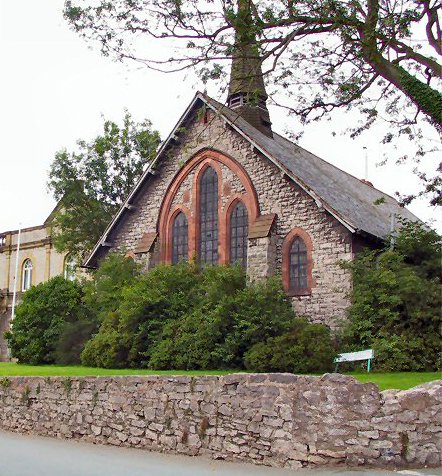
A modest Victorian chapel built in stone for the residents of Holywell Workhouse, designed by Chester architect John Douglas and now a Grade II listed building.
At a glance
This small chapel served the spiritual needs of workhouse inmates in nineteenth-century North Wales. Built alongside vagrants’ wards as part of a unified institutional complex, it represents a period when Poor Law provision extended to religious welfare.
History
Holywell Workhouse Chapel was constructed in 1883–84 on Old Chester Road. The architect John Douglas, based in Chester, designed both the chapel and associated vagrants’ wards as part of the broader workhouse complex. Following the decline of the workhouse system, the institution later became Lluesty Hospital, though the chapel’s subsequent history remains limited in available sources.
What you see
The chapel is built in stone with a slate roof and features a shingled flèche—a slender spire rising from the roof. Douglas’s design is characteristic of late Victorian institutional architecture, modest in scale but built to endure.
Cultural significance
The chapel exemplifies Victorian attitudes toward institutional life and the moral framework that underpinned Poor Law provision. Its survival as a listed building preserves evidence of how nineteenth-century society approached both charitable care and religious observance.
Key facts
- Designed by Chester architect John Douglas
- Built 1883–84
- Location: Old Chester Road, Holywell, Flintshire, Wales
- Coordinates: 53.2663, −3.2168
- Grade II listed building (Cadw)
- Original function: chapel for Holywell Workhouse
Practical information & getting there
The chapel is located in Holywell, Flintshire, in the northeast of Wales. As a listed building, it is protected by heritage designation, though public access should be verified locally before visiting.
Sources & resources
Find it on the map
See this place and what’s around it →📷 Become a Cultural Heritage Online photographer
Share your photos of places: they stay published under your name as the author. The more they're seen, the more you get noticed — and soon a contest will reward the most appreciated photos.
Log in or sign up free to add a photoIs this page about you?
This page is read by travellers and heritage enthusiasts who find it on Google. Tell us how you are connected to this place and we will take it from there.