
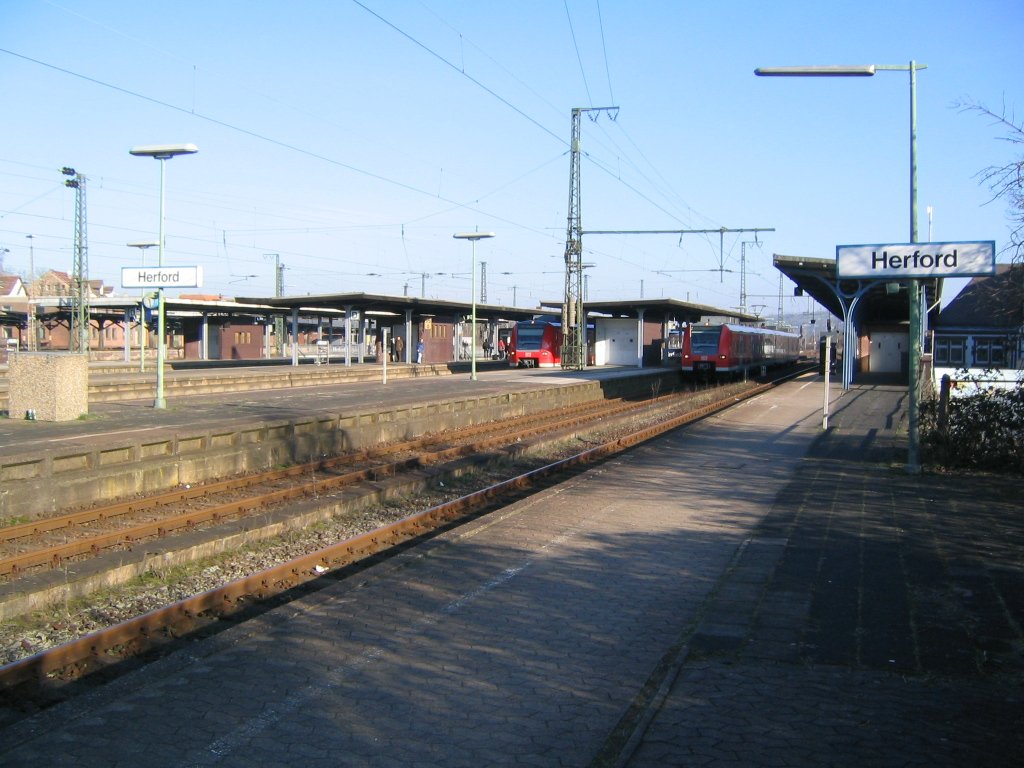
A four-platform railway junction in North Rhine-Westphalia, Herford station sits at the intersection of multiple historic rail lines connecting the industrial heartland of western Germany.
At a glance
Herford station is a category 2 junction station serving the town of Herford, with four platforms and seven platform tracks. The station sits on the electrified, quadruple-track Hamm–Minden railway, a major corridor linking the Ruhr Valley to the North Sea ports.
History
The station lies on a section of the historic Cologne-Minden Railway Company’s original route, one of Germany’s pioneering rail lines. Herford’s importance grew as a junction point where multiple rail branches converge, reflecting the town’s role in the industrial development of the Westphalia region.
What you see
The station features four platforms and seven platform tracks arranged to handle the complexity of its junction role. The infrastructure reflects the demands of high-capacity rail traffic on the heavily used Hamm–Minden corridor.
Cultural significance
Herford station represents a pivotal point in Germany’s rail network, where economic routes to industrial centers merge with connections to smaller towns. Its category 2 classification underscores its importance in regional and interregional transport. The station embodies the nineteenth-century engineering vision that wove Westphalia into Germany’s modern transport infrastructure.
Key facts
- Country: Germany
- City: Herford, North Rhine-Westphalia
- Coordinates: 52.1194, 8.6639
- Classification: Deutsche Bahn category 2 station
- Platforms: 4 (with 7 platform tracks)
- Lines: Hamm–Minden railway (quadruple track, electrified); branches to Altenbeken, Ravensberg Railway to Bünde and Rahden
Practical information & getting there
Herford station serves as a major interchange for trains traveling between the Ruhr Valley and North German cities. Regional and long-distance trains connect through the station. For current schedules, connections, and facilities, consult Deutsche Bahn’s journey planner.
Sources & resources
Find it on the map
See this place and what’s around it →📷 Become a Cultural Heritage Online photographer
Share your photos of places: they stay published under your name as the author. The more they're seen, the more you get noticed — and soon a contest will reward the most appreciated photos.
Log in or sign up free to add a photoIs this page about you?
This page is read by travellers and heritage enthusiasts who find it on Google. Tell us how you are connected to this place and we will take it from there.