

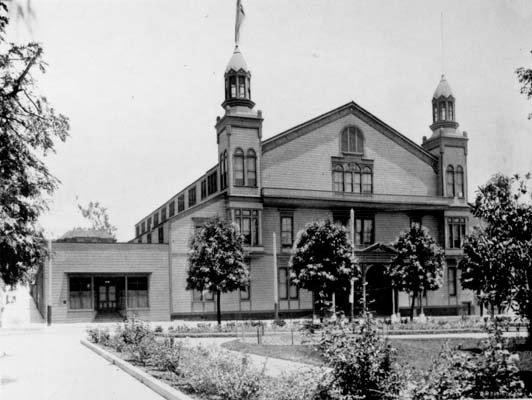
A wooden auditorium seating thousands, Hazard’s Pavilion dominated the Los Angeles skyline at the corner of Fifth and Olive Streets, embodying the city’s theatrical ambitions in the late nineteenth century.
At a glance
Hazard’s Pavilion was a large capacity auditorium built in 1887 at Fifth and Olive Streets in Los Angeles. The timber structure, fronted by two prominent towers, could seat between 4,000 and 8,000 people—making it a major venue for the young city’s cultural life.
History
The site’s origin traces to showman George “Roundhouse” Lehman, who purchased the land intending to construct a large theatre center. When Lehman’s financial circumstances changed, the property passed to Henry T. Hazard, a City Attorney who would later serve as Mayor. Hazard commissioned the pavilion’s construction in 1887.
What you see
Architects Kysor, Morgan & Walls designed the building as a wood-frame structure with a clapboard exterior. Two towers framed the front façade, creating a distinctive silhouette. The interior was divided into two galleries; sources disagree on total capacity, with estimates ranging from 4,000 to 8,000 seats.
Cultural significance
At a construction cost of $25,000—substantial for 1887—the pavilion represented a significant investment in Los Angeles’s emerging cultural infrastructure. It served as a major public gathering space for theatrical and civic events during a formative period in the city’s development.
Key facts
- Built: 1887
- Architects: Kysor, Morgan & Walls
- Location: Fifth and Olive Streets, Los Angeles, California
- Seating capacity: 4,000–8,000
- Construction cost: $25,000
- Primary material: Wood with clapboard exterior
- Coordinates: 34.0495, −118.2529
Practical information & getting there
Hazard’s Pavilion no longer stands. The site is located in downtown Los Angeles at the former intersection of Fifth and Olive Streets. Today, the area is part of the central business district and can be reached via public transit or car.
Sources & resources
Find it on the map
See this place and what’s around it →📷 Become a Cultural Heritage Online photographer
Share your photos of places: they stay published under your name as the author. The more they're seen, the more you get noticed — and soon a contest will reward the most appreciated photos.
Log in or sign up free to add a photoIs this page about you?
This page is read by travellers and heritage enthusiasts who find it on Google. Tell us how you are connected to this place and we will take it from there.