
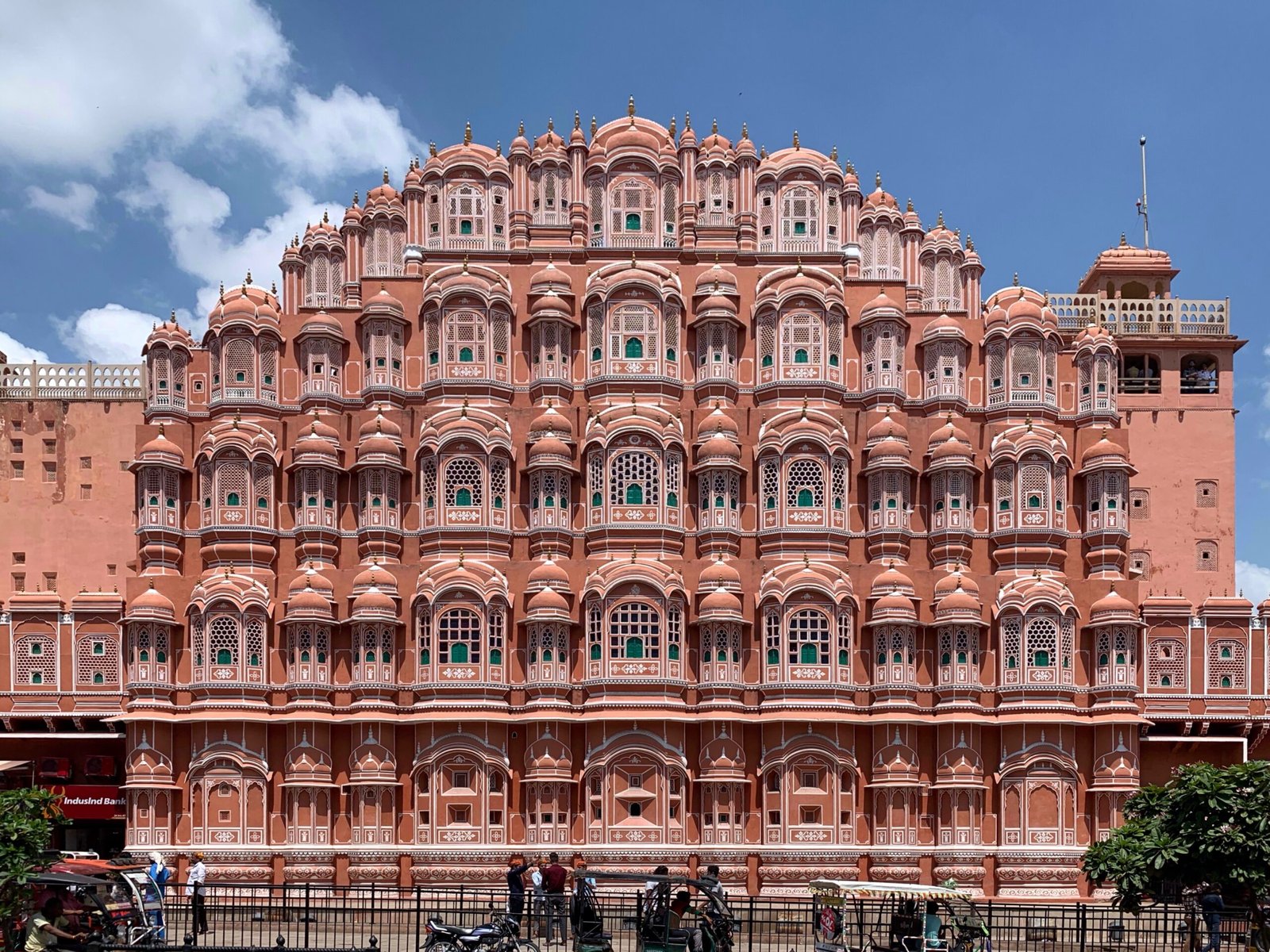
The Palace of Winds rises as a five-storey honeycomb of red and pink sandstone, its 953 intricately carved windows offering a masterpiece of Rajasthani architecture and social custom.
At a glance
Hawa Mahal stands at the edge of Jaipur’s City Palace, its celebrated façade concealing the Zenana—the women’s quarters of the royal household. Built in 1799 under Maharaja Sawai Pratap Singh, it remains one of India’s most recognizable monuments. The structure’s distinctive jharokhas (small windows) were designed to serve both practical and social purposes.
History
Maharaja Sawai Pratap Singh, grandson of Jaipur’s founder Maharaja Sawai Jai Singh, commissioned Hawa Mahal in 1799. The Rajput ruler drew inspiration from the innovative design of Khetri Mahal when creating this grand structure. Designed by Lal Chand Ustad, the palace represents an extraordinary fusion of aesthetic ambition and practical constraint. After fifty years without intervention, major renovation works were undertaken in 2006, funded at an estimated cost of Rs 4.568 million, with the Unit Trust of India adopting the monument for ongoing maintenance.
What you see
The palace derives its name from 953 jharokhas—small windows carved with intricate latticework—arranged in a honeycomb pattern across its five storeys. The design employs the Venturi effect: cool air flows through the dense network of openings, naturally ventilating the interior and providing respite during Rajasthan’s scorching summers.
Stone-carved screens, delicate casements, arched roofs and finely modelled hanging cornices define the monument’s ornamental vocabulary. Significantly, what most visitors perceive as the palace’s front elevation is actually its rear façade; the structure extends backward into a larger complex.
Cultural significance
Hawa Mahal epitomizes Rajasthani royal life and the architectural innovations born from purdah—the practice of female seclusion. Its jharokhas enabled the women of the court to observe street festivals and daily life below without revealing themselves, transforming architectural constraint into aesthetic achievement. The palace reflects the sophisticated climate-control strategies available to 18th-century builders and remains a symbol of Jaipur’s planning and cultural refinement.
Key facts
- Country: India
- City: Jaipur, Rajasthan
- Built: 1799
- Architect: Lal Chand Ustad
- Builder: Maharaja Sawai Pratap Singh
- Notable feature: 953 jharokhas (windows)
- Coordinates: 26.9239°N, 75.8267°E
Practical information & getting there
Hawa Mahal is centrally located in Jaipur’s old city, accessible by road and rail. As a working historical monument, access and visiting hours vary; contact local tourism authorities for current details. Photography of the exterior is permitted from the street; interior access may be restricted. The nearby City Palace complex offers additional architectural interest.
Sources & resources
Find it on the map
See this place and what’s around it →📷 Become a Cultural Heritage Online photographer
Share your photos of places: they stay published under your name as the author. The more they're seen, the more you get noticed — and soon a contest will reward the most appreciated photos.
Log in or sign up free to add a photoIs this page about you?
This page is read by travellers and heritage enthusiasts who find it on Google. Tell us how you are connected to this place and we will take it from there.