
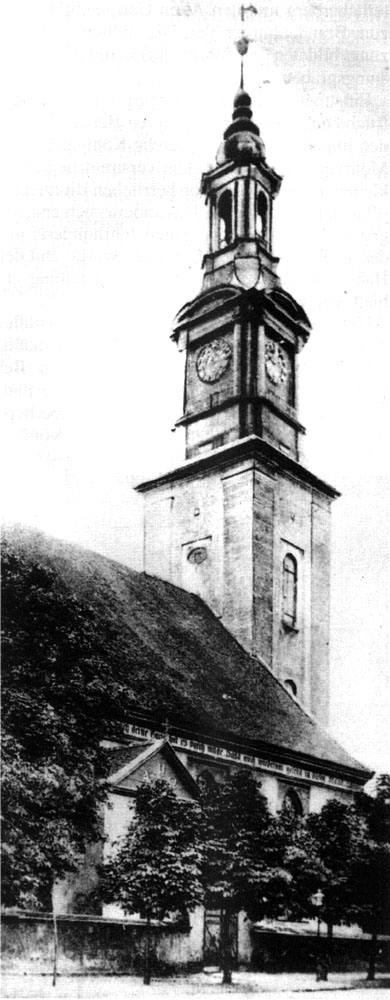
A vanished Lutheran church of Königsberg, its Rococo interior once counted among the finest in East Prussia before war and demolition erased it entirely.
At a glance
Haberberg Church, also known as Holy Trinity Church, stood on the highest point of Oberhaberberg, a district of old Königsberg. Built and rebuilt across four centuries, it survived fire and shelling before being reduced to ruins in 1945 and finally demolished in 1953. Nothing of the structure remains today; the site now lies within Kaliningrad, Russia.
History
The story begins modestly. A chapel rose here in 1537. Growth followed. In 1652 the Lutheran congregation split from Königsberg Cathedral’s parish, and a larger church went up between 1653 and 1683, its steeple added in 1705. Lightning struck in a winter storm of 1747, and the building burned. Reconstruction ran from 1748 to 1753, when the church was rededicated. Its organ, the work of Adam Gottlob Casparini, was finished that same year; a new altar arrived in 1765. In 1774 the Königsberg coppersmith Lorenz Wietander crowned the steeple with a single-winged golden angel weathervane. Nine years later, on Immanuel Kant’s recommendation, the church became the first in Königsberg fitted with a lightning rod. War reached it twice more. After the Battle of Eylau in February 1807 it served as a field hospital for Russian troops; a French shell struck the building that June during the bombardment of Königsberg. The parish later shed the Ponarth congregation in 1905. The 1945 Battle of Königsberg left the church badly damaged, and its remains were cleared away in 1953 under Soviet administration.
What you see
There is nothing left to see. The church that stood here combined a long building history with a Baroque-era exterior and an 18th-century Rococo interior praised as among the region’s most beautiful. Contemporary accounts singled out the Casparini organ and the 1765 altar as its finest furnishings, crowned by a gilded, single-winged angel turning above the steeple. All of it is known now only through records, photographs and description.
Cultural significance
Haberberg Church mattered beyond its congregation. Kant’s personal recommendation for a lightning rod ties the building to Königsberg’s Enlightenment-era intellectual life, a small but telling detail. Its use as a Russian field hospital after Eylau places it directly in the Napoleonic Wars. Its 1953 demolition, carried out after Königsberg became Kaliningrad, marks it as one of many East Prussian landmarks lost in the postwar remaking of the city’s German heritage into Soviet Kaliningrad.
Key facts
- Original chapel built 1537; church rebuilt 1653–1683 and again 1748–1753
- Also known as Holy Trinity Church (St. Trinitatis-Kirche)
- Organ by Adam Gottlob Casparini, completed 1753
- Altar added 1765; weathervane by Lorenz Wietander, 1774
- First Königsberg church with a lightning rod, 1783, on Kant’s recommendation
- Damaged in the 1945 Battle of Königsberg; demolished 1953
Practical information & getting there
No structure survives, so there is nothing to visit on site. The former location sits at approximately 54.697° N, 20.503° E, within the Haberberg area of present-day Kaliningrad. Anyone researching the site is best served by archival and historical sources rather than a physical visit.
Sources & resources
Find it on the map
See this place and what’s around it →📷 Become a Cultural Heritage Online photographer
Share your photos of places: they stay published under your name as the author. The more they're seen, the more you get noticed — and soon a contest will reward the most appreciated photos.
Log in or sign up free to add a photoIs this page about you?
This page is read by travellers and heritage enthusiasts who find it on Google. Tell us how you are connected to this place and we will take it from there.