
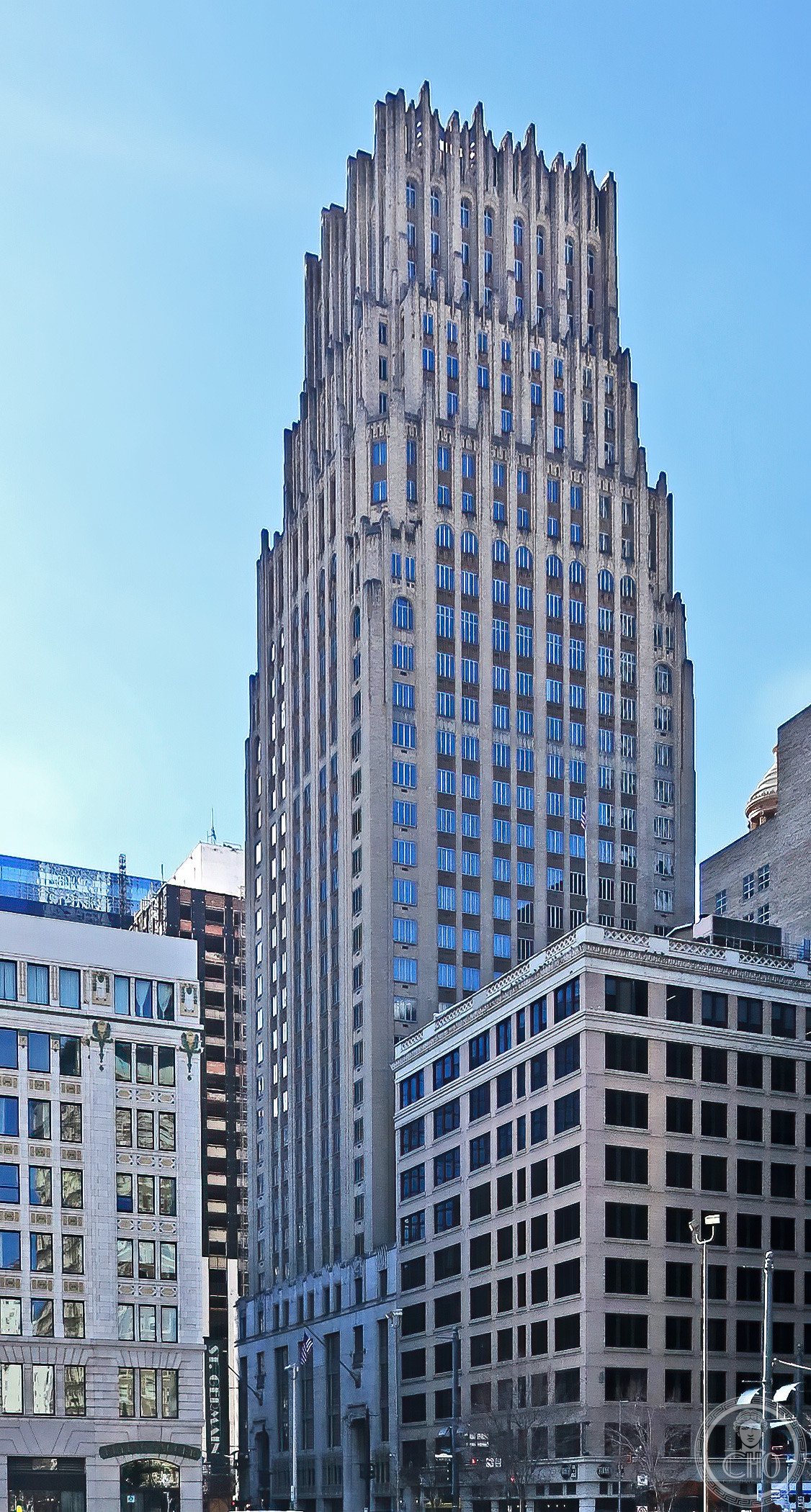

Completed in 1929 at 712 Main Street, the Gulf Building is the pre-eminent Gothic Art Deco skyscraper of Texas — a 37-story tower designed by Alfred C. Finn with stepped setbacks and a Gothic crown that rose above every other structure in Houston for three decades, serving as both the headquarters of Gulf Oil’s Texas operations and the defining element of the city’s pre-war skyline.
At a glance
The Gulf Building at 712 Main Street was designed by Houston architect Alfred C. Finn and completed in 1929 for the Gulf Oil Corporation, then one of the most powerful oil companies in the world. At 37 stories, it was the tallest building in Texas at completion and remained Houston’s tallest for decades. The Gothic ornamental programme — pointed arches at the crown, carved stone tracery at the setback zones, and bronze ornament at the entrance — reflects the influence of the Tribune Tower competition style on commercial architecture across the United States, and the building’s silhouette, with its stepped crown visible from far across the flat Texas coastal plain, made it one of the most recognisable commercial structures in the region. The building is listed on the National Register of Historic Places.
Key facts
- Completed: 1929
- Architect: Alfred C. Finn
- Style: Gothic Art Deco
- Address: 712 Main St, Houston, TX 77002
- Height: 37 stories
- NRHP: Listed; Texas Historic Landmark
- Notable: Tallest building in Texas at completion (1929); Gothic stepped crown; Gulf Oil HQ for Texas operations
History
Alfred C. Finn was Houston’s most prolific commercial architect in the first half of the 20th century, responsible for more than 500 buildings in Texas including the San Jacinto Monument (1939, reportedly the world’s tallest war monument). The Gulf Building commission, received from the Gulf Oil Corporation in the late 1920s, was the most prestigious of his career: a skyscraper that would serve as the Texas headquarters of one of the “Seven Sisters” oil companies and announce Houston’s position at the centre of the American petroleum industry.
Finn’s design reflects the dominant influence of the 1922 Tribune Tower competition on American commercial architecture of the decade: the Gothic vocabulary — pointed arches at the upper windows, carved tracery panels at the setback zones, finials at the crown — is deployed with restrained skill, the ornamental density concentrated at the transition zones while the shaft itself is relatively plain. The result is a tower that achieves its authority through mass and setback proportion rather than surface decoration, which is characteristic of the best commercial Gothic skyscrapers outside New York. The stepped crown, with its Gothic arched windows and finials, is particularly effective at a distance: visible from the elevated freeways and from the industrial areas to the south and east of downtown, it reads as a medieval campanile transposed to the Texas flatlands.
The Gulf Building was completed just months before the October 1929 stock market crash. Gulf Oil maintained its Texas headquarters in the building through the postwar decades, and the building remained the tallest in Houston until the post-war construction boom. Gulf Oil’s eventual merger into Chevron in 1984 ended the corporate connection, but the building retained the Gulf name and remained a prestigious downtown address. It was listed on the National Register of Historic Places in recognition of its architectural and historical significance.
What you see
The Main Street facade of the Gulf Building is a lesson in the vertical grammar of the commercial Gothic: the building rises from a two-story base with arched entrance portals and carved stone surrounds, through a central shaft of vertical piers with Gothic tracery in the spandrel zones, to the setback crown where the Gothic vocabulary accelerates. The setback transition at approximately the 30th floor is the building’s most elaborate ornamental zone: the carved tracery panels, the pointed arched windows, and the stone finials create a frieze that reads from the street as the building’s climactic element. Above this zone, the final tower section rises to its crown in a sequence of pointed arches and carved stone that resolves the building’s composition.
The entrance on Main Street is one of the most formally resolved of any pre-war Houston commercial building: the recessed portal, with its bronze doors and carved stone surround, leads into a lobby of marble walls, original bronze elevator hardware, and coffered plasterwork ceilings. The corner of Main and Rusk, where the Gulf Building’s full height becomes visible against the flat Houston sky, is the best single position from which to understand the building’s relationship to its context.
Practical information
- Lobby access: Open weekdays during business hours; free entry
- Best view: Main Street looking north from Prairie Ave; or from the elevated freeway approach on I-45
- Time needed: 20–30 minutes lobby + exterior
- GPS: 29.7567° N, 95.3698° W
- Nearest transit: METRORail Main Street Square station (1 minute walk)
Getting there
The Gulf Building stands at 712 Main Street in the heart of downtown Houston, directly on the METRORail Red Line Main Street Square station. George Bush Intercontinental Airport (IAH) is approximately 23 miles (37 km) north; the METRO Express Bus 102 connects the airport to downtown Houston in approximately 50–70 minutes.
Nearby
- Niels Esperson Building (1927) — Italian Renaissance / Art Deco tower at 808 Travis, 3 minutes north; John Eberson architect; CHO place card
- JPMorgan Chase Tower (1982) — I. M. Pei’s 75-story glass supertall at 600 Travis; the current tallest building in Texas; 2 minutes north
- Market Square Park — Houston’s original town square, Travis and Congress; 4 minutes north
Sources
- National Register of Historic Places, Gulf Building nomination — nps.gov
- Texas Historical Commission, Gulf Building marker — thc.texas.gov
- Houston Preservation Alliance, Gulf Building entry — houstonpreservation.org
- Barnstone, Howard. The Architecture of John F. Staub: Houston and the South. University of Texas Press, 1979. (Context for Houston pre-war commercial architecture.)
- Wikidata, Gulf Building Houston — wikidata.org
Find it on the map
See this place and what’s around it →📷 Become a Cultural Heritage Online photographer
Share your photos of places: they stay published under your name as the author. The more they're seen, the more you get noticed — and soon a contest will reward the most appreciated photos.
Log in or sign up free to add a photoIs this page about you?
This page is read by travellers and heritage enthusiasts who find it on Google. Tell us how you are connected to this place and we will take it from there.