

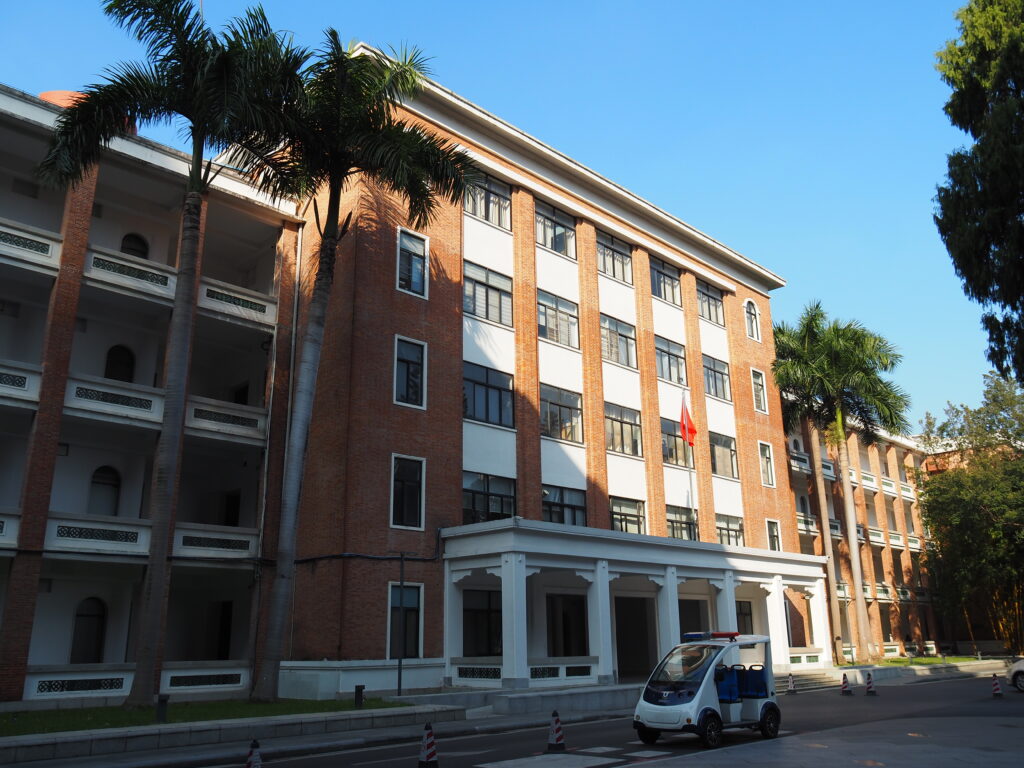
The Guangzhou Academy of Fine Arts teaches art and design from a brick main building on Changgang East Road, in the Haizhu district of Guangzhou. The building is a listed historic building of the city.
At a glance
The academy is one of the eight specialised art schools of China, and it brings fine art, design, art education and art history under one roof. Its original campus stands at Changgang in Haizhu, and a second campus at University City took the undergraduate teaching in 2004. A third campus in Foshan is under construction. The school began in 1953 in Wuhan and moved to Guangzhou in 1958.
Key facts
- Founded on 19 November 1953 in Wuhan as the Central South Art College
- Moved south to Guangzhou in July 1958 and renamed in August of that year
- The artist Hu Yichuan was its first president
- Main building of the 1950s in national style, with an exposed red brick surface
- A Guangzhou historic building, in the first batch of the city's list
- Lingnan School of Painting Memorial Hall on the campus, by Mo Bozhi, opened in 1991
- 257 Changgang East Road, Haizhu District, Guangzhou
History
The academy began on 19 November 1953. The Ministry of Higher Education was reorganising the country's universities. The art departments of three schools were merged: the South China College of People's Literature and Arts in Guangdong, the Central South Literature and Arts College in Hubei, and the Guangxi Provincial Art College. The result was the Central South Art College, teaching in Wuchang, with Hu Yichuan as its first president. An attached secondary art school opened on 9 October 1954.
With the approval of the Ministry of Culture, the college moved south in July 1958, to a site at Liuwangdiangang in Haizhu, where Changgang now stands. In August the Guangdong party committee approved a new name, Guangzhou Academy of Fine Arts, and the school began taking undergraduates that year. In November 1969 it was merged with the Guangdong music and dance schools into the Guangdong People's College of Arts.
The undergraduate teaching moved to the University City campus in September 2004, in what the school calls one school, two campuses. A doctoral programme was approved in 2021. Today the academy teaches 7,338 undergraduates and 1,552 postgraduates, and a campus in Foshan is being built.
What you see
The main building sets the tone. It was designed in the 1950s in a national style, and its exposed red brick supplies the texture of the walls. Colour and ornament are handled with care. Later buildings took the main building as their model, and that is how the school acquired an architectural language of its own. The south building of the attached secondary school, with rows of red brick columns and green balustrades, follows the same line. The main building and that south block are now among the few early buildings left on the campus.
Inside the campus stands the Lingnan School of Painting Memorial Hall, opened on 8 June 1991. Mo Bozhi designed it with 3,200 square metres of floor space, a white exterior and flowing curves, and in 2023 it entered the seventh batch of China's twentieth-century architectural heritage. The studios, workshops and exhibition rooms of the school work around it.
Practical information
- Address: 257 Changgang East Road, Haizhu District, Guangzhou 510250
- Campuses: Changgang; University City, where undergraduate teaching moved in 2004; Foshan, under construction
- 7,338 undergraduates and 1,552 postgraduates
- The Lingnan School of Painting Memorial Hall on the campus is a museum and can be visited
- A working art school: the studios are not open to visitors
Getting there
The Changgang campus stands on Changgang East Road in Haizhu, near Changgang station on metro line 2.
Nearby
- Changgang station on metro line 2
- Jiangnanxi shopping street
- Haizhu Bridge over the Pearl River
Sources
Find it on the map
See this place and what’s around it →📷 Become a Cultural Heritage Online photographer
Share your photos of places: they stay published under your name as the author. The more they're seen, the more you get noticed — and soon a contest will reward the most appreciated photos.
Log in or sign up free to add a photoIs this page about you?
This page is read by travellers and heritage enthusiasts who find it on Google. Tell us how you are connected to this place and we will take it from there.
This entry stays online and free either way — and a free account lets you add to it yourself.