
.jpg)
For eight centuries the sick of Lyon were carried through these doors. The hospital closed in 2010; eight years later the courtyards opened as streets, and the city walked into a building it had only ever entered out of necessity.
At a glance
The Hôtel-Dieu stands on the right bank of the Rhône, on the Presqu’île, the tongue of land between the two rivers that carries the centre of Lyon. Its river front is the work of Jacques-Germain Soufflot (1713–1780), the architect of the Panthéon in Paris, and it is long enough to read as a piece of city rather than a building. The complex is part of the Historic Site of Lyon inscribed on the UNESCO World Heritage List. Since the 2018 reopening its courtyards, cloister walk and gardens are open to anyone, with seven entrances tying the quayside to the streets behind.
Key facts
- What it is: a former hospital, now a mixed complex of shops, restaurants, offices, apartments and a hotel
- Origin: a Confrérie des frères pontifes founded in 1184; a functioning hospital from 1454
- Architects of the present building: Guillaume Ducellet in the seventeenth century, Jacques-Germain Soufflot in the eighteenth
- Closed as a hospital: 2010; works from 2015; reopened to the public as the Grand Hôtel-Dieu on 27 April 2018
- Protection: classed monument historique, within the UNESCO Historic Site of Lyon
- Where: place de l’Hôpital, Lyon 2e, on the right bank of the Rhône; the Cour du Midi opens towards the quayside
History
The institution began in 1184 as a refuge run by a brotherhood, for clergy travelling and local. Lyon lived on trade fairs, and the first patients were largely travellers who had arrived ill. A doctor, Maître Martin Conras, was engaged in 1454, and from that point the Hôtel-Dieu worked as a hospital — for several centuries one of the most important in France.
Two names from the sixteenth century belong to the building rather than to medicine. François Rabelais was appointed here in 1532 and wrote Gargantua and Pantagruel during his time in the post. Pierre Tolet, a practitioner in the 1530s and 1540s, was among those who argued for medicine to be written in French rather than Latin.
The building you see is mostly the result of two expansions. Guillaume Ducellet enlarged it in the seventeenth century; Soufflot rebuilt the river front in the eighteenth, giving Lyon the wings, courts and dome that now define the quay. The hospital function ended in 2010. Work began in 2015 on some two hectares of building, and the site reopened to the public on 27 April 2018. It now holds shops, cafes and restaurants, offices, a small number of apartments and a five-star hotel, with the courtyards and the cloister walk left open as public space.
What you see
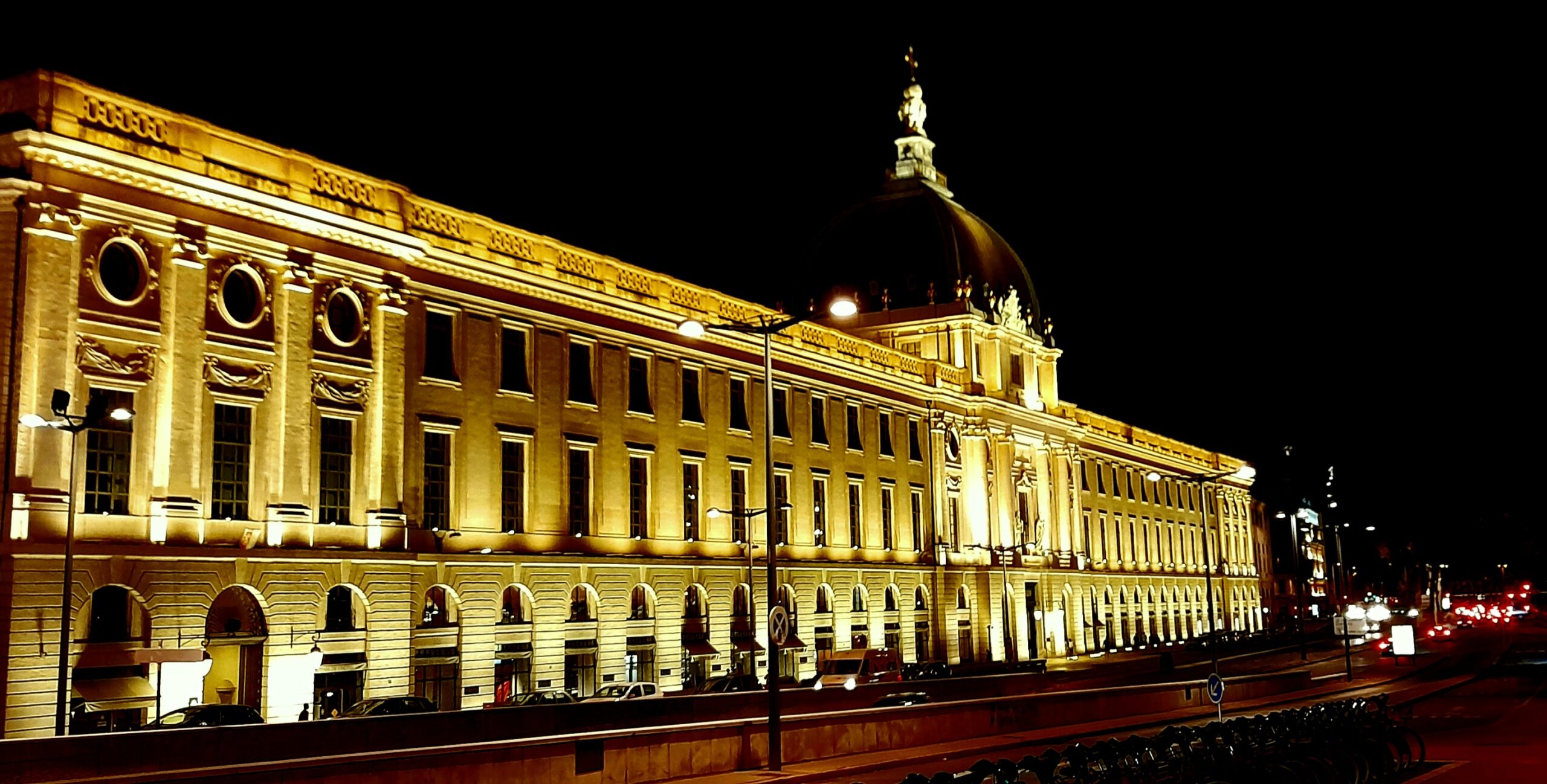
From the quay the front runs in a single measured rhythm, pilasters and round-headed windows, broken at the centre by the dome. It was built to be seen across the Rhône, and at night, lit, it still performs that job.
Behind it the scale changes. The courtyards are enclosed, paved and quiet, and the covered walk along their edge keeps the plan of an institution that had to move patients under cover. The Grand Dôme, built between 1755 and 1764 to Soufflot’s design, is the point the whole composition turns on. It burned on 4 September 1944 and was rebuilt in the 1960s. The Cour du Midi, where the exhibition spaces open at level -1, lies to the south.
Practical information
- The courtyards and passages are open to the public and crossed freely; shops and restaurants keep their own hours.
- Seven entrances connect the quayside to rue Bellecordière and the streets behind.
- Exhibitions are held in the spaces off the Cour du Midi; check the organiser’s dates and ticketing.
Getting there
The nearest metro station is Bellecour, a few minutes on foot; the quays along the Rhône run past the building.
Nearby
- Place Bellecour, the largest open square in Lyon, two streets away.
- The Presqu’île and the old town of Vieux Lyon, both within the UNESCO Historic Site.
- The banks of the Rhône, re-landscaped as a promenade along the front of the building.
Sources
- English Wikipedia, Hôtel-Dieu de Lyon — the 1184 foundation, the 1454 appointment of the first doctor, Rabelais and Tolet, the Ducellet and Soufflot expansions, the 2010 closure and the UNESCO inscription.
- Wikidata (Q4013) — coordinates and the attribution of the river front to Jacques-Germain Soufflot.
- French Wikipedia, Hôtel-Dieu de Lyon — the Grand Dôme built 1755–1764, its destruction by fire on 4 September 1944 and reconstruction in the 1960s, the works from 2015 and the reopening on 27 April 2018, and the Bellecour metro station.
- Grand Hôtel-Dieu — the seven entrances and the present mix of uses.
Find it on the map
See this place and what’s around it →Events here — now on & upcoming
- Alphonse Mucha at the Grand Hôtel-Dieu (Lyon)04 Sep 2026 — 24 Jan 2027See the event →
📷 Become a Cultural Heritage Online photographer
Share your photos of places: they stay published under your name as the author. The more they're seen, the more you get noticed — and soon a contest will reward the most appreciated photos.
Log in or sign up free to add a photoIs this page about you?
This page is read by travellers and heritage enthusiasts who find it on Google. Tell us how you are connected to this place and we will take it from there.