
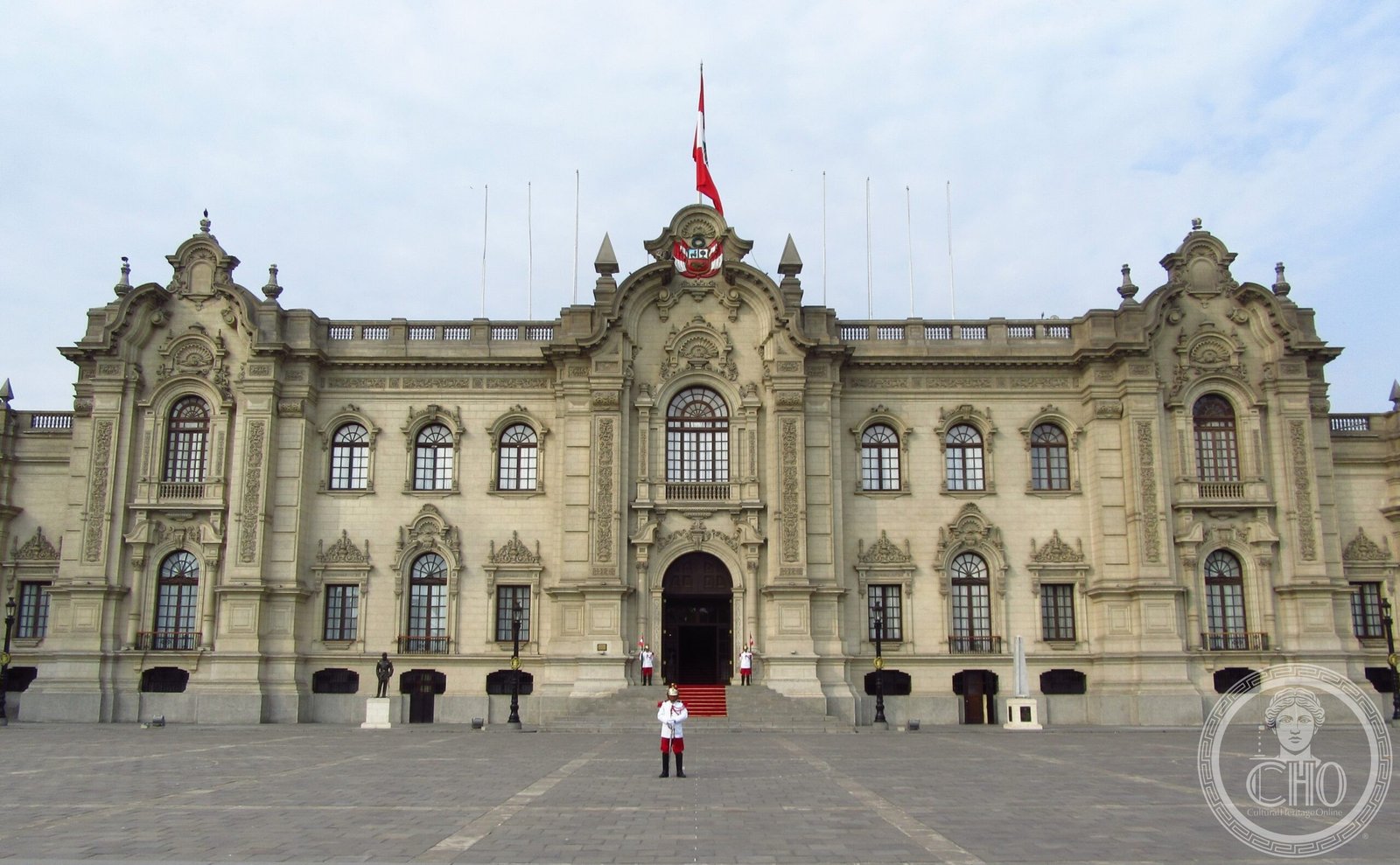
The Government Palace of Peru — Palacio de Gobierno — occupies the northern flank of Lima historic Plaza Mayor and stands on the most historically charged ground in the Americas: the very site where Francisco Pizarro built his personal residence in 1535, just months after founding the city. That original colonial mansion became the seat of Spanish viceregal power and later the republican presidency, surviving fires, earthquakes, and political upheavals across five centuries. The current facades, completed in 1938 under President Oscar R. Benavides, are a confident exercise in French-influenced Baroque Neoclassicism — symmetrical towers, ornate balconies, and a projecting central pavilion faced in pale stone that gleams against the Lima overcast. Inside, state salons preserve the room where Pizarro was assassinated by rival conquistadors in 1541, with what tradition claims are his original bloodstains still visible in the stone floor. The building remains the official residence and principal workplace of the President of Peru. Its daily Changing of the Guard at noon — elaborate uniforms, mounted cavalry, and a full military band performing on the plaza — is among Lima most photographed public spectacles.
At a glance
- Type
- Presidential palace and official government residence
- Period
- Founded 1535; current building completed 1938
- Style
- French Baroque Neoclassical
- Location
- Plaza Mayor, Historic Centre of Lima, Peru
- Coordinates
- 12.0455 S, 77.0308 W
- Architect(s)
- Claude Sahut (1937-38 reconstruction)
Overview
The Government Palace anchors the northwest corner of Lima Plaza Mayor, which UNESCO recognised as part of the Historic Centre of Lima World Heritage Site in 1988. Together with the Lima Cathedral to the east and the Archbishop Palace to the north, it forms one of South Americas finest colonial civic ensembles, albeit one whose principal facades were substantially rebuilt in the twentieth century. The palace functions simultaneously as working presidential headquarters, ceremonial state venue, and living museum of Peruvian political history from the conquest to the present.
History
Francisco Pizarro laid out the Plaza Mayor and constructed his personal house on this site in 1535, the year he founded Ciudad de los Reyes, later renamed Lima. His house became the Governor palace and was enlarged by successive Spanish viceroys. Pizarro was killed here in 1541 during an armed attack by partisans of Diego de Almagro the Younger. The palace burned in 1921 and again in 1937; after the second fire President Benavides commissioned a complete reconstruction completed in 1938, retaining historical footprint but entirely replacing the facades in the then-fashionable French Baroque manner. The interior preserves colonial-era elements including decorated ceilings and the room associated with Pizarros assassination.
Architecture and Design
Architect Claude Sahut designed the 1938 reconstruction with two symmetrical towers flanking a projecting central bay, the whole composition faced in pale limestone-effect render with heavily rusticated lower floors. Balconies with elaborate iron railings mark the piano nobile, while the central portico features paired Corinthian pilasters supporting a sculptural pediment. The interior state rooms are furnished in a hybrid of French Empire and Spanish colonial styles. The main courtyard retains the colonial arcade proportions established in the viceregal period, grounding the 1938 exterior in a spatial memory that predates it by three centuries.
Cultural significance
The Government Palace is the symbolic centre of Peruvian sovereignty, its Plaza Mayor location connecting five centuries of political authority in an unbroken line from Pizarro to the present republic. As part of the UNESCO World Heritage Historic Centre of Lima, the palace contributes to one of the largest colonial urban ensembles in the Americas. The Pizarro assassination room and its legendary bloodstained floor have made the palace a site of dark tourism as well as official ceremony, embodying the ambiguities of colonial memory in contemporary Peru.
Visiting today
Free guided tours of the state salons are offered on weekdays and can be booked through the official presidential palace website. The Changing of the Guard ceremony takes place daily at noon on Plaza Mayor and is open to all without reservation. The plaza itself is pedestrianised and freely accessible at all hours, surrounded by cafes and the Cathedral, which also offers interior tours.
Getting there
Plaza Mayor is the historic heart of Lima Centro and is easily reached by the Metropolitano BRT from Miraflores or San Isidro (alight at Jiron de la Union stop). Taxis and ride-shares from the Miraflores hotel district take 20 to 35 minutes depending on traffic. The surrounding historic centre — Cathedral, Archbishop Palace, Santo Domingo Convent — is walkable within a compact area, making a half-day circuit practical.
Sources and resources
Find it on the map
See this place and what’s around it →📷 Become a Cultural Heritage Online photographer
Share your photos of places: they stay published under your name as the author. The more they're seen, the more you get noticed — and soon a contest will reward the most appreciated photos.
Log in or sign up free to add a photoIs this page about you?
This page is read by travellers and heritage enthusiasts who find it on Google. Tell us how you are connected to this place and we will take it from there.