
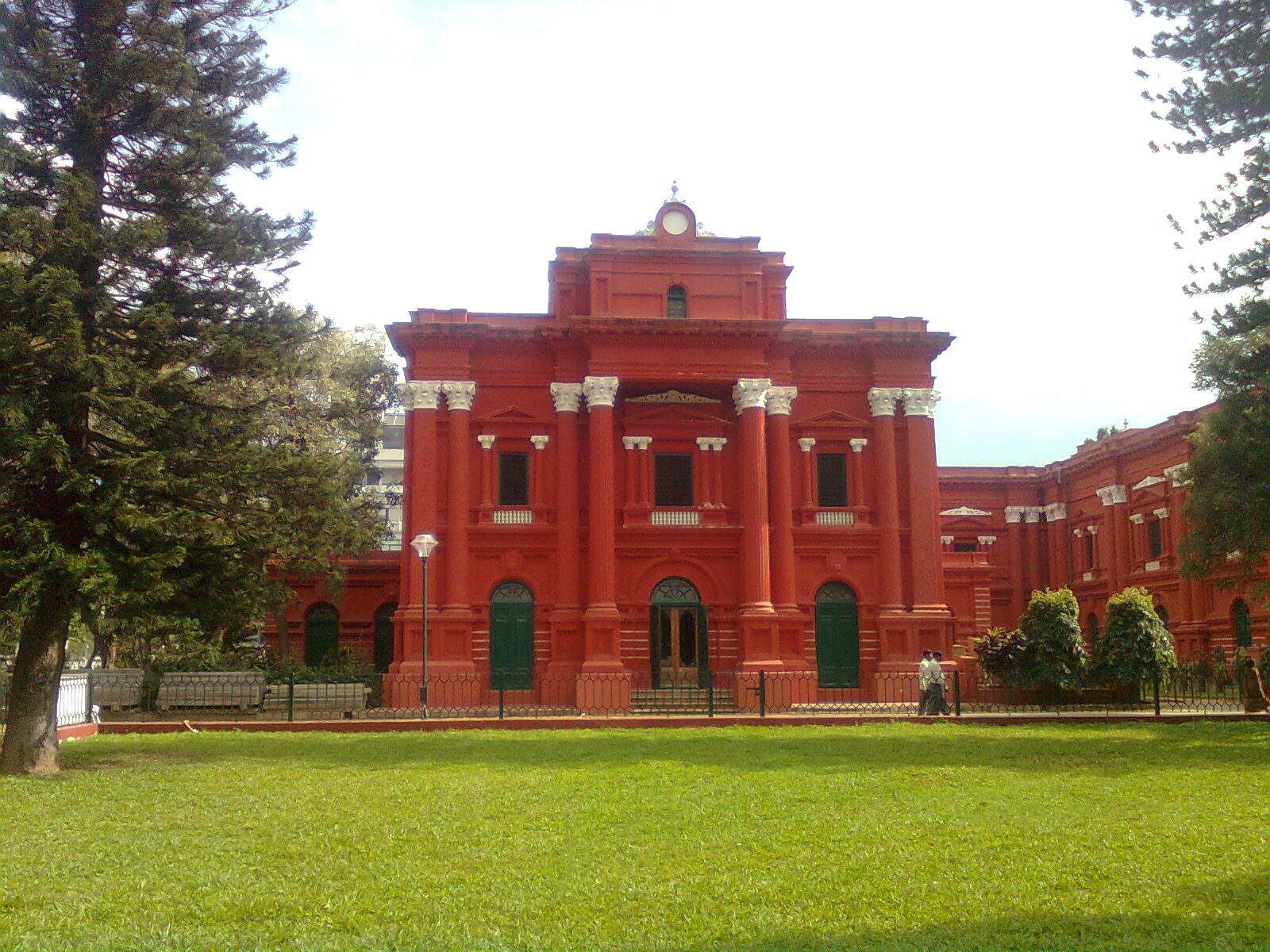
Founded in 1865, this pioneering institution holds one of India’s most significant archaeological collections, anchored by the Halmidi inscription—the earliest known example of written Kannada.
At a glance
One of India’s oldest museums and the second oldest in South India, the Government Museum preserves rare archaeological and geological treasures spanning centuries. Its collections reveal the material culture and linguistic heritage of the Deccan region through artifacts of exceptional historical weight.
History
Established by the Mysore State in 1865, the museum was founded under the guidance of Surgeon Edward Balfour, who had pioneered museum work in Madras, and supported by L.B. Bowring, Chief Commissioner of Mysore. The institution emerged during a period of growing interest in systematically preserving and studying India’s material past.
What you see
The museum houses an extensive archaeological collection including jewelry, sculpture, coins, and inscriptions from multiple periods. Among its holdings, the Halmidi inscription—dated to around 450 AD—represents a watershed moment in Indian epigraphy as the earliest surviving inscription in the Kannada language, marking a critical point in the region’s literary and cultural development.
Cultural significance
The museum stands as a crucial repository for understanding the Deccan’s pre-modern history and the emergence of Kannada as a written language. Its preservation of inscriptions, sculptural fragments, and decorative arts documents the religious, economic, and social life of successive civilizations that shaped South India’s heritage.
Key facts
- Established: 1865
- Location: Bengaluru, India
- Coordinates: 12.9747°N, 77.5958°E
- Status: Second oldest museum in South India
- Notable holding: Halmidi inscription (circa 450 AD)
Practical information & getting there
The Government Museum is located in Bengaluru. For current opening hours, admission fees, and access details, consult the museum directly or official Karnataka tourism resources before your visit.
Sources & resources
Find it on the map
See this place and what’s around it →📷 Become a Cultural Heritage Online photographer
Share your photos of places: they stay published under your name as the author. The more they're seen, the more you get noticed — and soon a contest will reward the most appreciated photos.
Log in or sign up free to add a photoDo you manage this place?
This page is read by travellers and heritage enthusiasts who find it on Google. Keep it accurate — and make it work for you. Free for non-profit heritage institutions.