
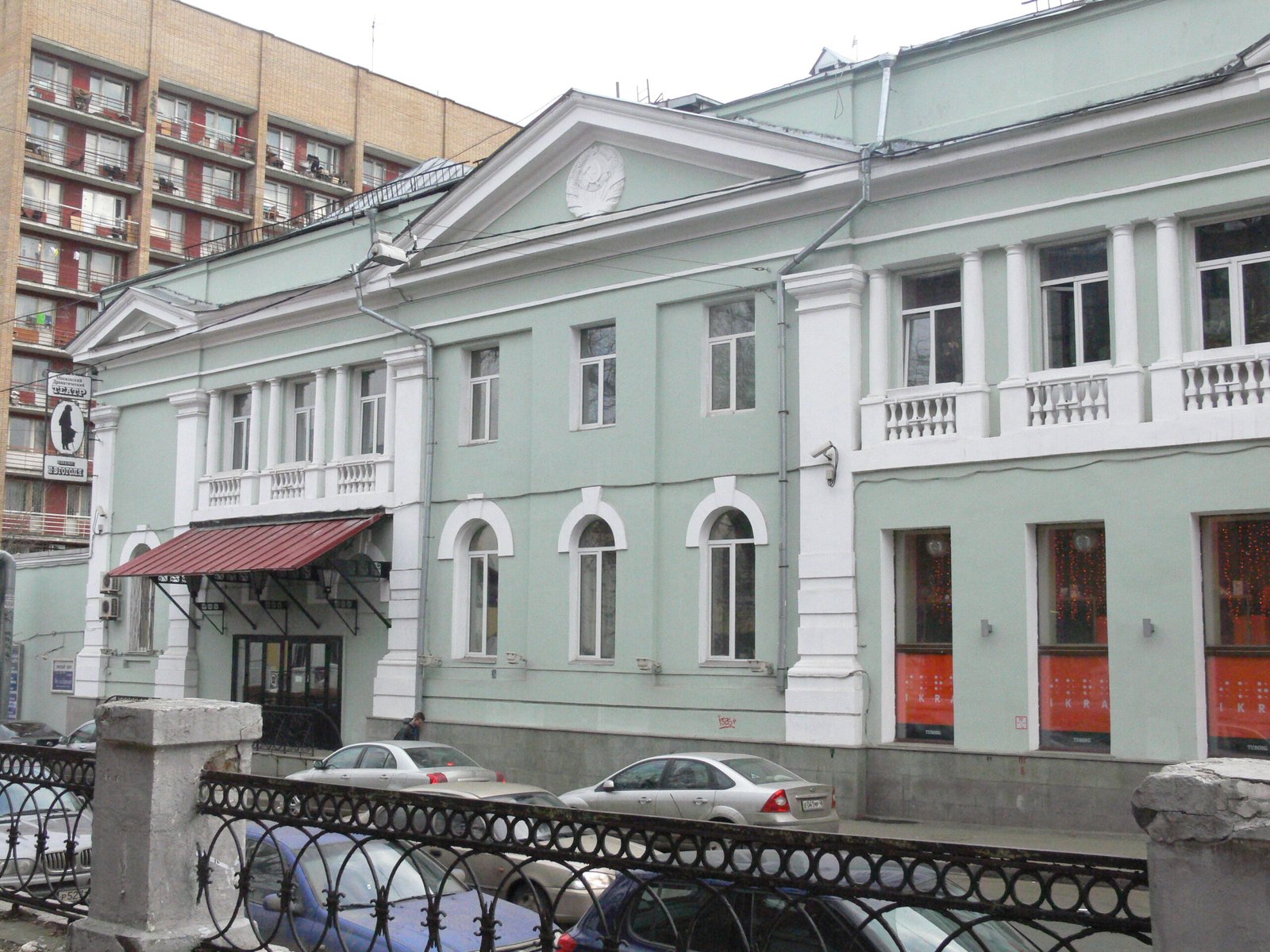
A theatre on Kazakova Street that began serving railway workers, took Gogol’s name in 1935, and became Russia’s most watched stage for contemporary drama before the state shut it down in 2022.
At a glance
The Gogol Center occupies a working theatre building at 8A Kazakova Street in Moscow. Founded as a company in 1925, it operated under several names before adopting Nikolai Gogol’s in 1935. Its most recent incarnation, launched in 2013, turned the venue into a multi-use arts complex hosting drama, film, music and dance until its closure in June 2022.
History
The institution started as the Drama and Comedy Theatre in 1925, created to serve railway employees under manager K. Golovanov. State control shifted repeatedly: to Glaviskusstvo in 1930, to the Central Committee of the Rail Union in 1931, and under the artistic wing of the Moscow Art Theatre No. 2 by 1934. In April 1935, on the 150th anniversary of Gogol’s birth, the theatre finally took his name. It was renamed again in 1939 as the Central Theatre of Transport. War interrupted operations. Between 1941 and 1943 the company toured Transbaikal and Mongolia before settling into the Kazakova Street building in 1943, where it has remained since. A long line of Soviet-era directors followed, from Ilya Sudakov in 1948 through B. Golubovsky and S. Yashin later in the century.
What you see
The article gives no architect or construction date for the building itself, only its 1943 occupation by the theatre company. Under Kirill Serebrennikov’s 2013 reinvention, the interior became part of the experience. The lobby held neon-lit mirrors shaped like the silhouettes of famous directors. Several stages allowed simultaneous programming of plays, film screenings and concerts. It felt less like a single auditorium than a clubhouse for contemporary art.
Cultural significance
As the Gogol Center, the venue became synonymous with Russia’s avant-garde theatre scene. It staged Dead Souls and Hamlet in its opening season, hosted an artist-in-residence program built around genre-defying performance, and gave a platform to figures such as dramaturge Valeriy Pecheykin. That visibility drew official scrutiny. A 2017 raid led to Serebrennikov’s questioning on embezzlement charges that commentator Michael Idov called pretext for shutting down a hub of free expression. Serebrennikov was removed as director in 2021 amid a wider crackdown following pro-Navalny protests. The center’s final production, staged on 30 June 2022, closed with a line from Yuri Levitansky’s poetry and a director’s blunt declaration that the theatre was closed forever, an ending Serebrennikov linked directly to its opposition to the invasion of Ukraine.
Key facts
- Founded in 1925 as the Drama and Comedy Theatre, serving railway workers
- Named after Nikolai Gogol in April 1935, on his 150th birth anniversary
- Moved into its current building at 8A Kazakova Street in 1943
- Relaunched as Gogol Center in February 2013 under Kirill Serebrennikov
- Closed by the Moscow Department of Culture in June 2022 and renamed Nikolai Gogol Drama Theatre
Practical information & getting there
The building stands on Kazakova Street in central Moscow, at coordinates 55.762, 37.662. Following its 2022 closure and renaming, you should check current status before planning a visit, since programming and access have changed under the new administration. The official website, listed below, may carry updated information.
Sources & resources
Find it on the map
See this place and what’s around it →📷 Become a Cultural Heritage Online photographer
Share your photos of places: they stay published under your name as the author. The more they're seen, the more you get noticed — and soon a contest will reward the most appreciated photos.
Log in or sign up free to add a photoIs this page about you?
This page is read by travellers and heritage enthusiasts who find it on Google. Tell us how you are connected to this place and we will take it from there.