

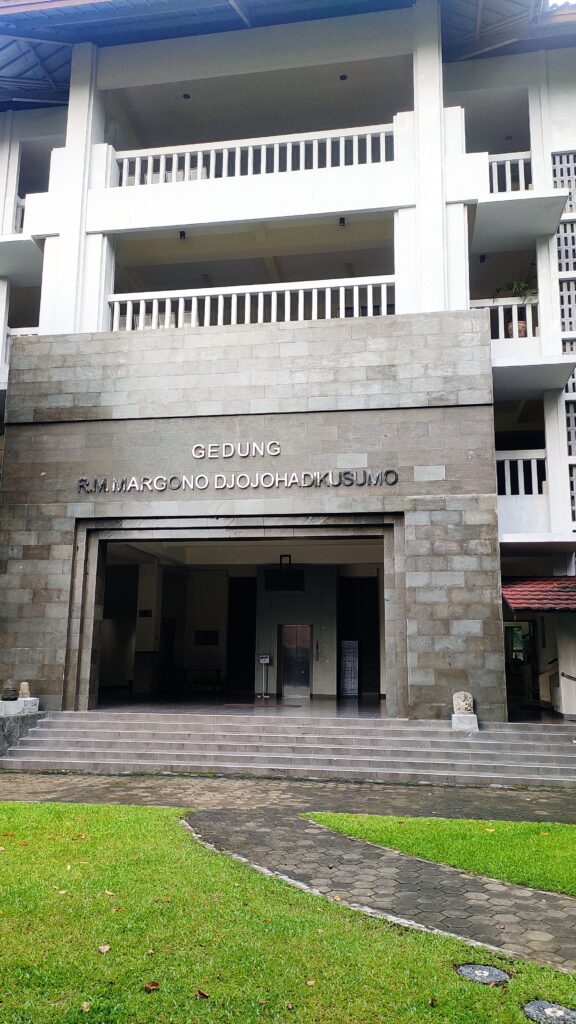
The Department of Archaeology of Universitas Gadjah Mada works from Gedung Margono, in the Faculty of Cultural Sciences at Bulaksumur, and has taught the subject in Yogyakarta since the academic year 1962/1963.
At a glance
Gedung Margono stands on Jl. Sosio-Humaniora in Bulaksumur, the northern campus of Universitas Gadjah Mada in Yogyakarta. It houses the Department of Archaeology, one of the departments of the Faculty of Cultural Sciences. The department runs a four-year undergraduate programme and a master's programme, and it takes students into excavation, laboratory work and heritage management. Its master's programme is accredited A by BAN-PT, the Indonesian national accreditation body.
Key facts
- Department of Archaeology, Faculty of Cultural Sciences, Universitas Gadjah Mada
- Teaching opened in the academic year 1962/1963 as Jurusan Purbakala, with 43 students
- Undergraduate programme of eight semesters, 144 to 149 credits
- Master's programme of four semesters, 40 to 50 credits, accredited A by BAN-PT
- Master's specialisations: Archaeology, Museology, Cultural Heritage Management
- Three master's routes: by course, by research, double degree
- Facilities: Mandala Majapahit showroom, laboratory, reference room
History
The department opened in the academic year 1962/1963 as an outgrowth of the sub-department of Ancient Indonesian History. It was then called Jurusan Purbakala, and it began with 43 students. It also took undergraduates from the Indonesian literature and history departments, both at Gadjah Mada and at other universities. Teachers were scarce, so the department brought lecturers in from other cities, among them R. Soekmono, M. Boechari, R.P. Soejono and Uka Tjandrasasmita.
Money ran short, and the department closed in 1966. It reopened and took the name Departemen Arkeologi in 1967. In the middle of the 1980s a visiting lecturer arrived from the Ford Foundation, Dr John N. Miksic, and new courses followed in museology, environmental archaeology and ethnoarchaeology. Staff went away to take master's and doctoral degrees, at home and abroad.
A postgraduate programme in archaeology opened in 2001 under the university's graduate school, with a concentration in the management of archaeological resources. It drew teachers from other disciplines, including R.P. Soejono of the national research centre for archaeology and Wiendu Nuryanti of UGM's architecture department. A reorganisation in 2006 left the Department of Archaeology with two study programmes, undergraduate and master's. The master's passed to direct departmental management in 2008, and in 2010 the department opened a museology track at both levels with the Tropenmuseum and the Reinwardt Academie in Amsterdam; Dutch lecturers taught in it for five years. From 2010 the department has also helped run the undergraduate tourism programme.
No source consulted here dates Gedung Margono. The department's own leaflet gives the building, the street, the postcode and two telephone numbers, and nothing about its construction. The university's institutional history and the department's page describe the school that occupies the rooms, not the fabric of the block.
What you see
Three spaces carry the teaching. Mandala Majapahit is a showroom with a library on the Majapahit kingdom, holding replicas of finds and books, and students use it for meetings and group work. The laboratory holds research equipment and works as a hands-on room for examining finds. The reference room keeps books, past theses, dissertations and conference proceedings, most of them donated.
The undergraduate curriculum runs over eight semesters and 144 to 149 credits, thesis and community service included. Courses range from prehistoric archaeology and ancient Indonesian history to geoarchaeology, maritime archaeology, palaeoanthropology, iconography, conservation and restoration of archaeological finds, and GIS for archaeology. The master's takes four semesters and 40 to 50 credits with a thesis, and students pick one of three specialisations. The heritage management track carries compulsory courses in heritage management, critical studies in heritage management, conservation of cultural heritage and an internship in heritage management. The museology track pairs the history and theory of museums with critical museology, museum curatorship and a museum internship. The master's can be followed by course, by research or as a double degree. Dr Fahmi Prihantoro heads the department.
Practical information
- Address: Gedung Margono, Jl. Sosio-Humaniora, Bulaksumur, Yogyakarta 55281, Indonesia
- Telephone (0274) 901136 and 513096; fax (0274) 550451; [email protected]
- A working department inside the Faculty of Cultural Sciences: visits by arrangement
- Teaching in Indonesian; the department publishes an English site with curriculum and admissions
- Master's programme accredited A by BAN-PT
Getting there
Bulaksumur is the northern campus of Universitas Gadjah Mada, and Gedung Margono sits in the cluster of Faculty of Cultural Sciences buildings on Jl. Sosio-Humaniora. The campus is reached from the centre of Yogyakarta along Jl. Malioboro and Jl. Colombo.
Nearby
- Gedung Soegondo, Faculty of Cultural Sciences
- UGM central building (Gedung Pusat) and the Balairung hall
- Universitas Gadjah Mada campus mosque
- Gadjah Mada University library
Sources
Find it on the map
See this place and what’s around it →📷 Become a Cultural Heritage Online photographer
Share your photos of places: they stay published under your name as the author. The more they're seen, the more you get noticed — and soon a contest will reward the most appreciated photos.
Log in or sign up free to add a photoIs this page about you?
This page is read by travellers and heritage enthusiasts who find it on Google. Tell us how you are connected to this place and we will take it from there.
This entry stays online and free either way — and a free account lets you add to it yourself.